

Law firms handle money as often as they handle cases, and much of this money belongs to clients. Because of this, every law firm must keep clear and careful records at all times. This is where law office bookkeeping becomes a core part of daily operations, not just a back-office task.
Rules around client funds are strict and leave little room for error. Even small mistakes in tracking or moving money can lead to audits, fines, or loss of trust. Strong law office bookkeeping helps firms stay in control, keep records clean, and avoid these risks before they grow.
A skilled law office bookkeeper supports this process by tracking funds, recording fees, and checking balances on a regular basis. With the right systems in place, law firms can manage money with confidence and spend more time focusing on their legal work.
What You Will Learn From This Blog
This blog is written for law firm owners, partners, and solo lawyers.
In this blog, you will learn:
- How trust accounts work
- Why trust rules matter for compliance
- How a law office bookkeeper manages daily records
- How to track fees the right way
- How to reduce risk with better law office bookkeeping
By the end, you will feel more confident about managing firm finances. You will also know when expert help is needed.
Difference Between Legal Accounting and Law Office Bookkeeping
Many firms confuse legal accounting with law office bookkeeping. They are linked, but not the same. Each serves a different purpose.
Legal Accounting Focuses On
- Rules set by bar bodies
These are the rules created by state or local bar groups. They explain how lawyers must handle client money and financial records. Law firms are required to follow these rules at all times. - Ethics and compliance laws
These laws guide what is right and wrong in handling legal funds. They help prevent misuse of client money and protect both the firm and its clients. - How client funds must be handled
Legal accounting explains where client money should be kept and when it can be moved. It also defines how trust accounts should be used and reviewed.
Law Office Bookkeeping Focuses On
- Daily money records
This includes recording payments, costs, and transfers as they happen. Accurate daily records are the base of strong bookkeeping. - Fee tracking and entries
Fees must be recorded only when earned and linked to client bills. A specialized law firm bookkeeper ensures that each fee entry is clear and correct. - Trust and operating account records
These records show how money moves between trust and firm accounts. Good bookkeeping keeps these accounts separate and easy to review.
A specialized bookkeeper follows legal rules while recording daily activity. Without proper bookkeeping, legal rules cannot be applied in real work.
Key Responsibilities of a Law Office Bookkeeper
A law office bookkeeper plays a major role in firm health. Their work goes beyond basic data entry. They help protect both clients and the firm.
Core responsibilities include:
- Managing trust and operating accounts
- Keeping client funds separate
- Recording daily income and costs
- Checking records for accuracy
- Preparing clean reports
Ongoing tasks also include:
- Monthly bank checks
- Trust account checks
- Client ledger matching
Strong bookkeeping keeps firms audit ready at all times. It also gives owners peace of mind.
What Are Retainers in Law Office Bookkeeping?
Retainers are advance payments made by clients before legal work begins. In law office bookkeeping, these payments are not treated as firm income when received. They remain client funds until the agreed work is completed and billed.
Handling retainers the right way is critical for trust rules. If retainers are used too early or recorded wrong, firms can face audits or penalties. Clear bookkeeping helps prevent these issues and keeps records easy to review.
How retainers are handled:
- Paid by the client before work starts
Clients pay retainers to secure legal services and cover future work. This payment shows the client’s intent to move forward with the case. - Placed into a trust account
A bookkeeper deposits retainers into a trust account, not the firm’s main account. This keeps client money safe and separate from firm funds. - Tracked by client name
Each retainer is linked to a specific client and matter. This makes it easy to see how much money belongs to each client at any time. - Moved only after billing
Funds are transferred from the trust account only after work is billed and approved. Good law firm bookkeeping ensures these transfers follow all rules.
A law office bookkeeper tracks each retainer with care and attention. Every transfer must be supported by a proper bill. Poor retainer handling is one of the most common reasons law firms face audits.
Trust Accounts vs Operating Accounts
Trust and operating accounts must stay separate at all times. Law firm bookkeeping requires strict control here.
Trust Accounts:
- Hold client money only
- Include retainers and case funds
- Cannot pay firm expenses
Operating Accounts:
- Hold earned firm income
- Used for rent and payroll
- Used for daily office costs
A law office bookkeeper ensures funds never mix. Even short use of trust money is not allowed. Regular checks are part of good bookkeeping.
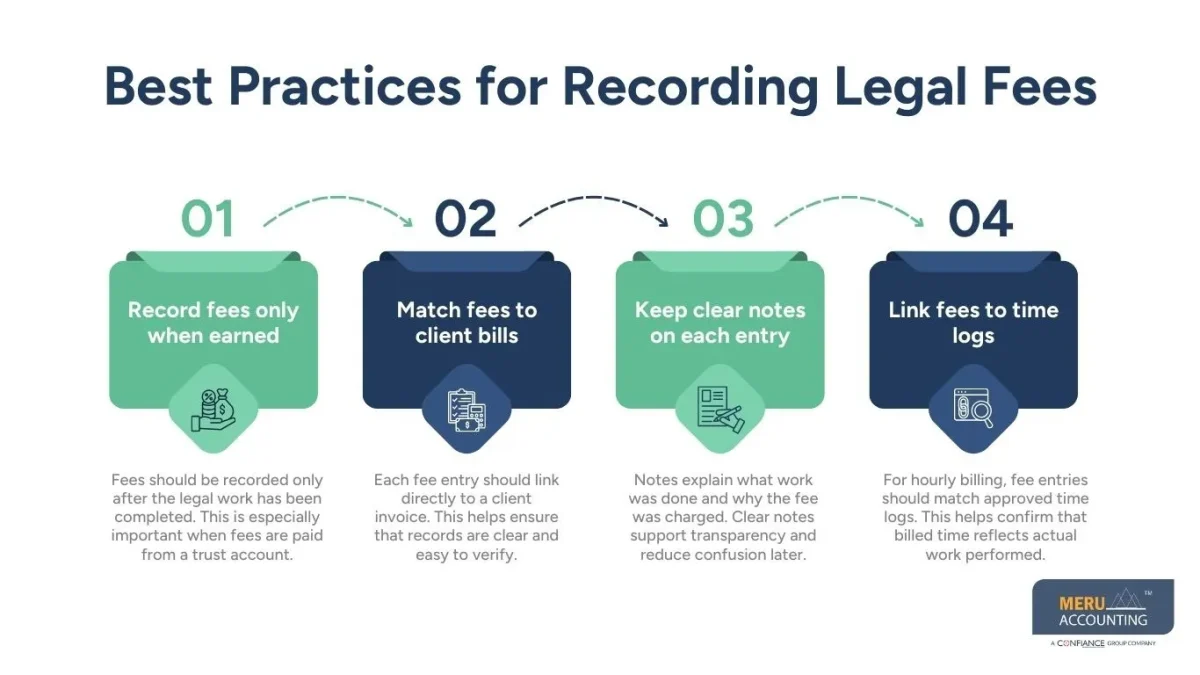
Best Practices for Recording Legal Fees
Recording legal fees the right way helps protect a law firm from risk. In law firm bookkeeping, fee records must always match billing terms and trust rules. If fees are recorded too early or without support, problems can arise during reviews or audits.
Clear and accurate fee records also help build trust with clients. When bills are easy to understand, clients are less likely to raise questions or disputes. Strong law office bookkeeping makes this process smooth and consistent.
Best practices include:
- Record fees only when earned
Fees should be recorded only after the legal work has been completed. This is especially important when fees are paid from a trust account. - Match fees to client bills
Each fee entry should link directly to a client invoice. This helps ensure that records are clear and easy to verify. - Keep clear notes on each entry
Notes explain what work was done and why the fee was charged. Clear notes support transparency and reduce confusion later. - Link fees to time logs
For hourly billing, fee entries should match approved time logs. This helps confirm that billed time reflects actual work performed.
A law office bookkeeper reviews all records before posting fees to the books. Clean records reduce client disputes and lower audit stress. Strong law office bookkeeping also supports clear and reliable financial reports.
Tracking Billable and Non-Billable Fees
Not all work earns fees, but all work matters. Law office bookkeeping tracks both billable and non billable time.
Billable work includes:
- Client calls
- Court work
- Legal research
Non billable work includes:
- Admin tasks
- Team meetings
- Internal reviews
A law office bookkeeper tracks both types. This helps firms see where time is spent. Clear bookkeeping supports better pricing and planning in law offices.
Flat Fees, Hourly Billing, and Contingency Fees Explained
Law firms use different billing styles. Law office bookkeeping must support each one.
Flat Fees:
- Often paid upfront
- May need trust tracking
- Earned over time
Hourly Billing:
- Based on time logs
- Needs review before billing
- Tied closely to bookkeeping
Contingency Fees:
- Earned after case result
- Not recorded early
- Require careful timing
A law office bookkeeper ensures each billing type follows rules. Clear systems reduce confusion for staff and clients.
Why Choose Meru Accounting for Law Office Bookkeeping Services
Managing legal books alone can feel stressful. Meru Accounting offers expert law office bookkeeping services built for law firms.
What we offer:
- Dedicated law office bookkeeper support
- Trust account checks
- Retainer tracking
- Billing and fee support
- Clear monthly reports
Our law office bookkeeping services help firms stay compliant and calm. We reduce risk and free your time. With Meru Accounting, your books stay clean and ready.
Key Takeaways
- Law office bookkeeping is critical for law firms
- Trust accounts need strict care
- Retainers must be tracked clearly
- Billing must follow firm rules
- A specialized law firm bookkeeper reduces risk
With the right system, bookkeeping becomes simple and safe.
FAQs
Law office bookkeeping deals with client funds. Legal rules require full care and clear records.
A law office bookkeeper records money, checks trust accounts, and keeps records clean.
Good law office bookkeeping includes monthly checks at least.
Yes. Many small firms use a law office bookkeeper to stay compliant.
Clean records make audits easy and stress free.


