




Manufacturing accounting plays a critical role in helping manufacturers stay stable, prepared, and financially clear over the long term. Unlike standard bookkeeping, accounting for manufacturing businesses focuses on tracking production costs, inventory movement, and operational spending that directly affect profit and sustainability.
When handled correctly, it supports better planning, controlled growth, and informed decisions that protect the business during both steady and uncertain periods.
In many cases, businesses struggle not because sales are low, but because financial data does not clearly show where money is earned or lost. This is where accounting for manufacturing businesses becomes essential. It creates structure, improves visibility, and supports long-term business stability by turning numbers into useful insights.
What You Will Learn From This Blog
- How manufacturing accounting helps manufacturers build strong financial systems for long-term stability
- The role of manufacturing accounting in planning and growth
- How accounting for manufacturing businesses supports cost control and cash flow management
- Highlights the differences between manufacturing-focused accounting and general accounting
- Explains why professional financial support is essential for manufacturing operations
- How the right accounting approach prepares manufacturers for market changes
Understanding the Role of Manufacturing Accounting in Long-Term Planning
Manufacturing accounting supports long-term planning by organizing financial data around production activities. It tracks material costs, labor, overhead, and inventory values, helping businesses plan future production levels and investments.
With accurate cost data, manufacturers can forecast profits, set realistic budgets, and plan expansions without risking financial strain.
Accounting for manufacturing businesses ensures that planning decisions are based on real operational data rather than assumptions. It also helps businesses identify trends and patterns in production costs over time.
By analyzing this data, manufacturers can spot inefficiencies early, adjust pricing strategies, and improve production planning. This proactive insight ensures long-term plans remain practical and aligned with actual performance.
How Manufacturing Accounting Creates a Strong Financial Foundation
Accurate Cost Tracking
Manufacturing accounting records raw materials, labor, and overhead costs in detail. This accuracy ensures that product pricing is based on actual expenses, not estimates, reducing the risk of hidden losses.
Inventory Valuation Control
Inventory often represents a large portion of assets. Accounting for manufacturing businesses tracks inventory movement and valuation, helping businesses avoid overstocking, shortages, and incorrect asset reporting.
Clear Production Cost Visibility
By breaking down costs by product or process, manufacturing accounting helps identify which products are profitable and which need improvement or pricing adjustments.
Structured Financial Records
Well-maintained financial records simplify audits, reviews, and financial planning. Consistent and organized data ensures readiness for reporting requirements.
Better Budget Management
Realistic budgets are created using historical production data, helping businesses control spending and avoid unexpected cost overruns.
Improved Decision Confidence
Clear and reliable financial data allows business owners to make informed decisions while reducing uncertainty in financial planning.
Why Manufacturing Accounting Is Essential for Sustainable Growth
Supports Controlled Expansion
Financial analysis shows whether current operations can support growth, helping assess capacity, cost impact, and funding needs before expanding production.
Prevents Cost Overruns
By tracking costs at each production stage, manufacturing accounting helps detect inefficiencies early and prevent uncontrolled spending.
Improves Profit Planning
Understanding true production costs allows manufacturers to plan profit targets that are realistic and achievable.
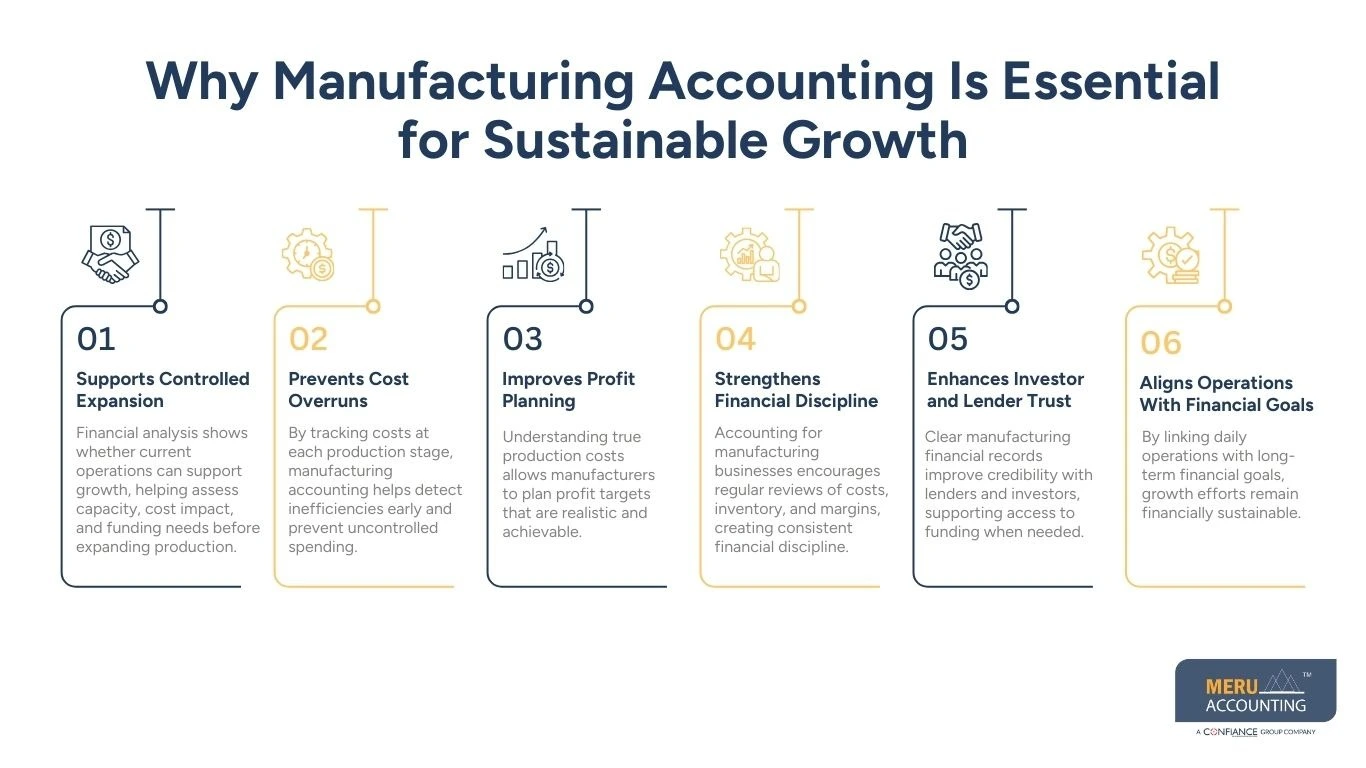
Strengthens Financial Discipline
Accounting for manufacturing businesses encourages regular reviews of costs, inventory, and margins, creating consistent financial discipline.
Enhances Investor and Lender Trust
Clear manufacturing financial records improve credibility with lenders and investors, supporting access to funding when needed.
Aligns Operations With Financial Goals
By linking daily operations with long-term financial goals, growth efforts remain financially sustainable.
The Difference Between General Accounting and Accounting for Manufacturing Business
Focus on Production Costs
General accounting tracks income and expenses broadly, while accounting for manufacturing business focuses on detailed production cost tracking.
Inventory Complexity
Manufacturing businesses manage raw materials, work-in-progress, and finished goods, requiring precise tracking to maintain accurate inventory records.
Cost Allocation Methods
Specialized costing methods such as job costing and process costing are used to track production expenses, going beyond what standard accounting systems typically support.
Overhead Distribution
Indirect costs like utilities and maintenance are systematically allocated across products, improving overall cost accuracy.
Profit Analysis by Product
Profitability is evaluated at the product level rather than only at the overall business level, enabling better pricing and production decisions.
Compliance and Reporting Needs
Industry-specific inventory valuation and cost reporting standards are met, ensuring accurate financial reporting and regulatory compliance.
How Accounting for Manufacturing Business Improves Cash Flow Predictability
Better Inventory Planning
Accurate inventory tracking helps avoid excess stock, freeing up cash tied up in unused materials.
Clear Payment Scheduling
Production cycles are aligned with supplier payments, reducing the risk of cash shortages.
Improved Cost Forecasting
Knowing future production costs helps businesses plan cash needs more accurately.
Reduced Waste Spending
Manufacturing cost accounting identifies waste and inefficiencies that drain cash over time.
Smarter Pricing Decisions
When pricing reflects true costs, cash inflows become more predictable and consistent.
Stronger Working Capital Control
Accounting for manufacturing business supports better control of receivables, payables, and inventory balances.
Common Financial Risks Manufacturers Face Without Structured Accounting
Without structured manufacturing accounting, manufacturers face several financial risks that can slowly damage profitability and stability. These risks often go unnoticed until they become major problems.
Uncontrolled Production Costs
When costs are not tracked properly, manufacturers may overspend on raw materials, labor, or overhead. This leads to reduced profit margins and hidden losses.
Poor Inventory Management
Lack of structured accounting causes inventory mismatches, overstocking, and stockouts. This ties up cash and disrupts production schedules.
Pricing Errors
Without accurate cost data, pricing becomes guesswork. Manufacturers may underprice products and lose money or overprice and lose customers.
Cash Flow Uncertainty
Manufacturers may face sudden cash shortages due to unplanned spending or delayed receivables. Structured accounting helps predict cash needs.
Missed Financial Compliance
Manufacturing businesses must follow specific inventory and cost reporting standards. Without structured accounting, compliance errors can lead to penalties and audits.
Weak Profit Tracking
Without product-level profit analysis, businesses may continue producing low-margin products, which reduces long-term growth and stability.
How Manufacturing Accounting Supports Long-Term Business Stability During Market Changes
Adapts to Cost Fluctuations
Manufacturing cost accounting helps adjust pricing and production plans when material or labor costs change.
Supports Scenario Planning
Clear financial data allows manufacturers to plan for best-case and worst-case market situations.
Protects Profit Margins
By tracking margins closely, manufacturing accounting helps protect profits during price pressure.
Maintains Financial Clarity
During uncertain markets, structured financial data reduces confusion and supports calm decision-making.
Improves Risk Awareness
Manufacturing accounting highlights financial risks early, allowing timely corrective actions.
Supports Steady Operations
Even during market changes, manufacturing bookkeeping and accounting keep financial processes stable and organized.
When to Consider Professional Support for Accounting for Manufacturing Business
Growing Production Volume
As production grows, financial processes become more complex and may require expert handling.
Increasing Product Lines
Multiple products increase cost tracking needs, making professional support valuable.
Cash Flow Challenges
If cash flow feels unpredictable, professional manufacturing accounting support can help restore control.
Compliance Pressure
Manufacturing businesses face strict reporting standards that professionals manage more effectively.
Limited Internal Expertise
If internal teams lack experience in accounting for manufacturing businesses, outsourcing ensures accuracy and reliability.
Need for Strategic Insights
Professionals provide analysis that supports long-term planning and stability.
How Meru Accounting Supports Manufacturing Businesses
At Meru Accounting, we understand that manufacturing businesses face unique financial challenges. From inventory valuation to production cost tracking, accurate accounting is essential for long-term stability. That’s why we provide specialized manufacturing accounting services tailored to your business needs.
Specialized Manufacturing Accounting Services
- We focus on manufacturing, bookkeeping, and accounting to support long-term business stability.
- Our team understands the unique financial challenges faced by manufacturers.
Expertise in Inventory Valuation
- We help track and value raw materials, work-in-progress, and finished goods.
- Accurate inventory valuation ensures correct financial reporting and cost control.
Production Cost Tracking
- We monitor costs across each stage of production, including labor and overhead.
- This helps identify areas of inefficiency and reduce unnecessary expenses.
Clear Cost Visibility
- We provide detailed insights into product-wise cost and profitability.
- This helps manufacturers make smarter pricing and production decisions.
Improved Cash Flow Predictability
- We help manage cash flow by aligning production costs with payments and sales.
- Better cash flow forecasting supports stable business operations.
Accurate Financial Records
- We maintain consistent and reliable accounting records for manufacturing businesses.
- This ensures better planning, reporting, and compliance.
Focus on Growth
- Manufacturers can focus on production and operations while we manage financial structure.
- Our support helps ensure stable growth and long-term financial health.
Key Takeaways
- Manufacturing accounting is essential for long-term business stability
- It provides accurate cost tracking and inventory control
- Manufacturing accounting supports better planning and growth decisions
- Accounting for manufacturing business improves cash flow predictability
- Professional support strengthens financial clarity and compliance
FAQs
Manufacturing accounting focuses on tracking production costs, inventory, and overhead related to manufacturing operations.
Manufacturing accounting tracks detailed production costs, while regular accounting focuses on general income and expenses.
Accounting for a manufacturing business helps control costs, manage inventory, and support stable financial planning.
Yes, clear and reliable financial data support better decision-making during uncertain periods.
When production grows, costs increase, or financial clarity becomes difficult, professional support is helpful.


