




Manufacturing accounting plays a critical role in the financial health of any production-based company. When a business undergoes mergers and acquisitions (M&A), the accounting practices that were once routine often face significant changes.
Understanding how manufacturing accounting adapts during these transitions is vital for maintaining accurate financial records, complying with regulations, and ensuring smooth integration of operations.
In this blog, we will explore the effects of mergers and acquisitions on manufacturing accounting, the challenges faced during integration, and the role of modern tools like accounting software for manufacturing industry in streamlining these processes.
What You Will Learn From This Blog
- Learn the key principles and practices that guide manufacturing accounting in both stable and transitional periods.
- Understand how financial reporting, cost structures, and accounting workflows are affected during M&A activities.
- Explore common issues businesses face when merging accounting systems and reconciling financial statements.
- See how accounting software for manufacturing industry can simplify integration, reporting, and compliance.
- Gain insights into best practices to maintain accuracy, efficiency, and transparency after an acquisition or merger.
- Learn how to maintain strong financial controls and reduce risks during and after mergers and acquisitions.
Understanding Manufacturing Accounting
Manufacturing accounting focuses on tracking production costs such as raw materials, labor, and overheads. Accurate cost tracking ensures correct product pricing and healthy profit margins, while errors can lead to distorted financial results.
Inventory management is equally important, covering raw materials, work-in-progress, and finished goods, to maintain precise financial reporting. Job costing assigns expenses to specific projects or production runs, helping businesses evaluate project-level profitability and make informed operational decisions.
Alongside this, budgeting and forecasting allow manufacturing accountants to plan production costs, manage cash flow, and allocate resources efficiently, ensuring smooth business operations.
Compliance and reporting are central to manufacturing accounting, ensuring adherence to financial regulations, tax rules, and industry standards. Accurate reports and regular audits maintain credibility with stakeholders and prevent regulatory issues.
Finally, performance analysis provides insights into operational efficiency, cost overruns, and profit margins. By evaluating this data, management can optimize processes, reduce waste, and improve overall business performance.
How Mergers and Acquisitions Influence Financial Reporting
Changes in Accounting Policies
When companies merge, differences in accounting policies must be reconciled. For manufacturing accounting, this includes cost recognition, depreciation methods, and inventory valuation.
Consolidation of Financial Statements
M&A requires combining financial statements, which can be complex if the companies use different accounting practices or systems.
Valuation Adjustments
Assets, liabilities, and goodwill are often revalued during a merger. Manufacturing accounting teams must carefully adjust inventory, equipment, and production facilities to reflect fair values.
Revenue Recognition
Different revenue models in manufacturing businesses may require aligning revenue recognition policies to ensure consistency in post-merger reporting.
Disclosure Requirements
Regulators often demand detailed disclosures during mergers. Accurate manufacturing bookkeeping and accounting ensures compliance with reporting standards.
Internal Control Changes
Financial controls may need to be updated or merged to maintain oversight and reduce risk after M&A.
Challenges in Manufacturing Accounting During M&A
Data Integration Issues
Merging accounting systems can be difficult due to incompatible software, differing data structures, or inconsistent records.
Inventory Reconciliation
Discrepancies in inventory records between merging companies can create reporting errors and affect production planning.
Cost Allocation Conflicts
Different approaches to allocating manufacturing costs can lead to confusion in post-merger financial statements.
Human Resource Accounting Challenges
Employee benefits, payroll, and labor costs must be accurately integrated, which can be tricky during a merger.
Compliance and Regulatory Risks
Ensuring that merged operations meet all financial reporting and regulatory requirements is a constant challenge.
Cultural and Process Differences
Accounting teams may face difficulty adapting to new processes, workflows, and reporting expectations after M&A.
How Mergers and Acquisitions Impact Manufacturing Accounting
Standardizing Costing Methods
After M&A, manufacturing bookkeeping and accounting teams must decide on uniform costing methods to ensure comparability across all operations. This helps management evaluate product profitability accurately across the merged entity.
Streamlining Inventory Accounting
Combining inventories requires reconciling records, adjusting valuations, and tracking work-in-progress consistently. Proper inventory alignment prevents discrepancies that could affect financial statements.
Harmonizing Payroll and Overheads
Labor costs, overhead allocations, and benefits must be aligned across merged entities to maintain accurate product cost calculations. Ensuring consistency helps avoid misallocation of expenses.
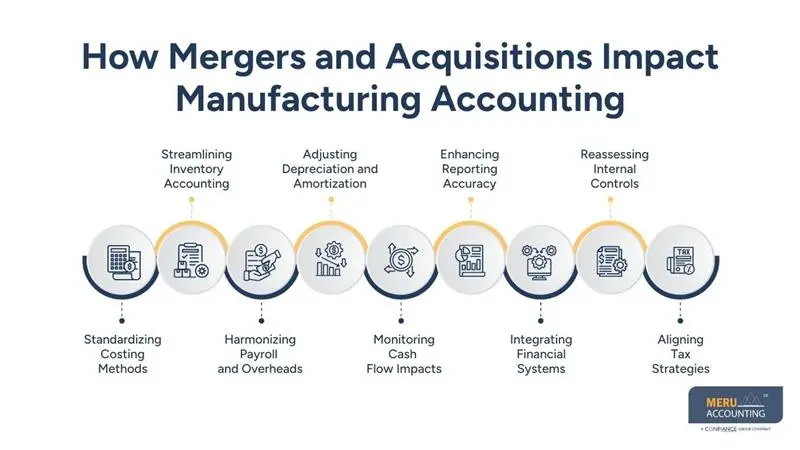
Adjusting Depreciation and Amortization
Fixed assets from acquired companies may have different depreciation methods, which must be standardized for consistent accounting. This ensures fair representation of asset values in financial reports.
Monitoring Cash Flow Impacts
M&A can temporarily disrupt cash flows. Manufacturing accounting must closely track inflows, outflows, and working capital requirements to avoid liquidity issues.
Enhancing Reporting Accuracy
Post-merger, timely and accurate financial reporting is critical for management, investors, and regulatory authorities. Accurate reporting also helps in making informed strategic decisions quickly.
Integrating Financial Systems
Accounting software and legacy systems must be merged carefully to maintain accurate records and reduce data errors. Proper integration allows for smoother day-to-day financial operations.
Reassessing Internal Controls
Internal controls should be reviewed and updated to prevent errors and maintain compliance across the combined organization. Strong controls reduce the risk of fraud and accounting mistakes.
Aligning Tax Strategies
Tax treatment and reporting may need adjustment after a merger to optimize liabilities and comply with regulations. Proper alignment ensures the merged company avoids unnecessary penalties or tax issues.
Role of Accounting Software for Manufacturing Industry in M&A
System Integration
Modern accounting software for manufacturing industry allows seamless integration of financial data from multiple entities.
Automated Cost Tracking
These tools automate production cost tracking, ensuring accuracy even during complex mergers and acquisitions.
Inventory Management
Advanced software helps reconcile inventory, track materials, and manage work-in-progress effectively post-merger.
Reporting and Compliance
Accounting software provides real-time reporting, audit trails, and regulatory compliance features critical during M&A.
Data Accuracy and Consistency
Centralized systems reduce errors, prevent data duplication, and maintain consistency in manufacturing accounting practices.
Decision Support
The software provides analytics and insights that help management make informed decisions during integration and post-merger operations.
Best Practices for Manufacturing Accounting Post-Merger
Establish Standard Accounting Policies
Develop uniform accounting policies for costing, depreciation, and revenue recognition across the merged entity.
Consolidate Financial Systems
Integrate accounting software for manufacturing industry to maintain centralized and accurate financial records.
Train Accounting Teams
Ensure staff from both companies understand new policies, systems, and reporting requirements.
Regular Audits and Reviews
Conduct internal audits to verify data accuracy and ensure compliance with regulations.
Monitor Key Performance Metrics
Track production costs, inventory levels, and cash flow to evaluate post-merger performance.
Focus on Transparency
Maintain clear communication with management, investors, and auditors to prevent misunderstandings or reporting errors.
Why Choose Meru Accounting?
Choosing the right accounting partner is crucial for manufacturing businesses, especially during mergers and acquisitions. Meru Accounting offers specialized expertise to handle complex financial scenarios, streamline processes, and ensure accurate reporting throughout every stage of the transition.
Expertise in Manufacturing Accounting
Meru Accounting has years of experience in handling complex accounting scenarios in manufacturing businesses, including mergers and acquisitions.
Custom Solutions for M&A
We provide tailored solutions to align cost structures, reconcile inventories, and integrate accounting systems during M&A.
Advanced Software Implementation
Our team implements and manages accounting software for manufacturing industry, ensuring smooth integration and accurate reporting.
Regulatory Compliance and Reporting
We help manufacturing businesses comply with all accounting standards and tax regulations during M&A, minimizing risks and audit issues.
Financial Analysis and Insights
Meru Accounting provides detailed post-merger financial analysis, helping management track costs, evaluate production efficiency, and make informed strategic decisions.
Key Takeaways
- Manufacturing accounting is central to accurate cost tracking, inventory management, and financial reporting.
- Mergers and acquisitions create challenges in integrating financial systems, reconciling data, and standardizing accounting practices.
- Using accounting software for manufacturing industry simplifies integration, improves reporting accuracy, and ensures compliance.
- Post-merger, companies should establish uniform policies, train staff, and regularly audit records to maintain smooth operations.
- Partnering with experts like Meru Accounting can make the transition easier and more efficient.
FAQs
Mergers and acquisitions affect cost tracking, inventory records, and financial reporting in manufacturing accounting. Businesses must integrate systems and align accounting methods.
Challenges include reconciling inventories, aligning cost allocation, integrating accounting systems, and maintaining accurate reports.
Accounting software for manufacturing industry helps merge financial data, track costs, and maintain accurate reporting efficiently.
Standardizing accounting policies, consolidating systems, training staff, and performing audits help maintain accuracy post-merger.
Yes, M&A can change inventory valuation methods, requiring adjustments to maintain accurate financial statements.


