




Manufacturing companies accounting is more than just recording transactions. It is a strategic tool that provides businesses with a clear understanding of their financial health, enables efficient resource management, and supports informed decision-making. In manufacturing firms, where costs, inventory, and production processes are closely interconnected, maintaining accurate accounting records is critical to ensuring profitability and long term sustainability.
This blog examines why manufacturing companies accounting is essential for financial planning and forecasting and highlights its impact on every facet of a manufacturing business.
What You Will Learn From This Blog
- The basics of manufacturing companies accounting and its importance
- Key principles of accounting for manufacturing
- How accounting supports financial planning and strategic decision-making
- Insights into cost analysis, profit margin tracking, and production forecasting
- Ways to integrate accounting with supply chain and investment planning
What Is Manufacturing Companies Accounting
Manufacturing companies accounting is the process of recording, tracking, and analyzing all financial transactions related to manufacturing operations. It includes everything from raw material costs to finished goods, labor, overhead, and inventory.
This specialized form of accounting focuses on production-specific metrics such as cost per unit, work in progress, and production efficiency, setting it apart from general accounting practices.
Accurate manufacturing companies accounting plays a crucial role in business operations. It ensures that resources are allocated effectively, reduces waste, and helps optimize production schedules. By providing clear visibility into costs and operations, it supports informed decision-making and contributes to overall operational efficiency.
Beyond operational benefits, manufacturing companies accounting is essential for compliance and management. Proper accounting records help meet tax regulations, auditing requirements, and reporting standards.
At the same time, accounting serves as a powerful management tool, offering insights for cost control, budgeting, and long-term financial planning.
Key Principles of Accounting for Manufacturing
Cost Tracking
Accounting for manufacturing involves detailed tracking of all production costs, including materials, labor, and overhead.
Inventory Valuation
Proper inventory accounting ensures accurate valuation of raw materials, WIP, and finished goods, essential for determining profitability.
Expense Allocation
Expenses are allocated to the correct production lines, helping to understand which products are profitable and which are not.
Revenue Matching
Revenue is matched with the corresponding production costs to calculate the true profitability of each product.
Internal Reporting
Regular reports provide insights into cost variances, production efficiency, and overall financial performance, supporting informed decision-making.
How Manufacturing Companies Accounting Supports Financial Planning
Budgeting for Production
With detailed financial records, companies can create realistic budgets for materials, labor, and overhead costs.
Cash Flow Management
Manufacturing companies accounting tracks cash inflows and outflows, ensuring sufficient liquidity for daily operations.
Forecasting Sales and Demand
By analyzing historical financial data, businesses can predict future demand and adjust production accordingly.
Cost Reduction Opportunities
Accounting highlights areas of inefficiency, allowing management to implement cost-saving measures.
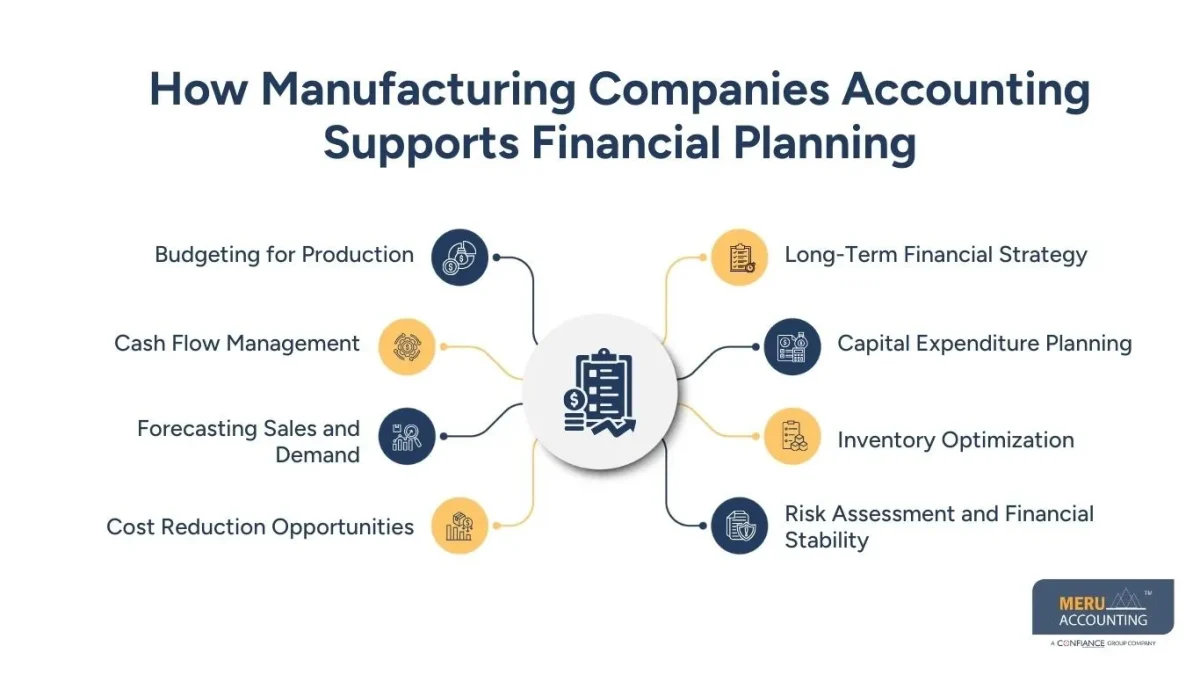
Long-Term Financial Strategy
Accurate accounting provides the foundation for strategic planning, helping manufacturers set achievable financial goals.
Capital Expenditure Planning
Manufacturing companies accounting helps evaluate investments in machinery and equipment by analyzing costs, returns, and long term financial impact.
Inventory Optimization
Accurate accounting for manufacturing supports better inventory planning, reducing excess stock while preventing production delays.
Risk Assessment and Financial Stability
Consistent financial tracking allows manufacturers to identify potential risks early and maintain financial stability during market fluctuations.
The Role of Accounting for Manufacturing in Strategic Decision-Making
Product Pricing Decisions
Understanding production costs helps in setting competitive yet profitable pricing strategies.
Investment Planning
Financial records guide decisions on equipment purchases, facility expansion, or technology upgrades.
Risk Assessment
Accounting for manufacturing identifies financial risks associated with production delays, cost overruns, or supply chain disruptions.
Performance Measurement
Tracking key performance indicators (KPIs) allows management to evaluate the efficiency and profitability of operations.
Resource Allocation
Accounting data supports decisions on where to allocate resources for maximum financial impact.
Profitability Analysis by Product Line
Accounting for manufacturing helps identify which products generate the highest margins and which require cost or pricing adjustments.
Market Expansion Evaluation
Reliable accounting data supports decisions related to entering new markets or scaling existing operations.
Long Term Business Planning
Manufacturing companies accounting provides the financial clarity needed to align strategic goals with sustainable growth plans.
The Importance of Accurate Cost of Goods Sold (COGS) Calculation
Identifying True Production Costs
COGS includes all direct costs of manufacturing, providing a clear picture of profitability per product.
Pricing Accuracy
Accurate COGS ensures that product pricing covers costs and maintains healthy profit margins.
Budgeting and Forecasting
Knowing the exact COGS helps in planning future budgets and predicting financial outcomes.
Tax Compliance
COGS is a critical component of taxable income calculations, ensuring accurate reporting.
Inventory Management
Properly calculated COGS supports better inventory valuation and reduces write-offs.
Integrating Accounting for Manufacturing with Supply Chain Management
Tracking Material Costs
Accounting data helps monitor the cost of raw materials and identify expensive or underperforming suppliers.
Reducing Waste
Integration ensures that excess inventory or unused materials are minimized, improving operational efficiency.
Supplier Performance Monitoring
Financial insights can highlight which suppliers provide the best value for money.
Production Scheduling
Accurate accounting helps schedule production runs efficiently by tracking costs, inventory levels, and labor availability.
Coordinated Planning
Combining accounting and supply chain data ensures resources are allocated effectively across the entire production process.
How Manufacturing Companies Accounting Helps in Profit Margin Analysis
Product-Level Profitability
By comparing revenue and costs, manufacturers can determine the profit margin for each product line.
Identifying High-Cost Areas
Accounting highlights areas where costs are higher than expected, allowing corrective action.
Comparing Performance
Profit margin analysis across different periods helps evaluate the effectiveness of cost-control measures.
Strategic Adjustments
Insights from profit margins guide decisions on pricing, production methods, and marketing strategies.
Enhancing Overall Profitability
Regular analysis ensures that all operations contribute positively to the company’s bottom line.
Forecasting Production Costs Using Manufacturing Companies Accounting Data
Historical Cost Analysis
Analyzing past costs helps predict future expenses and identify trends in material or labor costs.
Estimating Overheads
Accounting records help forecast overhead expenses, ensuring accurate budgeting.
Scenario Planning
Companies can model different production scenarios and estimate their financial impact.
Reducing Financial Surprises
Accurate forecasting minimizes unexpected costs and improves financial stability.
Supporting Investment Decisions
Forecasted production costs provide crucial input for decisions on expansion, equipment upgrades, or new product lines.
Standard Cost Benchmarking
Manufacturing companies accounting enables businesses to set standard costs and compare them with actual expenses to improve cost control.
Monitoring Cost Variances
Regular variance analysis helps identify deviations from projected costs and allows timely corrective actions.
Aligning Forecasts with Production Capacity
Accurate accounting data supports realistic forecasting by matching projected costs with available production capacity and resources.
Preparing for Capital Investments Using Manufacturing Companies Accounting
Assessing Financial Readiness
Accounting records show whether the company has the funds to invest in new machinery or facilities.
ROI Calculation
Accounting for manufacturing helps calculate expected returns on investments, ensuring financial viability.
Financing Decisions
Detailed financial data guides decisions on loans, equity financing, or internal funding for capital projects.
Long-Term Planning
Accounting ensures that capital investments align with the company’s long-term financial goals.
Risk Mitigation
By understanding costs and cash flow, companies can plan investments without overextending resources.
How Meru Accounting Supports Manufacturing Businesses
Meru Accounting provides specialized services in manufacturing companies accounting to help businesses manage costs, improve efficiency, and make informed financial decisions. Our expertise ensures accurate reporting and compliance for sustainable growth.
Expert Financial Analysis
At Meru Accounting, we provide specialized services in manufacturing companies accounting, helping businesses gain accurate insights into their financial health.
Cost Management Solutions
Our team ensures precise cost tracking, helping manufacturers reduce waste and increase profitability.
Forecasting and Planning
We assist companies in creating accurate financial forecasts and budgets based on real accounting data.
Strategic Decision Support
Meru Accounting helps management make informed decisions on product pricing, investments, and resource allocation.
Compliance and Reporting
Our professionals ensure that your accounting practices meet all regulatory requirements, avoiding potential legal issues.
Key Takeaways
- Manufacturing companies accounting is essential for financial planning, cost management, and profitability.
- Proper accounting for manufacturing helps in strategic decision-making and investment planning.
- Accurate COGS calculation is critical for pricing, budgeting, and tax compliance.
- Integrating accounting with supply chain management improves efficiency and reduces costs.
- Leveraging professional services like Meru Accounting ensures accurate records, compliance, and insightful financial forecasts.
FAQs
It is the process of tracking all financial transactions in a manufacturing business, including material, labor, and overhead costs.
It provides accurate cost and production data, which helps create realistic budgets and manage cash flow effectively.
COGS shows the true cost of producing goods, helping in pricing products correctly and analyzing profit margins.
Yes, it helps identify high-cost areas, reduce waste, and optimize resource allocation.
Meru Accounting offers expert accounting services, cost tracking, financial forecasting, and compliance support tailored for manufacturing companies.


