


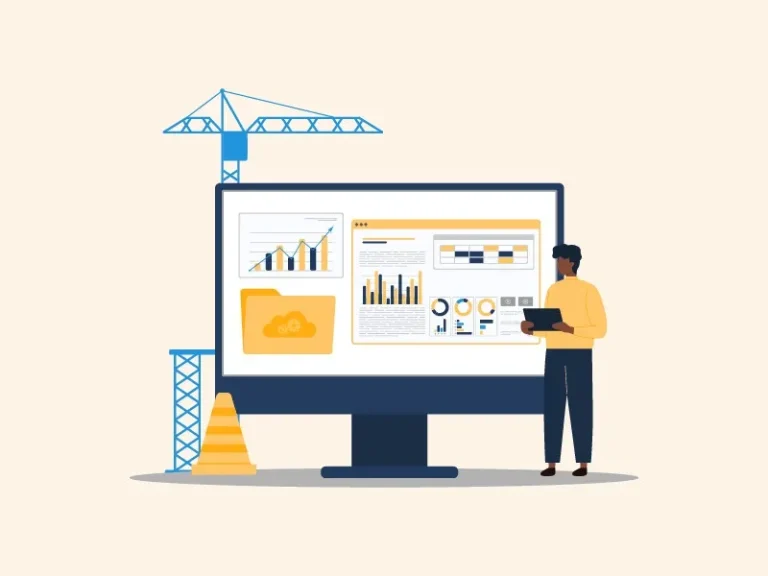
Managing finances in construction and trade-based businesses has always been complex. Multiple jobs run at the same time, expenses change daily, and payments often arrive in stages. Online accounting for contractors helps bring structure to this complexity by giving contractors a clear and organized way to manage their financial workflows.
Instead of relying on spreadsheets or paper records, contractors can now track income, costs, and profits in one system that stays updated in real time. This blog explains how modern financial workflows are shaped through online systems and why this approach matters for contractors today.
What You Will Learn From This Blog
This blog will help you understand the practical value of online accounting for contractors through clear and simple points:
- How online accounting for contractors helps manage daily financial tasks such as invoicing, expense tracking, and payments
- Ways online accounting for contractors supports long-term planning by giving a clear view of cash flow and project costs
- Common financial challenges faced by contractors and how online accounting systems help resolve them
- Key features in online accounting tools that improve accuracy and reduce manual errors
- How automation supports job costing, project tracking, and timely financial updates
- What to look for when choosing the best online accounting software for contractors
- How professional accounting support helps with setup, compliance, and ongoing financial management
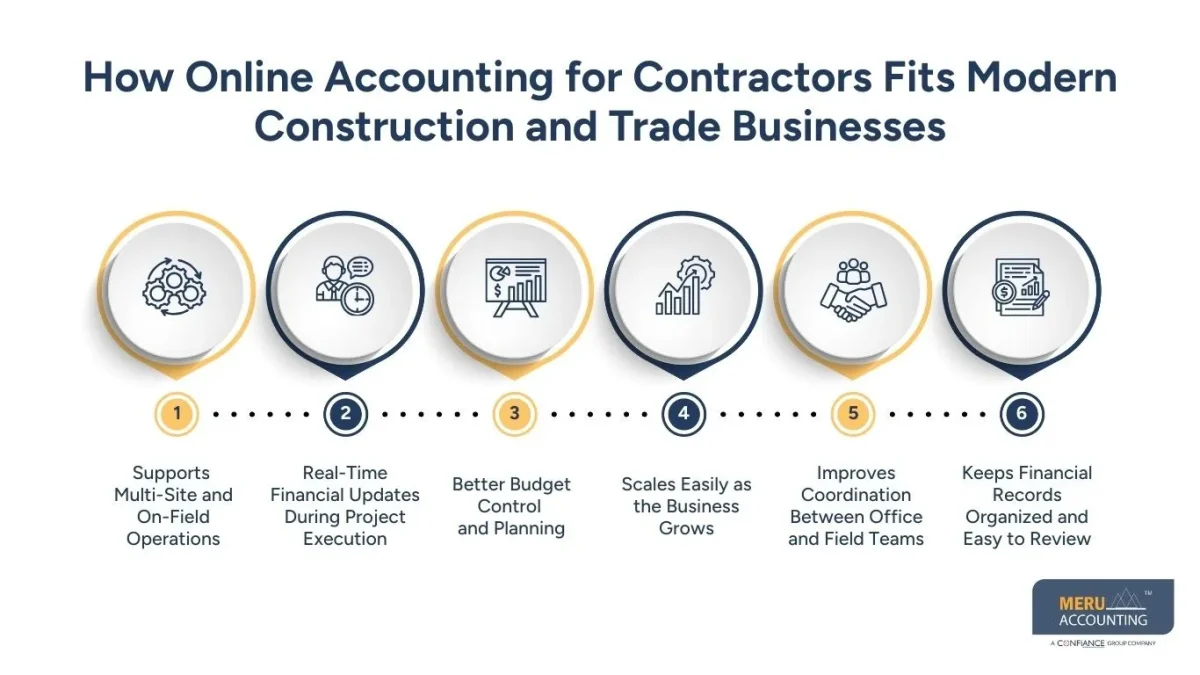
How Online Accounting for Contractors Fits Modern Construction and Trade Businesses
Supports Multi-Site and On-Field Operations
- Construction and trade work often happens across multiple job sites
- Teams, vendors, and supervisors operate from different locations
- Online accounting for contractors allows access to financial data from anywhere
- Accounts stay updated without waiting for end-of-day or office reporting
Real-Time Financial Updates During Project Execution
- Expenses can be recorded as soon as they occur
- Payments, invoices, and costs are reflected immediately
- Financial data stays aligned with ongoing project activity
- This reduces delays and improves accuracy in records
Better Budget Control and Planning
- Income and expenses remain visible at all times
- Project budgets can be reviewed regularly
- Cost overruns are identified early instead of after project completion
- Financial planning becomes easier with clear and current data
Scales Easily as the Business Grows
- New projects can be added without changing systems
- No need for complex manual updates or extra spreadsheets
- Remote accounting solutions adapt to higher job volumes
- Financial workflows remain organized as operations expand
Improves Coordination Between Office and Field Teams
- Office staff and field teams work with the same financial data
- Expenses submitted from job sites are visible to the accounting team instantly
- Reduces miscommunication related to costs and payments
- Helps maintain consistency in financial records across teams
Keeps Financial Records Organized and Easy to Review
- All project-related financial data is stored in one place
- Past and current job records can be accessed quickly
- Supports easier reviews during audits or internal checks
- Makes it simple to track performance across different projects and periods
Key Financial Challenges Solved by Online Accounting for Contractors
Contractors face unique accounting challenges that general systems often fail to address. Online accounting for contractors helps solve several of these issues:
Irregular Cash Flow
Payments often depend on project milestones or client approvals. Online accounting systems track all receivables quickly and accurately.
Job-Based Expenses
Costs need to be assigned to specific projects, not just general accounts.
Multiple Vendors and Subcontractors
Managing payables becomes simpler with centralized records.
Tax Compliance
Accurate records support correct tax filings and reporting.
By addressing these challenges, remote accounting for contractors creates a structured financial process that supports informed decisions.
Core Features of Online Accounting for Contractors
The strength of online accounting for contractors lies in features built around project-based work. Common features include:
- Job-wise income and expense tracking
- Real-time financial dashboards
- Invoice creation linked to projects
- Expense categorization by job and cost type
- Bank and payment reconciliation
- Time tracking for labor and subcontractor hours
- Automated reporting for profit, loss, and project summaries
These features help contractors see the financial position of each project and the business as a whole. Compared to generic tools, systems designed for contractors offer better visibility and control.
Role of Automation in Online Accounting for Contractors
Automation is a key component of online accounting for contractors. It simplifies accounting tasks, reduces errors, and saves time. The main benefits and features include:
Automatic Transaction Imports
Bank feeds can automatically import transactions, eliminating the need for manual data entry.
Recurring Invoices
Invoices for regular clients or repeat projects can be generated automatically, ensuring timely billing.
Real-Time Report Updates
Financial reports update automatically as new transactions are recorded, giving contractors an accurate view of their finances at all times.
Error Reduction
Automation reduces mistakes caused by duplicate entries or missed expenses, improving overall accuracy.
Time Savings
Contractors and accounting staff can spend less time on paperwork and more time managing projects.
Consistent Records
Automated workflows maintain uniform and reliable accounting records over time.
Simplified Audits
With accurate and organized records, audits become easier and less stressful.
By utilizing automation, online accounting for contractors makes financial management more efficient, accurate, and stress-free.
Job Costing and Project Tracking Through Online Accounting for Contractors
Job costing is a critical feature of online accounting for contractors, helping contractors monitor project profitability and manage expenses effectively. Key aspects include:
Project-Specific Cost Tracking
Every cost and payment is linked to a specific project, ensuring accurate job-level accounting.
Detailed Expense Categorization
Materials, labor, equipment, and overheads can be tracked separately for each job.
Comparison of Estimated vs. Actual Costs
Contractors can compare planned budgets with real expenses to identify variances and control costs.
Progress Billing Management
Project tracking tools help monitor invoices tied to milestones or stages of a job.
Outstanding Invoices Overview
Contractors can see unpaid invoices and pending payments for each project.
Budget Monitoring
Remaining budgets for ongoing projects are tracked in real-time, helping avoid overspending.
Informed Decision-Making
With clear project financials, contractors can adjust pricing, resources, and planning for current and future work.
Using virtual accounting for contractors for job costing and project tracking ensures that projects stay profitable and financially organized, reducing surprises and improving decision-making.
Comparing Features in the Best Online Accounting Software for Contractors
|
Feature Area |
What to Look For |
Why It Matters for Contractors |
|
Job Costing Tools |
Ability to track costs and income by project |
Helps measure project profit and control job expenses |
|
Project Tracking |
Support for managing multiple projects at the same time |
Allows contractors to monitor progress and finances across jobs |
|
Financial Reporting |
Clear and detailed financial reports |
Makes it easier to review business performance and project results |
|
User Access Controls |
Role-based access for owners, staff, and accountants |
Keeps financial data secure and organized |
|
Payroll Integration |
Connection with payroll systems |
Ensures accurate labor cost tracking for each project |
|
Project Management Integration |
Ability to link with project management tools |
Improves coordination between job progress and financial data |
|
Financial Summaries |
Simple dashboards and summaries |
Provides quick insight without complex steps |
|
Ease of Use |
Simple navigation and clear layout |
Supports daily use without extensive training |
|
Scalability |
Ability to handle business growth |
Ensures the software remains useful as projects increase |
How the Best Online Accounting Software for Contractors Supports Business Growth
The best online accounting software for contractors plays an important role in supporting long-term business growth by improving financial clarity and control. Key ways it helps include:
Accurate Financial Insights
Reliable and up-to-date financial data helps contractors understand cash flow, costs, and profitability.
Better Growth Planning
With clear financial information, contractors can plan business expansion, take on larger projects, and manage growth with confidence.
Support for Hiring Decisions
Accurate reports make it easier to decide when to hire new staff or subcontractors.
Informed Equipment Investment
Contractors can assess financial readiness before purchasing tools, machinery, or vehicles.
Compliance and Reporting Support
Proper records are maintained for lenders, tax authorities, and business partners.
Scalability as Work Increases
As the number of projects grows, the system continues to handle higher volumes of data without slowing down.
Consistent Financial Management
Standardized processes help maintain control as the business expands.
By using the best online accounting software for contractors, businesses gain the financial visibility and structure needed to grow steadily while staying organized and compliant.
Transitioning from Manual Systems to Online Accounting for Contractors
Moving from spreadsheets or paper records to online accounting for contractors is a major step. The transition usually starts with reviewing existing data and setting up a proper chart of accounts.
Historical data can be migrated into the system to maintain continuity. Training ensures that staff understand how to record transactions correctly. While the change may seem challenging at first, contractors often find that daily tasks become easier once the system is in place.
Common Mistakes to Avoid When Using Online Accounting for Contractors
Even with reliable systems in place, certain mistakes can reduce the effectiveness of online accounting for contractors. Being aware of these common issues helps maintain accurate financial records. Key mistakes to avoid include:
Incorrect Job Assignment
Failing to assign expenses and income to the correct job can distort project costs and profitability.
Delayed Transaction Entry
Recording transactions late can lead to incomplete data and inaccurate financial reports.
Skipping Regular Reconciliations
Ignoring bank and account reconciliations increases the risk of errors and mismatches.
Using Generic Settings
Not applying contractor-specific features can limit the usefulness of the accounting system.
Lack of Review Processes
Not reviewing reports regularly can allow small issues to grow into larger problems.
Avoiding these mistakes ensures that virtual accounting for contractors provides accurate results, reliable reports, and better financial control across projects.
How Meru Accounting Supports Online Accounting for Contractors
Meru Accounting offers dedicated services to help contractors manage finances effectively through online accounting for contractors. The support is designed around real contractor workflows and business needs. Key areas of support include:
System Setup Aligned to Contractor Workflows
Accounting systems are set up to match how contractors manage jobs, costs, and payments.
Chart of Accounts Configuration
A structured chart of accounts is created to support project-based tracking and clear reporting.
Job Costing Setup
Job costing tools are configured to track materials, labor, equipment, and overheads accurately.
Customized Reporting Structures
Financial reports are designed specifically for construction and trade businesses.
Ongoing Bookkeeping Services
Regular bookkeeping ensures transactions are recorded accurately and on time.
Reconciliation and Review
Bank and account reconciliations are performed regularly to maintain data accuracy.
Software Selection Support
Guidance is provided in choosing and using the best online accounting software for contractors based on business size and project complexity.
With professional support from Meru Accounting, contractors can focus on project execution while remote accounting for contractors keeps financial records organized, accurate, and easy to manage.
Looking to simplify your contractor accounting and gain better control over project finances? Contact Meru Accounting today to set up reliable online accounting for contractors tailored to your business needs.
Key Takeaways
- Online accounting for contractors simplifies job-based financial management
- Automation improves accuracy and saves time
- Job costing tools help measure project profitability
- The best online accounting software for contractors supports growth and compliance
FAQs
Online accounting for contractors is a system that helps contractors manage income, expenses, and projects using cloud-based software.
Yes, virtual accounting for contractors works well for small and growing businesses because it scales as work increases.
Job costing tracks all costs and income related to a specific project, helping contractors understand profit or loss.
Look for software with strong job tracking, clear reports, and ease of use. The best online accounting software for contractors fits your project needs.
Yes, with proper setup and guidance, moving to online accounting for contractors can be smooth and beneficial.


