




Manufacturing is a complex business for many companies. It involves raw materials, production lines, labor, inventory, shipping, and customer orders, each with its own financial impact. That is why outsourced accounting for manufacturing companies has become a smart choice for businesses that want to expand or launch new products.
With the right accounting support, manufacturing leaders can make better financial decisions, avoid costly mistakes, and stay on track for growth. This support also helps track costs and improve efficiency. Accurate financial data makes expansion and product launches easier.
What You Will Learn From This Blog
In this blog, you will learn:
- Why manufacturing accounting is different from regular accounting
- How outsourced accounting for manufacturing companies supports growth
- How accounting helps manage cash flow during expansion
- How to handle financial challenges during new product launches
- How outsourced accounting for manufacturing companies improves product profitability
- How accounting helps prevent financial risks
- Why Meru Accounting is a strong choice for manufacturing firms
Introduction to Outsourced Accounting for Manufacturing Companies
Manufacturing businesses face many financial tasks that need accurate and timely handling. Outsourced accounting means hiring an external accounting team to manage your bookkeeping, financial reporting, payroll, and cost tracking. It is a smart solution for outsourced accounting for manufacturing companies.
This approach gives manufacturing companies the ability to focus on production and growth, while experts handle financial tasks behind the scenes.
Outsourced accounting for manufacturing companies also helps maintain accurate financial records, supports compliance, and improves financial decision-making. This makes it easier for businesses to plan expansion or launch new products with confidence.
By outsourcing accounting, manufacturing companies can also benefit from scalable support that adjusts to their business needs. Whether you are a small workshop or a large production facility, an outsourced accounting team can handle fluctuating workloads during peak seasons, manage complex inventory and cost accounting, and provide timely financial insights.
This flexibility helps manufacturing companies stay agile, reduce overhead costs, and access specialized expertise without hiring full-time staff.
Key Aspects of Manufacturing Accounting
Manufacturing accounting is not the same as accounting for retail or services. It requires special attention to:
- Cost of goods sold (COGS)
- Material and labor costing
- Inventory tracking
- Overhead allocation
- Job costing
- Production variance analysis
- Factory overhead accounting
All of these factors must be recorded accurately. Otherwise, your profits can look good on paper while your business is losing money in reality.
Outsourced accounting for manufacturing companies helps ensure that these numbers are accurate and reliable.
Why Manufacturing Companies Need Specialized Accounting Support
Manufacturing companies face challenges that other industries rarely see. Some of these challenges include:
1. Complex Costing Methods
Manufacturing companies use multiple costing methods such as standard costing, activity-based costing, and job costing. A small mistake can cause major profit errors.
2. Inventory Management
Manufacturers have raw materials, work-in-progress, and finished goods. Tracking each stage accurately is essential for financial clarity.
3. Production Planning and Forecasting
Production needs to be planned according to demand and cash flow. Poor planning can lead to overproduction, wasted materials, and cash shortages.
4. Compliance and Reporting
Manufacturers must follow specific accounting standards and tax rules. Outsourced accounting teams are trained to stay compliant.
This is why manufacturing accounting requires dedicated expertise, which is why many businesses choose outsourced accounting for manufacturing companies.
How Outsourced Accounting Helps During Business Expansion
Expansion is exciting, but it can also be risky. When a manufacturing company expands, it needs more equipment, more staff, more inventory, and more space. All of these require proper financial planning.
Here’s how outsourced accounting for manufacturing companies helps during expansion:
1. Accurate Financial Forecasting
When you expand, you need a clear view of future revenue and expenses. Outsourced accounting teams build financial forecasts that help you make informed decisions.
2. Budgeting and Cost Control
Expansion costs can quickly spiral out of control. Outsourced accounting teams set budgets and monitor spending to keep costs within limits.
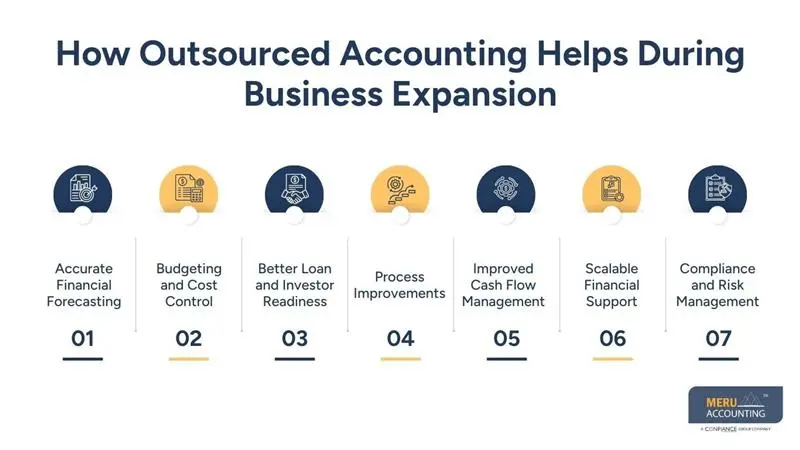
3. Better Loan and Investor Readiness
If you need financing for expansion, investors and banks will ask for financial statements and projections. Outsourced accounting ensures your reports are clean and accurate.
4. Process Improvements
Manufacturing companies often face inefficiencies during growth. Outsourced accounting identifies weak spots and suggests process improvements.
5. Improved Cash Flow Management
Expansion increases cash flow pressure due to higher inventory and payroll needs, making outsourced accounting for manufacturing companies crucial for cash flow stability.
Outsourced accounting helps track cash flow closely, ensuring you have enough working capital at all times.
6. Scalable Financial Support
During expansion, financial workload increases. Outsourced accounting provides scalable support, so your accounting team can grow with your business without hiring full-time staff.
7. Compliance and Risk Management
Expansion often brings new regulations and tax requirements. Outsourced accounting ensures compliance with local laws, reduces risk, and avoids costly penalties.
Overall, outsourced accounting for manufacturing companies gives your expansion a stronger financial foundation.
Role of Outsourced Accounting in Managing Cash Flow During Growth
Cash flow is the lifeline of manufacturing businesses. Growth often leads to higher cash needs because:
- More raw materials are required
- More staff is hired
- Production increases
- Inventory levels rise
- Receivables increase
Without proper cash flow planning, companies can face sudden cash shortages.
Outsourced accounting helps by:
1. Cash Flow Forecasting
They track cash inflows and outflows and create forecasts that show when money will be needed.
2. Managing Receivables and Payables
Outsourced accounting teams ensure invoices are sent on time, and payments are collected faster.
3. Inventory Control
They monitor inventory levels to prevent overstocking or stockouts, both of which harm cash flow.
4. Expense Monitoring
They help you track and control operating expenses, ensuring that growth doesn’t become costly.
With outsourced accounting for manufacturing companies, cash flow becomes predictable, which makes expansion smoother and safer.
New Product Launches: Financial Challenges Manufacturing Companies Face
Launching a new product is risky. It requires careful planning and financial control. Some common challenges include:
1. High Initial Costs
New product development needs money for design, testing, production, and marketing.
2. Demand Uncertainty
You may not know how well the product will sell, making forecasting difficult.
3. Production Adjustments
Manufacturing lines may need reconfiguration, which costs time and money.
4. Inventory Risk
If the product doesn’t sell well, inventory becomes a major cost burden.
5. Pricing and Profit Margin Pressure
Setting the right price is difficult when production costs are high and demand is uncertain. Incorrect pricing can reduce profit margins and affect long-term profitability.
6. Cash Flow Strain
New product launches often require upfront spending on materials, production, and marketing. This can create cash flow pressure, especially if sales are slower than expected.
7. Supply Chain Disruptions
New products may require new suppliers or materials. Any delay or shortage can impact production schedules and increase costs.
These challenges make manufacturing accounting essential for new product launches.
How Outsourced Accounting Improves Product Profitability Analysis
Profitability analysis is the process of understanding how much profit a product generates after all costs. For manufacturing companies, this includes:
- Material cost
- Labor cost
- Overhead cost
- Packaging
- Shipping
- Marketing expenses
- Returns and warranty costs
Outsourced accounting helps with:
1. Product Cost Tracking
They track every cost related to the product, ensuring accurate pricing decisions.
2. Margin Analysis
They analyze profit margins and identify which products are profitable and which are not.
3. Break-even Analysis
They calculate the minimum sales needed to cover costs, helping you plan production and pricing.
4. Real-Time Reporting
They provide reports that help you monitor profitability throughout the product lifecycle.
With outsourced accounting for manufacturing companies, product profitability becomes clear, helping you make smart decisions.
How Outsourced Accounting Enhances Decision-Making for Expansion
When you expand, you must make decisions like:
- Should we add a new production line?
- Should we open a new factory?
- Should we invest in automation?
- Should we hire more staff or outsource labor?
- Should we increase prices?
Outsourced accounting for manufacturing companies supports these decisions by providing:
1. Data-Based Financial Insights
They provide clear financial data that shows the real cost and benefit of each decision.
2. Cost-Benefit Analysis
They compare options and help you choose the best path based on financial outcomes.
3. Risk Assessment
They identify financial risks and suggest ways to reduce them.
4. Long-Term Planning
They help you create financial plans that support long-term growth.
That’s why outsourced accounting for manufacturing companies is important for making confident decisions during expansion.
How Outsourced Accounting Prevents Financial Risks
Manufacturing companies face many risks, such as:
- Inventory losses
- Cost overruns
- Fraud
- Tax errors
- Compliance violations
- Uncontrolled spending
Outsourced accounting helps prevent these risks by:
1. Regular Financial Audits
They review financial records to detect errors early. They also help identify weak areas in accounting processes so issues can be fixed before they become bigger problems.
2. Strong Internal Controls
They set rules and processes that prevent fraud and misuse. These controls also ensure proper approval workflows for purchases and payments, reducing the chance of unauthorized spending.
3. Compliance Management
They ensure tax and financial compliance to avoid penalties. They also keep track of changing tax laws and regulations to make sure your business stays up to date.
4. Cost Monitoring
They track costs closely to prevent budget overruns. They also compare actual costs against budgets and provide alerts when expenses start exceeding limits.
With outsourced accounting for manufacturing companies, financial risks are reduced, and business growth becomes more stable.
Why Choose Meru Accounting for Your Manufacturing Business?
At Meru Accounting, we understand the unique financial needs of manufacturing companies. Our team offers specialized manufacturing accounting services designed to support growth and new product launches.
Here’s what we provide:
Costing and Inventory Management
Accurate tracking of raw materials, work-in-progress, and finished goods to keep costs under control.
Financial Forecasting and Budgeting
Realistic financial projections and budgets to support expansion plans and decision-making.
Product Profitability Analysis
Clear insights into which products are profitable and why, helping you improve margins.
Cash Flow Management
Strong cash flow monitoring to ensure smooth operations even during periods of growth.
Compliance and Reporting
Timely and accurate financial reports that meet all regulatory requirements.
Scalable Services
Whether you are expanding or launching a new product, we can scale our services to match your needs.
With Meru Accounting, you get reliable accounting support that helps you grow safely and confidently.
Key Takeaways
- Outsourced accounting for manufacturing companies helps manage complex costing and inventory systems.
- Manufacturing accounting requires specialized knowledge for accurate financial tracking.
- Outsourced accounting supports expansion through forecasting, budgeting, and risk management.
- Cash flow is managed better with professional accounting support.
- New product launches need careful cost tracking and profitability analysis.
- Outsourced accounting reduces financial risks and improves decision-making.
- Meru Accounting provides reliable and scalable services for manufacturing firms.
FAQs
Outsourced accounting for manufacturing companies means hiring an external accounting team to manage your financial records, costing, inventory, and reports instead of doing it internally.
Outsourced accounting helps manufacturing companies grow by improving cash flow, tracking costs, creating budgets, and providing clear financial reports for expansion decisions.
Manufacturing companies need specialized manufacturing accounting because they must track raw materials, production costs, labor, and inventory, which is more complex than regular business accounting.
Outsourced accounting supports new product launches by tracking product costs, calculating profitability, managing budgets, and helping businesses decide pricing and production quantities.
Outsourced accounting can prevent risks like cost overruns, inventory losses, tax errors, cash flow problems, and inaccurate financial reports during expansion.


