


Commercial real estate operations involve layered financial and operational structures. These structures require disciplined real estate accounting practices consistently. Technology now drives leasing, tenant management, and accounting processes.
Disconnected systems create inefficiencies across commercial real estate portfolios. Accurate real estate accounting ensures transparency and regulatory compliance. Errors can significantly impact profitability and investor confidence.
CRM platforms manage relationships, leasing data, and sales pipelines. They lack detailed financial recording capabilities by design. Businesses increasingly seek unified operational and accounting ecosystems.
This raises questions regarding system connectivity and data flow. This blog will also explain how Can you integrate commercial real estate CRM with accounting software?
What You Will Learn From This Blog
- Real estate accounting fundamentals for commercial properties explained clearly.
- How CRM systems support leasing operations and their limitations.
- The impact of leasing data on accounting accuracy and reporting.
- You will also learn how Can you integrate commercial real estate CRM with accounting software?
- How to integrate commercial real estate CRM with accounting software.
- Operational and financial benefits are achieved through system integration.
- Meru Accounting’s approach to end-to-end integration and support.
What Is Real Estate Accounting for Commercial Properties?
Real estate accounting manages all financial activities related to commercial properties. It systematically records income, expenses, assets, and liabilities, ensuring clear and accurate financial tracking.
Commercial properties involve complex lease and billing structures, which require advanced accounting controls for proper management. Each property must maintain separate accounting records to track profitability and performance accurately.
Lease terms directly affect revenue recognition, and real estate accounting ensures compliance with standard accounting principles. Shared expenses, such as CAM charges, must be allocated precisely across tenants to maintain proper financial reporting.
Real estate financial management also supports audits and regulatory compliance. Proper tracking reduces financial risks, prevents errors, and ensures businesses remain compliant with tax and reporting obligations.
Understanding the Role of CRM in Commercial Real Estate
CRM Purpose in Commercial Real Estate
CRM systems manage tenant relationships and leasing pipelines. They focus on operational and relationship-driven data management.
Lead and Prospect Management
CRM platforms track leads from inquiry to lease execution. This improves leasing efficiency and deal visibility.
Lease Lifecycle Tracking
CRM systems track lease stages and renewal timelines. This supports proactive tenant communication strategies.
Centralized Tenant Information
CRM platforms store tenant details and communication histories. This improves service quality and relationship management.
CRM Limitations in Accounting
CRM systems do not manage financial transactions or ledgers. They cannot replace real estate accounting software functionality.
Integration Need Recognition
Commercial real estate firms often ask about system integration. Specifically, they ask, Can you integrate commercial real estate CRM with accounting software? Integration connects operational and financial systems, improving accuracy and efficiency.
How Leasing Data Impacts Real Estate Accounting
Lease agreements define rent, escalations, and billing schedules. These terms directly impact real estate accounting accuracy.
Rent Escalation and Adjustments
Escalation clauses change revenue amounts over time. Accurate accounting depends on timely lease data updates.
CAM and Shared Expenses
Lease data determines tenant responsibility for shared costs. Incorrect data causes inaccurate CAM reconciliations.
Security Deposits Accounting
Deposits require separate accounting treatment and tracking. Lease data ensures proper liability recognition.
Manual Entry Risks
Manual data transfers increase error and delay risks. This negatively affects real estate accounting reliability.
Importance of Data Integration
Integrated systems reduce discrepancies across financial records. Hence, integrating commercial real estate crm with accounting software becomes critical.
Can You Integrate Commercial Real Estate CRM with Accounting Software?
Yes, you can integrate commercial real estate crm with accounting software. Modern platforms support secure system connectivity.
How Integration Works
Integration enables automatic data exchange between systems. Lease events trigger accounting transactions instantly.
Automated Invoicing Processes
Rent invoices are generated directly from CRM lease data. This ensures billing accuracy and consistency.
Payment Synchronization
Tenant payments update both CRM and accounting records. This maintains aligned operational and financial data.
Technology Used for Integration
APIs and connectors enable real-time system communication. Custom workflows handle complex leasing scenarios.
Business Adoption Trends
Most commercial real estate firms now adopt integrated systems. Integration supports scalable real estate accounting operations.
Benefits of Integrating CRM, Leasing, and Real Estate Accounting Systems
Improved Data Accuracy
Integration eliminates duplicate data entry across systems. This improves real estate accounting accuracy significantly.
Faster Billing Cycles
Automated invoicing reduces billing delays substantially. Cash collections improve through timely tenant invoicing.
Enhanced Lease Management
Lease changes reflect instantly in accounting records. This prevents revenue mismatches and reporting errors.
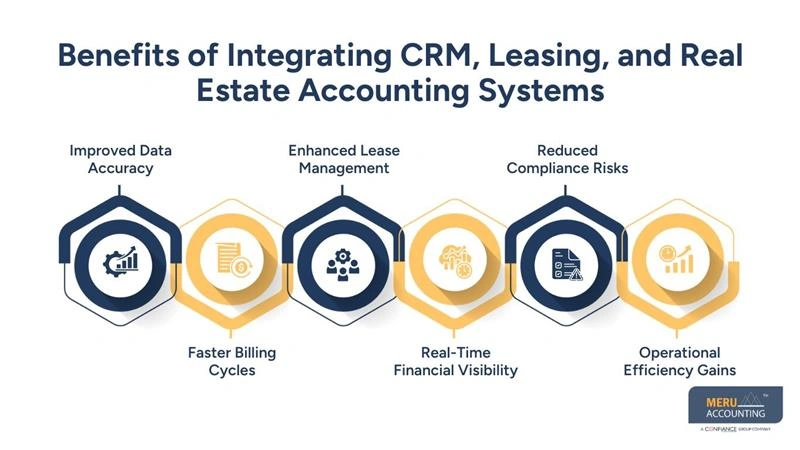
Real-Time Financial Visibility
Management accesses live financial and leasing reports. This supports proactive financial decision-making.
Reduced Compliance Risks
Accurate records simplify audits and regulatory reporting. This reduces financial and legal exposure.
Operational Efficiency Gains
Integrated systems reduce administrative workload. Teams focus on strategic tasks instead.
Popular Accounting Software That Supports Commercial Real Estate Integration
QuickBooks Online
QuickBooks Online integrates with various CRM platforms. It supports basic commercial real estate accounting needs.
Xero Accounting Software
Xero offers cloud-based accounting with integration flexibility. It supports scalable property accounting operations.
NetSuite ERP
NetSuite handles complex commercial real estate accounting requirements. It supports enterprise-level integration capabilities.
Odoo Platform
Odoo combines CRM and accounting within one system. It reduces integration complexity significantly.
Yardi Systems
Yardi specializes in real estate accounting solutions. It supports comprehensive property management workflows.
MRI Software
MRI Software offers advanced commercial real estate platforms. It supports deep financial and operational integration.
How Integrated Real Estate Accounting Improves Decision-Making
Unified Financial Visibility
Integrated real estate accounting provides complete financial clarity. Data-driven insights improve strategic planning accuracy.
Property Performance Analysis
Managers analyze profitability at property-level granularity. Underperforming assets are identified early.
Cash Flow Forecasting
Integrated data improves cash flow prediction accuracy. This supports better liquidity management.
Investment Decision Support
Reliable reports guide acquisition and disposition decisions. Risk assessments become more accurate.
Budgeting and Planning
Integrated systems support realistic budget creation. Variance analysis becomes easier and faster.
Executive Reporting
Leadership receives consistent and trustworthy financial reports. This improves stakeholder confidence significantly.
How Meru Accounting Streamlines Commercial Real Estate Accounting and CRM Integration
Specialized Industry Expertise
Meru Accounting specializes in commercial real estate accounting. Our team understands complex leasing structures deeply. We have years of experience to provide tailored solutions for every property type.
System Assessment and Planning
We evaluate existing CRM and accounting systems. Integration strategies align with business goals. Our planners identify gaps and recommend strategies for seamless system connectivity.
Data Migration and Cleanup
Our experts clean and migrate historical financial data. This ensures accurate real estate accounting continuity. We validate all data for consistency to prevent errors in future reporting.
Lease-to-Accounting Mapping
Lease terms are mapped correctly to accounting rules. Revenue recognition remains accurate and compliant. This mapping ensures all tenant charges and CAM allocations are precise.
Integration Implementation
We configure APIs and integration workflows professionally. Testing ensures system reliability and accuracy. We monitor initial transactions to ensure smooth, error-free operation post-integration.
Ongoing Support Services
Meru Accounting provides continuous accounting and reporting support. Clients achieve long-term operational stability. Our team is always available to address queries, updates, and system enhancements.
Performance Monitoring and Optimization
Meru Accounting continuously monitors system performance and accuracy. We identify improvements to optimize workflows and processes. Ongoing optimization keeps real estate accounting and CRM systems efficient.
Key Takeaways
- Real estate accounting is essential for commercial property financial success. It ensures accuracy, compliance, and reliable reporting consistently.
- CRM systems manage leasing, tenants, and relationships efficiently. They support smooth operations and improve overall business performance.
- Integration of CRM and accounting software drives operational scalability.
- Integrated systems enhance reporting accuracy and support informed decisions. Errors are reduced, improving visibility across all property operations.
- Accurate integration minimizes financial risks and strengthens compliance. Businesses avoid penalties and operational inefficiencies consistently.
- Professional guidance ensures successful implementation and smooth system integration.
FAQs
Real estate accounting tracks income, expenses, and financial records accurately. It ensures compliance and provides transparency for property owners.
CRM systems manage tenant relationships, leases, and leasing workflows efficiently. They support communication, lease tracking, and sales pipeline management.
Yes, you can integrate commercial real estate crm with accounting software. Integration allows lease data to update accounting systems automatically.
Integration improves accuracy, automates billing, and enhances reporting efficiency. It reduces errors and speeds financial decision-making processes.
Popular tools include QuickBooks, Xero, Odoo, Yardi, NetSuite, MRI Software. These platforms enable seamless integration with CRM and leasing systems.


