



Top Tax Planning Strategies to Reduce Your Tax Bill in 2026
Paying taxes is a normal part of earning money, yet many people feel stressed and unsure when tax time arrives. Most of this stress comes from poor planning and last minute decisions. When you wait until the final weeks, you lose the chance to make meaningful adjustments that could reduce your tax burden. Tax planning for 2026 is not about escaping tax. It is about using legal tax planning strategies to lower how much you owe.
By planning early and reviewing your finances regularly, you gain control over your income, expenses, and savings approach. Smart tax planning strategies also improve cash flow, protect your future goals, and create financial stability.
Whether you are a salaried employee, business owner, or freelancer, the right planning methods can significantly reduce your tax bill. The strategies below focus on practical actions that help you save money while staying fully compliant with tax laws.
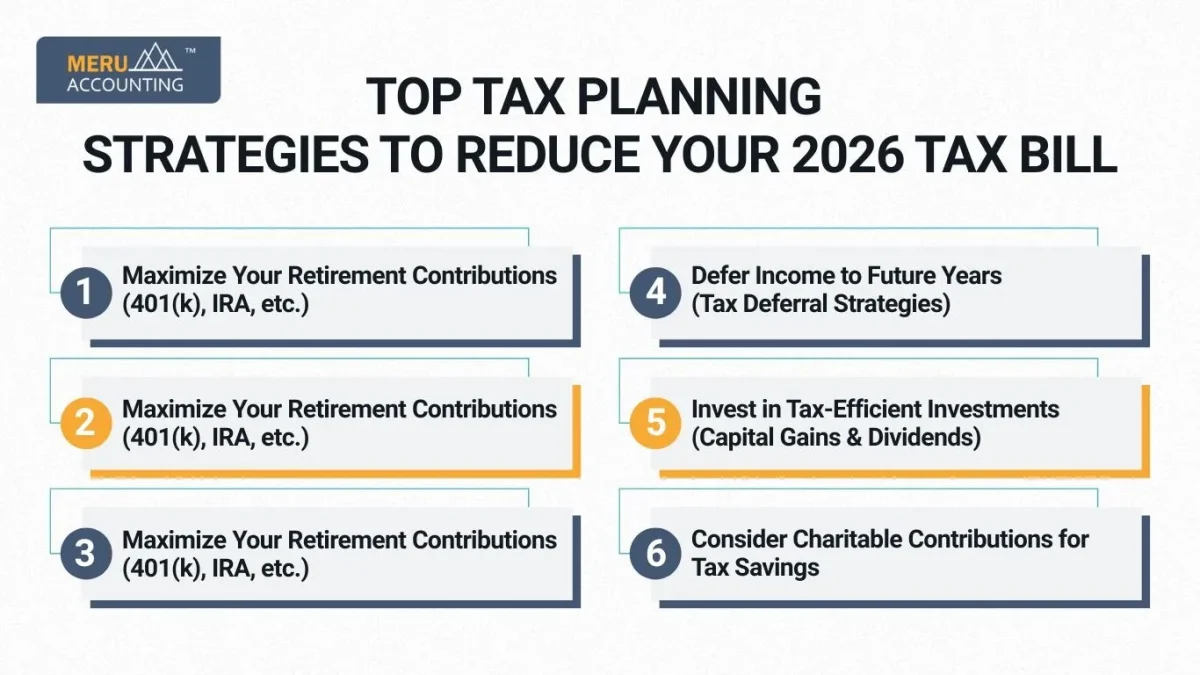
Top Tax Planning Strategies to Reduce Your 2026 Tax Bill
Here are some top tax planning strategies to reduce your tax bill in 2026:
1. Maximize Your Retirement Contributions (401(k), IRA, etc.)
Retirement contributions are one of the most powerful tools for tax reduction. When you contribute to retirement plans such as 401(k) or IRA, the contributed amount generally reduces your taxable income.
This means the more you contribute, the lower your tax exposure becomes for the year. These funds also grow over time, creating long term financial security while giving you instant tax benefits.
Major advantages of retirement contributions
- Reduces current year taxable income
- Builds long term financial protection
- Offers compounding growth benefits
- Helps stabilize future financial planning
Best practices for maximizing impact
- Start contributions early in the year
- Increase contribution when income rises
- Use employer matching programs fully
- Set automatic monthly deposits
Consistent contributions not only strengthen your retirement safety net but also keep your annual tax bill under control.
2. Take Advantage of Tax Credits and Deductions
Tax credits and deductions play a major role in reducing total tax liability. While deductions lower the amount of income subject to tax, credits directly reduce the tax amount itself.
Many taxpayers miss valuable claims due to poor awareness or lack of record keeping. Keeping detailed documentation helps unlock these benefits.
Common tax deductions include
- Education fees and training costs
- Medical treatments and health expenses
- Home loan interest payments
- Insurance premiums
- Business related expenses
- Childcare and dependent care costs
Benefits of using credits and deductions
- Lower overall tax payable
- Increased refund possibilities
- Better financial accuracy
- Reduced risk of overpayment
Understanding eligible deductions creates a strong foundation for efficient tax planning strategies.
3. Use Tax-Advantaged Accounts (HSA, FSA) to Lower Taxable Income
Health Savings Accounts and Flexible Spending Accounts provide an effective way to manage healthcare costs while reducing taxable income.
Money allocated to these accounts is generally not taxed when used for approved medical expenses, which makes them ideal for regular healthcare planning.
Key advantages
- Reduces taxable income
- Covers eligible medical costs
- Helps control health expense budgeting
- Creates predictable financial planning
Smart usage approach
- Estimate yearly healthcare needs
- Contribute practical amounts
- Monitor usage deadlines
- Avoid excess unused balance
These accounts form a practical bridge between health management and tax efficiency.
4. Defer Income to Future Years (Tax Deferral Strategies)
Income deferral focuses on shifting earnings to a later year when your tax rate may be lower. This is useful for individuals with fluctuating income levels or bonuses.
By managing when you receive payments, you control how much income appears in a specific tax year.
Common income deferral methods
- Postponing bonuses or incentive payouts
- Delaying freelance or contract payments
- Scheduling commissions in future cycles
Advantages of deferring income
- Keeps income within lower tax brackets
- Spreads financial burden evenly
- Provides smoother cash flow
- Avoids sudden tax spikes
Careful timing offers a strategic edge in long term tax planning strategies.
5. Invest in Tax-Efficient Investments (Capital Gains & Dividends)
Different investment types are taxed at different rates. Choosing tax efficient investments plays a major role in reducing the taxes paid on returns.
Long term investments are often taxed at lower rates compared to short term holdings. This makes patience a key factor in tax smart investing.
Examples of tax efficient investment options
- Long term stocks
- Dividend yielding mutual funds
- Retirement-focused investment plans
- Government backed savings bonds
Why this strategy works
- Reduces tax on profits
- Improves after tax returns
- Encourages stable wealth creation
- Maintains portfolio balance
A planned investment approach ensures growth without unnecessary tax pressure.
6. Consider Charitable Contributions for Tax Savings
Charitable contributions support meaningful causes while also providing tax saving opportunities. Donations made to approved institutions are often eligible for tax deductions.
This allows taxpayers to contribute to society while enjoying financial benefits.
Benefits of charitable giving
- Reduction in taxable income
- Positive social impact
- Improved tax profile
- Ethical financial planning
Important guidelines
- Donate only to registered charities
- Maintain proper receipts
- Ensure compliance with deduction limits
When planned wisely, donations offer both emotional and financial reward.
How to Use the 2026 Tax Brackets to Your Advantage
Understanding how tax brackets function gives you the power to control your financial outcomes. Each portion of your income is taxed at a specific rate. Knowing your position helps you take timely action.
Smart ways to use tax brackets
- Increase retirement contributions to remain in lower slab
- Spread income across two tax years
- Claim deductions before crossing higher threshold
- Plan bonuses and investments strategically
Managing your income placement across brackets helps lower your effective tax rate and preserve more earnings.
Tax Planning Strategies for High-Income Earners
High income earners face higher tax rates and stricter obligations. However, they also have greater access to advanced tax planning opportunities.
Effective tax planning strategies for saving:
- Structured investment portfolios
- Deferred compensation planning
- Income splitting with family
- Trust based financial structures
- Strategic capital management
Routine planning and financial review ensures high earners stay protected and optimized.
Common Tax Planning Mistakes to Avoid in 2026
Many taxpayers lose potential savings due to simple errors. Avoiding these mistakes ensures better financial results.
Frequent errors include
- Waiting until deadlines
- Ignoring updated tax changes
- Missing eligible deductions
- Failing to track expenses
- Overlooking professional help
- Incorrect documentation
Early planning and continuous monitoring reduce these risks significantly.
How a Professional Tax Planner Can Help You Achieve Maximum Tax Savings
Professional tax planners bring expertise that goes far beyond basic filing. They analyze your income patterns, identify saving opportunities, and create structured tax planning strategies. At Meru Accounting, we provide complete tax preparation services. Our smart tax planning strategies can help you achieve huge tax savings in 2026.
Our professional support includes:
- Personalized tax strategies
- Compliance with tax rules
- Risk management
- Long term financial forecasting
- Audit assistance
Their guidance transforms confusion into a confident and organized financial plan.
Why Choose Meru Accounting for Your Tax Planning in 2026
Meru Accounting provides reliable and professional tax preparation services. We help maximizing tax savings and minimizing risk. Our experienced team provides customized tax planning strategies for individuals, entrepreneurs, and businesses. Our every tax planning strategy is designed with accuracy, compliance, and financial growth in mind. We help clients reduce tax bills and gain long term financial clarity with our tax planning strategies.
Take control of your 2026 tax planning before deadlines take control of you. Reach out to Meru Accounting today to get customized tax planning strategies, expert preparation, and smarter financial solutions. Secure your savings, reduce stress, and move forward with confidence through professional tax planning support.
FAQs
- What is tax planning?
Tax planning is the process of organizing finances to reduce taxes legally. - Why is tax planning important for 2026?
It helps reduce unnecessary tax burden. - Can tax planning strategies lower my tax bill significantly?
Yes, with correct strategies, you can significantly reduce your tax bill. - What is the role of retirement contributions in tax saving?
Retirement contributions play a major role in reducing taxable income. - Are tax deductions and credits the same?
No, they work differently. - How do HSA and FSA help reduce tax?
HSA and FSA lower taxable income for health expenses. - What is income deferral?
It is shifting income to future years. - Are long term investments taxed lower?
Yes, in most cases long term investments are taxed lower. - Can donations reduce tax?
Yes, donations reduce tax if they are made to approved charities. - Who benefits from tax planning?
Everyone who is earning income can benefit from tax planning strategies. - Can high earners reduce tax legally?
Yes, through structured planning and tax planning strategies, high earners can reduce tax legally. - What is a tax bracket?
A tax bracket is a range that determines tax rate. - How often should tax planning be reviewed?
You must review your tax planning almost every year. - What happens if I skip tax planning?
If you skip tax planning, you may end up paying more tax. - Why consult a professional tax planner?
Professional tax planners can help you maximize tax savings. - Is tax planning legal?
Yes, when done correctly, it is completely legal. - What records should I keep for tax planning?
Expenses, receipts, and payment proof are required for tax planning. - Can tax planning reduce audit risk?
Yes, through accurate filing, you can reduce audit risk. - Is tax planning useful for small earners?
Yes, even small income earners benefit from tax planning. - Why choose Meru Accounting?
We provide expert tax guidance and reliable service.
