



Tax Relief Strategies for High Income Earners
Earning more often feels like success. Yet for many high income earners, tax season brings a sharp pause. The higher the income, the larger the tax amount. It can feel heavy and unfair for high income earners. Still, with the right tax relief strategies, that pressure can soften. In many cases, you can drop it down in smart and legal ways.
In this blog, we will show you some legal, practical, and clear ideas that can help reduce your tax load. With these tax relief strategies, you will be able to save a good amount of tax as a high income earner.
Understanding Tax Brackets and Income Thresholds
High income earners often fall into the top tax slabs. These slabs apply higher rates once income crosses set limits. Yet not all income gets taxed at the top rate. Only the part above each limit does.
Key points to keep in mind:
- Tax brackets rise as income rises
- Only a portion of income sits in each bracket
- Deductions and credits still lower taxable income
- Timing income can change total tax
A clear view of these brackets helps you create tax relief strategies.
High Income Tax Challenges
High earners face more than just big numbers. The tax system places extra limits and fewer relief options as income grows.
Common tax hurdles:
- Phase out of many credits
- Higher effective tax rate
- Extra surtaxes in some cases
- Limited access to some deductions
- More strict reporting rules
This makes smart planning less of a choice and more of a need.
Tax Efficient Investment Strategies
1. Utilizing Tax Deferred Accounts
Tax deferred accounts allow you to invest now and pay tax later. This helps reduce present taxable income. It can be considered one of the best tax relief strategies.
Main benefits are:
- Lower current tax bill
- Growth without annual tax drag
- Useful for long term planning
- Smooth income flow over years
Examples include retirement accounts where gains grow untouched for a long time.
2. Maximizing Roth Conversions
Roth conversions involve shifting funds from a traditional account to a Roth type account. Tax is paid now, yet future withdrawals remain tax free.
Why high earners consider this:
- Locks current tax rate
- Avoids future tax growth impact
- Adds flexibility in retirement
- Helps estate planning goals
It needs timing care, yet can work well over time.
3. Capital Gains Optimization
Capital gains get taxed when assets are sold. Planning when and how to sell makes a real difference.
Smart tax relief strategies include:
- Holding assets for long term gain rates
- Using losses to offset gains
- Spreading sales over years
- Aligning sales with low income years
This spreads tax stress and softens its edge.
Deductions and Credits Available to High Earners
Knowing deductions and credits available for high earners can be considered one of the best tax relief strategies. Here are some of them:
1. Itemized Deductions
Itemized deductions can still play a role for high earners, even with caps.
Common areas:
- Property tax
- Mortgage interest
- Medical costs above limits
- State and local taxes within allowed cap
These need clear records and careful tracking.
2. Charitable Giving Strategies
Giving not only helps others but also lowers taxable income.
- Ways to boost impact
- Donating appreciated assets
- Bunching donations in one year
- Using donor advised funds
- Planning gifts with long term view
This blends heart and finance in a balanced way.
3. Education and Family Related Tax Benefits
Some benefits still apply for high income families if planned well.
Possible areas:
- 529 plans for education
- Child care credits in some cases
- Dependent support deductions
- Flexible spending setups
Each has rules and needs checking.
Advanced Tax Relief Strategies
Here are some advanced tax relief strategies you must consider:
1. Setting Up Trusts and Estate Planning Tools
Trusts help manage wealth and reduce estate tax exposure.
Core uses are:
- Asset protection
- Future tax planning
- Wealth transfer control
- Legacy planning
This strategy suits those with long term vision.
2. Using Donor Advised Funds
Donor advised funds allow you to place money for charity now and give later.
Why they appeal:
- Immediate tax deduction
- Flexible giving schedule
- Simple management
- Structured approach to philanthropy
They work well for planned giving.
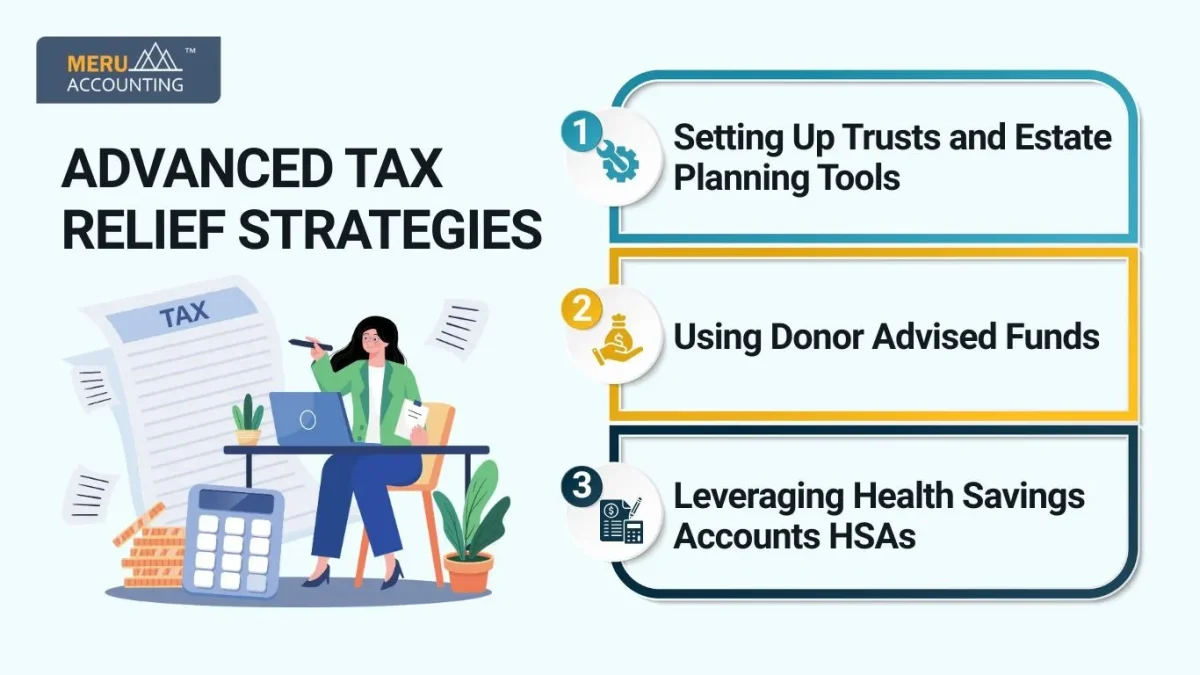
3. Leveraging Health Savings Accounts HSAs
HSAs offer triple tax benefits. Contributions are tax free. Growth is tax free. Withdrawals for health costs are tax free.
Why high earners use them:
- Boost future security
- Lower current tax
- Support rising health expenses
- Add retirement flexibility
They are quiet yet powerful.
Business Related Tax Relief Strategies for High Income Professionals
Some business related decisions can also be considered as tax relief strategies for high income earners:
S Corp vs LLC Tax Advantages
Choosing the right entity changes tax flow.
S Corp benefits are:
- Potential payroll tax savings
- Separate owner salary and profit
- Clear structure
LLC benefits are:
- Flexible profit sharing
- Simple setup
- Choice in tax treatment
Each suits different income levels and goals.
Qualified Business Income QBI Deduction
QBI allows eligible business owners to deduct a part of business income.
Key points:
- Applies to select service types
- Subject to income limits
- Needs proper calculation
- Requires detailed records
Proper planning keeps this benefit alive.
Deductible Business Expenses
Many costs linked to business reduce taxable income.
Examples include:
- Office supplies
- Travel costs
- Professional fees
- Software tools
- Home office usage
Tracking these expenses regularly avoids missed savings.
Real Estate Tax Relief Strategies
Here are some real estate related tax relief strategies:
Rental Property Depreciation
Depreciation lets you deduct a part of property value each year.
Why it helps:
- Reduces rental income tax
- Works even if cash flow is strong
- Supports long term planning
- Improves return on investment
It is a silent saver.
1031 Exchange Benefits
A 1031 exchange allows you to defer tax when selling one property and buying another.
Main advantages are:
- Postpones capital gains tax
- Keeps more capital working
- Supports portfolio growth
- Enhances wealth building pace
It needs strict timing rules.
Opportunity Zones
Investing in opportunity zones can reduce or defer capital gains tax.
Benefits include:
- Deferred tax on gains
- Potential tax free growth
- Community uplift aspect
- Long term upside
It is both a social and financial path.
Working With a Tax Professional
Tax rules often keep changing. Strategies shift alongside them. One missed step can cost a lot. High income earners benefit greatly from expert guidance. A skilled tax professional reads the fine lines, sees future risks, and gives tax relief strategies that fit your income style. They also ensure compliance and reduce stress during filing season.
Why Choose Meru Accounting for High Income Tax Planning
Meru Accounting supports high income clients with clear and focused tax relief strategies. Our experts study your income structure in detail. We suggest legal ways to lower tax pressure and improve cash flow. From advanced planning to business tax advice, we stay with you at every step. Our team provides accuracy with experience so your wealth grows smarter, not harder.
If you want to cut your tax load and protect your hard earned income, connect with Meru Accounting today. Let us help you with custom tax relief strategies with insight and care. Take the first step now and gain control of your financial future.
FAQs
- What is a high income earner in tax terms?
A high income earner is someone whose income places them in the top tax brackets. - Can high earners still claim deductions?
Yes, though some may face limits or phase outs. - How do tax deferred accounts reduce tax?
They lower current taxable income and delay tax to future years. - Are Roth conversions good for everyone?
Not always. Timing and income level matter. - Can charitable giving lower my tax bill?
Yes, if structured properly it can reduce taxable income. - What is capital gains optimization?
It is planning when and how to sell assets to reduce tax. - Do trusts help save tax?
Yes, they can reduce estate and future tax load. - Are HSAs useful for high income earners?
Yes, they offer triple tax benefits. - What is QBI deduction?
It allows eligible business owners to deduct part of business income. - Should I choose S Corp or LLC?
It depends on income structure and goals. - Do rental properties offer tax benefits?
Yes, through depreciation and expense deductions. - What is a 1031 exchange?
It lets you defer tax when swapping one property for another. - Are opportunity zones safe investments?
They carry risk but can offer tax benefits. - When should I hire a tax advisor?
When income grows complex or reaches higher levels. - Can tax planning really lower my bill?
Yes, with smart strategy and timing. - Do high earners lose all credits?
Some credits phase out, but not all. - Can business expenses reduce personal tax?
Yes, if correctly linked to business operations. - Is itemized deduction still worth it?
It can be if expenses exceed standard deduction. - How often should tax plans be reviewed?
At least once a year or when income changes. - Does Meru Accounting serve individuals and businesses?
Yes, we support both with tailored tax solutions.
