
Two stores can each make $20,000 in online sales and still show very different numbers in their bank accounts. One may sell through Amazon, another through Shopify, while both deal with fees, refunds, ads, shipping, and payment costs in different ways. This is where an ecommerce tax accountant needs to look past the final payout.
The key issue is simple: sales are not the same as cash received. Each channel has its own way of showing sales, fees, refunds, and payouts. If these figures are mixed without a clear method, the income statement may not show what really took place.
For sellers using more than one channel, a tax accountant for online sellers needs to trace each amount back to its source. That makes it easier to see where sales came from, what each channel cost, and why the bank balance does not always match reported revenue.
What You Will Learn From This Blog
- How financial reports differ across Amazon, Shopify, eBay, Walmart Marketplace, and Etsy.
- Why the same sales amount can lead to different payout amounts.
- Which financial data should be tracked for each ecommerce channel.
- How payout timing can affect monthly financial reports.
- How an ecommerce tax accountant can match multi-channel sales with bank activity.
- Which reporting mistakes can cause gaps in ecommerce records.
Key Reporting Differences Between Major Ecommerce Platforms
Amazon Financial Reporting
Amazon sellers often work with settlement reports that bring many transactions together. A settlement can contain sales, refunds, Amazon fees, adjustments, and the final amount sent to the seller.
So, a $12,000 Amazon payout does not mean the store made $12,000 in sales. An ecommerce tax accountant needs to break the settlement apart before posting the figures.
Shopify Financial Reporting
Shopify can give a seller a much closer view of the sale itself. The sales data can show orders, discounts, returns, taxes, and shipping, while payment reports show how money moved through the payment system. Shopify notes that its Shopify Payments finance data is different from its sales reports.
That split matters. A tax accountant for online sellers may need to compare both sets of data before matching the amount with the bank.
eBay Financial Reporting
eBay puts sales and payment activity into its managed payments system. Sellers can review transactions, refunds, fees, shipping labels, disputes, and payouts.
This gives an ecommerce tax accountant several points to check. A payout can be traced back to the transactions and deductions that made up the amount instead of being treated as one income entry.
Walmart Marketplace Financial Reporting
Walmart Marketplace uses payment and settlement reports to show the activity behind seller payouts. Depending on the transaction, reports can include sales, refunds, commissions, shipping, taxes, and adjustments.
For sellers using Walmart Fulfillment Services, fulfillment charges add another cost layer. An ecommerce tax accountant should keep these costs visible rather than hiding them inside one net figure.
Etsy Financial Reporting
Etsy uses its Payment account to show money coming in and costs taken out. Sellers can see sales, fees, refunds, deposits, and other payment activity and can download monthly statements.
This makes the Etsy Payment account an important source for reconciliation. A tax accountant for online sellers should compare the Etsy statement with the bank deposit instead of using the deposit alone.
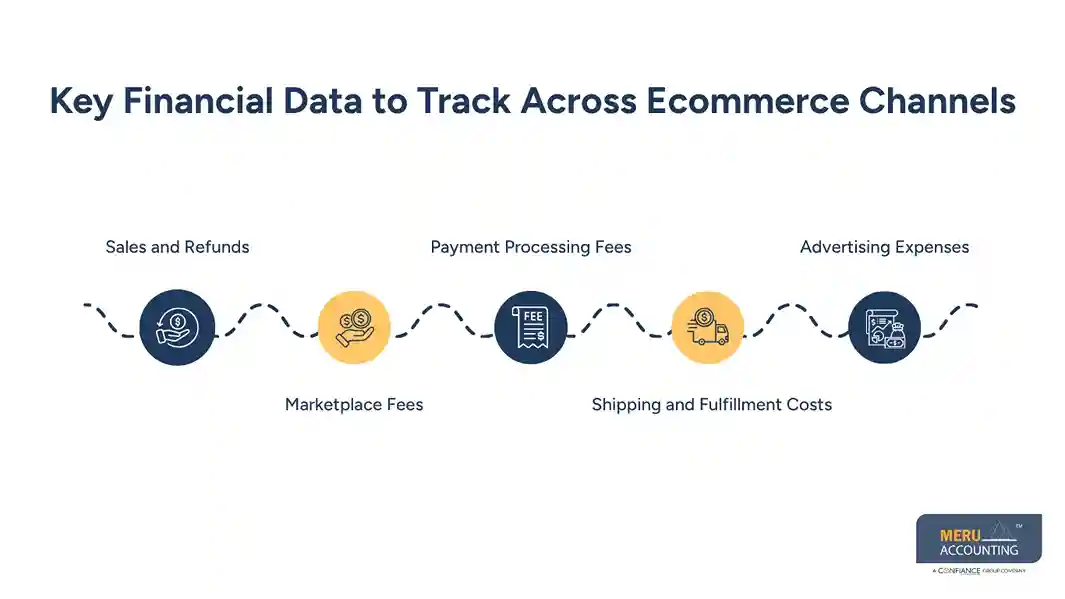
Key Financial Data to Track Across Ecommerce Channels
Sales and Refunds
Sales show what customers bought, but refunds can change the final result later. A seller may make strong sales in one month and see part of that amount reversed in the next month.
Keeping sales and refunds visible gives an ecommerce tax accountant a better way to review changes in revenue.
Marketplace Fees
Marketplace fees can take several forms. They may include selling fees, referral fees, transaction fees, listing charges, or other platform costs.
These deductions should not disappear inside the payout. Keeping them separate shows how much each channel costs to run.
Payment Processing Fees
Payment processing costs are not always the same as marketplace fees. A Shopify store, for example, may have payment charges linked to its payment provider, while another channel may include payment costs within its marketplace statement.
A tax accountant for online sellers should identify the source before placing the charge in the accounts.
Shipping and Fulfillment Costs
Shipping data can be easy to misread. Customer shipping income, shipping labels, warehouse fees, and fulfillment charges are not the same thing.
Tracking them apart gives the ecommerce tax accountant a clearer view of the cost of getting each order to the customer.
Advertising Expenses
Advertising can sit outside the main sales report. A seller might spend money on Amazon Ads, Etsy Ads, Google Ads, or social media campaigns while the related sales appear in another report.
The ad cost should be tied to the right channel and period so the seller can see the real cost of generating those sales.
How Marketplace Payouts Affect Ecommerce Financial Reporting
The Bank Shows the Final Amount
The bank usually shows what was paid after deductions. It does not explain every step behind the deposit.
For example, $18,000 in sales could become a $14,900 payout after refunds and platform costs. Recording only $14,900 as sales would hide part of the financial activity.
Sales and Payouts Can Fall in Different Months
A customer may place an order on the last day of a month, while the platform sends the related funds several days later.
This can create a gap between sales for September and cash received in October. An ecommerce tax accountant needs to check the dates instead of treating the timing gap as an error.
Holds Can Delay Cash
Some platforms may hold part of a seller’s funds before releasing them. eBay, for example, shows available, processing, and held funds in its payment system.
The amount shown in the platform account may therefore differ from both the bank balance and the sales report.
One Payout Can Contain Many Transactions
A single payout can cover a large number of orders. This is why matching a bank deposit to one order is not enough for a busy store.
The payout ID, settlement date, transaction data, and deductions give the tax accountant for online sellers a better trail to follow.
Adjustments Can Change the Final Amount
Refunds are not the only reason for a difference. Disputes, fee changes, credits, shipping charges, and other adjustments can also change the payout.
When the amount does not match, the ecommerce tax accountant should find the exact adjustment rather than force the difference into a general expense account.
How An Ecommerce Tax Accountant Reconciles Multi-Channel Sales
Start With Each Channel
The first step is to keep Amazon, Shopify, eBay, Walmart, and Etsy data apart. Each platform has its own report names, dates, and payment flow. Mixing the files at the start can make a small difference much harder for an ecommerce tax accountant to trace later.
Match Sales to Payouts
Next, the sales and payout data are compared. The aim is to explain how gross sales became the amount actually paid.
This gives the ecommerce tax accountant a full trail from the customer order to the bank deposit.
Separate Revenue and Costs
Gross sales should remain visible. Refunds, marketplace fees, payment costs, advertising, and other expenses should be recorded separately where appropriate.
This prevents a net payout from being mistaken for the actual revenue figure.
Check Bank Activity
The bank statement is then used by an ecommerce tax accountant to confirm the cash movement. If the platform says $8,450 was paid, but only $8,200 appears in the bank, the difference needs to be traced.
It may be a timing issue, a bank charge, a split payout, or another adjustment.
Review Unmatched Amounts
Not every difference means the records are wrong. Some are caused by timing or platform rules.
A tax accountant for online sellers can list unmatched items, identify the cause, and clear them before the reporting period is closed.
optional anymore
on running the business
Common Financial Reporting Mistakes In Multi-Channel Ecommerce
Treating Payouts as Sales
This makes the books look simple but removes useful detail. Fees and refunds can disappear inside the net amount.
The result may be lower reported sales and less visibility into the cost of each channel for an ecommerce tax accountant reviewing the records.
Mixing Channel Data
A seller may have Amazon sales, Shopify sales, and Etsy sales in one accounting feed. Without channel tags, it becomes hard to tell which platform caused a change in revenue or fees.
An ecommerce tax accountant should keep the source clear during the reconciliation process.
Recording the Same Fee Twice
A fee can be picked up from a marketplace report and then entered again from a bank transaction.
This creates an expense that never actually occurred twice. Comparing the source report with the bank feed can prevent the duplicate.
Missing Late Refunds
A refund may appear after the original sale was recorded. If it is not linked to the original transaction, the next period can show an unexplained reduction.
This is especially important for stores with high return rates.
Using Only Bank Data
Bank data shows cash movement, not the full story behind each ecommerce transaction.
A tax accountant for online sellers needs the marketplace or payment reports as well when preparing a complete financial picture.
Best Practices for Accurate Ecommerce Financial Reporting
Keep a Channel-Based Record
Use a clear structure for each marketplace. Sales, refunds, fees, ads, shipping, and payouts should be easy to trace back to their source.
This gives the ecommerce tax accountant a clear route when checking a difference.
Reconcile on a Set Schedule
Monthly checks are often more useful than one large review at year-end. Errors found soon after they occur are easier to trace.
High-volume stores may need more frequent checks based on their transaction volume.
Save Source Reports
Keep the reports used to create the accounting entries. Amazon settlement files, Shopify payment reports, eBay payout data, Walmart payment reports, and Etsy statements can serve as useful source records.
Keep Fees Easy to See
Do not hide every platform cost in one broad account if the business needs channel-level analysis. Separate fees can show where selling costs are rising.
This also gives a tax accountant for online sellers better data for review.
Check Large Differences First
A $5 difference and a $5,000 difference do not need the same review. Start with large unmatched payouts, unusual refunds, new fee types, and sudden changes in channel costs so an ecommerce tax accountant can focus on the items most likely to affect the financial review.
How Meru Accounting Handles Ecommerce Financial Reporting
Multi-Channel Sales Review
Meru Accounting reviews sales data from each ecommerce channel separately before bringing the figures into the main accounts. This keeps Amazon, Shopify, eBay, Walmart Marketplace, and Etsy activity easier to trace.
Payout and Bank Matching
An ecommerce tax accountant compares marketplace payouts with bank deposits to find the transactions behind each payment. Fees, refunds, and other deductions are reviewed rather than treating the net payout as total sales.
Channel-Wise Expense Tracking
Meru Accounting keeps key costs such as marketplace fees, payment charges, shipping, fulfillment, and advertising visible in the financial data. This gives sellers a clearer view of what each channel costs.
Tax-Ready Financial Records
An ecommerce tax accountant reviews sales and expense data with tax reporting needs in mind. Source reports, payout records, bank activity, and adjustments can be kept together so the figures have a clear trail.
Review of Reporting Differences
Different platforms can use different report formats and payout dates. We review these differences before preparing financial reports, reducing the chance of treating unlike transactions as if they were the same.
Our Expert Perspective
The main issue in multi-channel ecommerce is not usually the lack of data. It is the fact that the same business event can appear in several reports in different forms.
A sale may first appear as an order, then as a payment, later as a marketplace settlement, and finally as a bank deposit. A fee or refund may appear at another point in that chain. Looking at only one report can therefore give an incomplete view.
From our perspective, an ecommerce tax accountant should trace the movement from sale to payout rather than start and end with the bank statement. This approach makes it easier to explain differences and keep revenue, refunds, and costs in the right place.
For sellers using several channels, that clear trail matters even more. It gives the tax accountant for online sellers a better base for checking financial reports and preparing the data needed for tax work.
Key Takeaways
- Amazon, Shopify, eBay, Walmart Marketplace, and Etsy use different reporting and payout structures.
- An ecommerce tax accountant should not treat a marketplace payout as gross sales without reviewing the underlying transactions.
- Sales, refunds, fees, shipping, fulfillment, and advertising should be tracked with clear labels.
- Sales and bank deposits can fall in different accounting periods.
- Holds and adjustments can change the amount sent to the bank.
- Each payout should be matched with the source transactions behind it.
- An ecommerce tax accountant should review platform reports along with bank activity.
- Clear channel records make multi-channel financial reporting easier to check.
FAQs
Ecommerce financial reporting tracks sales, refunds, fees, payouts, expenses, and other financial activity across online sales channels.
Amazon mainly uses settlement-based reporting, while Shopify separates store sales data from payment and payout activity.
Ecommerce revenue can differ from payouts because platforms may deduct fees, refunds, shipping costs, advertising charges, or other adjustments.
An ecommerce tax accountant matches each payout with the related sales, refunds, fees, adjustments, and bank deposit.
A tax accountant for online sellers should track sales, refunds, marketplace fees, payment costs, shipping, advertising, settlements, and bank deposits.
optional anymore
on running the business