A production line runs late, two workers swap shifts, and an operator stays back to finish an urgent order. By payday, those small changes can turn into a payroll problem if the hours, rates, and approvals do not match. Payroll solutions for manufacturing must account for such daily changes while keeping wage records accurate and labor costs clear.
The right system should do more than issue pay slips. It should give factory owners a clear view of overtime costs, work hours, and payroll spending across teams and sites. While some firms manage payroll in-house, others choose Outsourced Payroll for Manufacturers to reduce routine admin work. The best option depends on how the factory runs, not just the software price.
What You Will Learn From This Blog
- Why payroll solutions for manufacturing need features beyond basic wage processing.
- Which payroll features matter most for factory staff and shift teams.
- How ADP Workforce Now, Paychex Flex, Paylocity, Paycor, Rippling, and Gusto compare.
- What to check when comparing software fees and total payroll costs.
- When outsourced payroll for manufacturers may suit your business.
- How Meru Accounting provides payroll and accounting services for business needs.
Why Manufacturing Payroll Requires Specialized Solutions
Different Shifts and Pay Rates
Factory staff may work day, night, weekend, or rotating shifts. Payroll solutions for manufacturing must record each shift and apply the correct pay rate or shift premium based on company policy.
Overtime and Extra Hours
Production targets may lead to extra hours during busy periods. Payroll solutions for manufacturing should use approved time records and apply the right overtime rules for each worker.
Hourly and Salaried Staff
A factory may employ machine operators, engineers, supervisors, office staff, and contract workers. The payroll setup must reflect each worker’s pay terms and classification.
Labor Costs Across Production Lines
Managers need to know how much labor each team, site, or production line uses. Payroll solutions for manufacturing should provide reports that show wages, overtime, and other labor costs by cost code.
Tax and Record Rules
US manufacturers must follow the federal, state, and local payroll tax rules that apply to their staff. Outsourced payroll for manufacturers can include tax calculations, payroll records, and filing services, depending on the provider’s scope of work.
Key Payroll Challenges in the Manufacturing Industry
Incorrect Time Records
Missed clock-ins, duplicate entries, and unapproved hours can lead to wrong pay. Payroll solutions for manufacturing should link time records with payroll and keep a record of changes and approvals.
Overtime Errors
Overtime rules depend on the worker’s status, hours worked, and applicable law. A system must use the right settings, and payroll staff must review unusual hours before each pay run.
Last-Minute Staff Changes
New hires, resignations, absences, and shift swaps can change payroll data close to payday. A clear process for sending and approving changes can reduce delays and repeat work.
Multiple Factory Sites
Manufacturers with plants in more than one state may face different tax and reporting duties. Payroll solutions for manufacturing should keep each site’s data and tax setup clear.
Poor Labor Cost Reports
A single wage total cannot show which shift or production line uses the most labor. Reports by team, job, and site give managers better information for budget reviews.
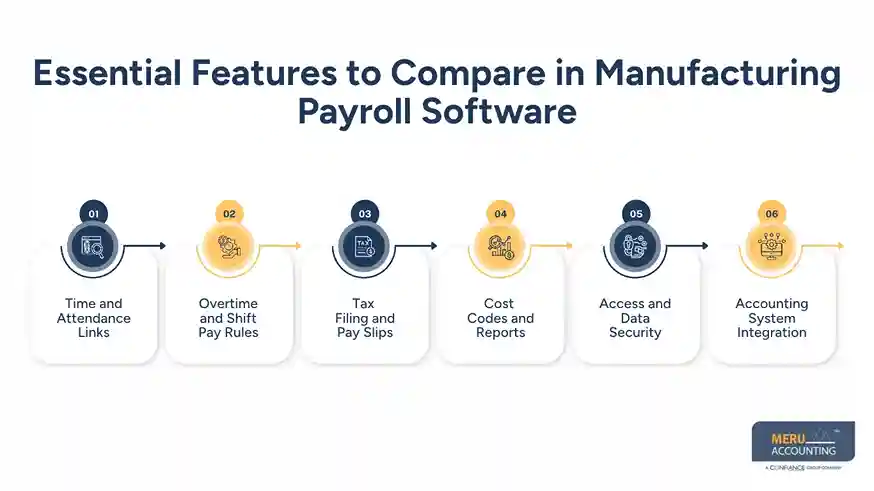
Essential Features to Compare in Manufacturing Payroll Software
Time and Attendance Links
Check whether the software connects with time clocks, digital timesheets, or shift tools. Payroll solutions for manufacturing should move approved hours into payroll without repeated manual entry.
Overtime and Shift Pay Rules
The system should allow different pay rates, extra pay types, and multiple pay schedules. Test real factory examples before choosing a plan.
Tax Filing and Pay Slips
Check which tax calculations, filings, payments, and year-end forms are included. Payroll solutions for manufacturing should make these tasks clear, while employers must still review records and legal duties.
Cost Codes and Reports
Look for reports by site, team, job, and labor type. These reports show where overtime costs rise and whether labor spend matches the factory budget.
Access and Data Security
Payroll records contain private pay and tax details. Choose role-based access, secure logins, audit records, and clear rules for data storage and access removal.
Accounting System Integration
Payroll entries should flow into the general ledger with the right wage, tax, and benefit codes. Payroll solutions for manufacturing with accounting links can reduce duplicate entry and make month-end checks easier.
Best Payroll Providers for Manufacturing Businesses Compared
ADP Workforce Now
ADP Workforce Now offers payroll, tax services, HR tools, reports, and links to general ledger systems. Writing
Manufacturers comparing outsourced payroll for manufacturers should assess ADP’s service scope, multi-site capabilities, and reporting options against their operational needs. Ask for a quote based on your staff count and required services.
Paychex Flex
Paychex Flex offers payroll services with options for HR and workforce management. It may suit firms that want payroll processing and extra business services from one provider. Test its shift and overtime features before making a choice.
Paylocity
Paylocity combines payroll with HR and workforce tools, including time tracking, attendance, reports, and custom workflows. It may suit manufacturers that want staff data and payroll in one system. Ask which features are included in the quote.
Paycor
Paycor provides payroll and HR tools, with options for time and attendance management. Manufacturers should review its ability to handle shift rules, overtime approvals, labor reports, and accounting links. Request a live demonstration using a real pay period.
Rippling
Rippling connects payroll with HR and other business systems. It offers tax filing features, custom pay types, pay-run comparisons, and accounting integrations. Its total price depends on the modules selected, so check the full cost before signing.
Gusto
Gusto offers payroll solutions for manufacturing, including tax filing, employee self-service, time tracking, and workforce reports. It may fit smaller manufacturers with simpler pay rules. Check whether the selected plan covers multi-state payroll, factory time records, and the reports you need.
optional anymore
on running the business
Best Payroll Solutions for Manufacturing Businesses
Best for Mid-Sized and Larger Firms
Among the available payroll solutions for manufacturing, ADP Workforce Now is worth considering when payroll needs include several sites, detailed reports, and broader HR tasks. Compare its cost and service level with the time your team spends on payroll today.
Best for Payroll and HR Services
Paychex Flex and Paycor are options for firms that want payroll alongside HR and staff management features. The best fit depends on the tools included in the quote and the level of service provided.
Best for Connected Business Systems
Rippling is worth a look when a company wants payroll data linked with HR and other apps. Check the price of every module you need rather than judging the service on its starting price alone.
Best for Workforce Management
Paylocity is a good option when time tracking, staff schedules, and payroll reports matter to plant managers. Test its workflow against your shift patterns and approval rules.
Best for Smaller Manufacturers
Gusto may suit a small factory with one main site and simpler pay rules. Businesses with complex shift terms or several locations should test their needs before choosing a plan.
Best Way to Compare Providers
Use the same test cases for every provider: a new hire, a shift change, overtime, a missed clock-in, and a pay correction. The best payroll solutions for manufacturing should pass these tests with clear records and reliable reports.
Payroll Solutions for Manufacturing: Pricing and Total Cost Comparison
Base Subscription Fees
Some providers publish plan prices, while others prepare custom quotes. Gusto lists starting prices on its official pricing page, while Rippling uses a modular pricing model. Payroll solutions for manufacturing should be compared on the cost of the features your factory needs, not just the advertised starting fee.
Employee-Based Fees
A per-worker charge may rise as the factory hires more staff. Ask whether seasonal workers, temporary staff, and inactive employees count toward the monthly bill.
Setup and Data Transfer
Initial setup may include moving employee records, setting tax details, building pay codes, and linking time clocks. Check whether these tasks are included or charged separately.
Extra Modules and Services
Time tracking, HR tools, advanced reports, and extra tax services may cost more. Ask for a full price list before choosing outsourced payroll for manufacturers or a software plan.
Cost of Payroll Errors
A low monthly fee may not be the cheapest option if errors take hours to fix. Compare software fees with staff time, correction work, training, and the cost of missed deadlines.
Compare the Full Annual Cost
Request a quote for your employee count and required features. Compare annual fees, contract terms, renewal rules, service costs, and exit charges before choosing a provider.
In-House Payroll vs. Outsourced Payroll for Manufacturers
Comparison factor | In-house payroll | Outsourced Payroll for Manufacturers |
Cost and staff time | Requires staff, training, and software costs. | Reduces internal workload through external payroll services. |
Control over payroll | Gives direct control over payroll tasks and changes. | Requires clear approval rules and data access controls. |
Tax filing and compliance | The internal team manages tax filings and records. | The provider handles agreed tax tasks under the service contract. |
Handling staff changes | The internal team updates employee and shift records. | The company sends approved staff changes to the provider. |
When to choose | Suits small teams with simple payroll needs. | Suits manufacturers with complex shifts or limited staff. |
Service agreement | Sets internal rules for payroll tasks and approvals. | Defines fees, deadlines, duties, and error handling. |
Meru Accounting’s Services for Manufacturing Payroll
Payroll Processing and Records
Meru Accounting provides payroll services for businesses that need clear wage records and an organized pay process. Our team can work with approved payroll data and agreed procedures to keep employee pay records in order.
Payroll Cost Tracking
Effective payroll solutions for manufacturing maintain clear records of wages, overtime, and other labor costs. Meru Accounting provides accounting and reporting services that bring payroll costs into a clearer view of business spending.
Payroll and Accounting Coordination
Payroll entries must match the wage and tax accounts in the general ledger. Our accounting services can keep payroll-related entries organized for account checks and monthly reports.
Flexible Service Scope
Each factory has its own payroll rules, staff size, and reporting needs. Meru Accounting can discuss the required service scope, available records, approval steps, and reporting schedule before work begins.
Clear Roles and Review Steps
Employers should retain control over approved work hours, pay changes, and final payroll authorization. Our service scope can define who checks the records, who approves pay, and how errors or missing details are reported.
Our Expert Perspective
A factory rarely needs more payroll features just for the sake of having them. It needs a process that can handle shift changes, approved overtime, and pay corrections without confusion. Before buying software or choosing Outsourced Payroll for Manufacturers, list the errors that occur most often and test each provider against those cases. Meru Accounting recommends comparing the service against real factory needs rather than choosing on price or brand name alone.
Key Takeaways
- Choose payroll solutions for manufacturing that match shift patterns, overtime rules, and pay schedules.
- Test time clock links, tax features, accounting links, and labor reports before signing a contract.
- Compare ADP Workforce Now, Paychex Flex, Paylocity, Paycor, Rippling, and Gusto using the same factory payroll cases.
- Check base fees, per-worker charges, setup costs, extra modules, and contract terms.
- Consider outsourced payroll for manufacturers when internal staff lack the time or skills to manage complex payroll tasks.
- Set clear rules for time approval, payroll review, tax duties, and employee data access.
- Review Meru Accounting’s payroll and accounting services against your factory’s needs before deciding on a service model.
FAQs
ADP Workforce Now, Paychex Flex, Paylocity, Paycor, Rippling, and Gusto are payroll options for manufacturers, based on business size, shift needs, and budget.
Payroll costs depend on employee count, software features, tax services, setup fees, and whether the manufacturer manages payroll in-house or outsources it.
ADP Workforce Now, Paylocity, Paycor, and Paychex Flex are options to assess for shift tracking, overtime rules, time records, and workforce reporting.
Manufacturing payroll software should offer time tracking, overtime calculations, shift pay rules, tax filing, labor cost reports, data security, and accounting integration.
Outsourced payroll for manufacturers can suit businesses that want external payroll processing, tax services, and record management while keeping control of pay approvals.
optional anymore
on running the business