A business can close its accounts on time and still face an IRS penalty because it filed the wrong return or missed a payment date. The problem often starts when owners assume that every business follows the same tax calendar. In the US, a C corporation, S corporation, partnership, and LLC may have different filing duties, even when they operate in the same industry. The corporate tax deadline in 2026 is especially important for businesses filing their 2025 tax returns.
Some returns are due in March, while others are due in April. Estimated tax payments also follow a separate schedule, so meeting the annual filing date does not settle every tax duty.
The key is to know which form applies, when it must reach the IRS, and how corporate tax preparation services can ensure records are ready before filing. This blog covers the 2026 dates, required forms, payment rules, and CPA checks that businesses should follow to avoid common filing errors.
What You Will Learn From This Blog
- Entity-wise corporate tax deadline dates for 2026.
- IRS forms used by corporations, partnerships, LLCs, and sole proprietors.
- Quarterly estimated tax payment dates and penalty rules.
- Financial records to collect before preparing a tax return.
- CPA checks for deductions, payroll, account balances, and tax payments.
- Common filing errors and ways to avoid them.
2026 Corporate Tax Deadline Calendar: Entity-Wise Filing Dates
The first step is to identify the federal tax status of the business. Its legal name alone does not determine the return or due date. The following corporate tax deadline calendar covers common calendar-year businesses filing for 2025
C Corporation Tax Deadline 2026 – Form 1120
A calendar-year C corporation must file Form 1120 by April 15, 2026. The return reports its 2025 income, expenses, deductions, credits, and tax due. Any unpaid tax must also be paid by the original due date.
A corporation that needs more time can submit Form 7004. The extension generally gives six additional months to file, but it does not move the payment date.
S Corporation Tax Deadline 2026 – Form 1120-S
Calendar-year S corporations must meet the corporate tax deadline by filing Form 1120-S on March 16, 2026, as March 15 falls on a Sunday. The company must also prepare Schedule K-1 forms for its shareholders.
These forms show each owner’s share of income, deductions, and credits. Filing on time gives shareholders the figures they need for their personal tax returns.
Partnership Tax Deadline 2026 – Form 1065
A calendar-year partnership must file Form 1065 by March 16, 2026. The return reports business income, gains, losses, and deductions. Each partner receives a Schedule K-1 showing their share of the results.
Partnerships can request an extension through Form 7004. However, an extension does not remove the need to provide accurate tax details to partners.
LLC Tax Filing Deadlines Based on Federal Tax Classification
An LLC does not have one fixed federal filing date. A single-member LLC treated as a disregarded entity generally reports business income on Schedule C with Form 1040, due April 15, 2026.
A multi-member LLC usually files as a partnership unless it elects another tax status. An LLC taxed as a corporation follows the relevant corporate return date. Owners should check their IRS classification before planning the filing.
Sole Proprietorship Tax Deadline 2026 – Schedule C
A sole proprietor reports business income and expenses on Schedule C with Form 1040. For the 2025 tax year, the return is generally due April 15, 2026.
The owner must also review self-employment tax and estimated payment duties. A registered business name does not turn a sole proprietorship into a corporation for federal tax purposes.
Fiscal-Year Corporation Filing Deadlines
A corporation with a fiscal year generally files by the 15th day of the fourth month after its tax year ends. For example, a September 30 year-end C corporation generally has a January 15, 2026, filing date.
S corporations and partnerships generally file by the 15th day of the third month after year-end. The corporate tax deadline must therefore be worked out from the entity’s actual tax year.
Essential IRS Tax Forms for Corporate Tax Filing in 2026
Using the wrong form can delay a return or lead to incorrect tax reporting. Knowing which forms apply to their business structure is an important part of corporate tax preparation services and meeting the filing deadline.
Form 1120 – U.S. Corporation Income Tax Return
C corporations use Form 1120 to report income, expenses, deductions, credits, and federal income tax. The figures should match the company’s final accounting reports.
Form 1120-S – U.S. Income Tax Return for an S Corporation
S corporations use Form 1120-S to report business results passed through to shareholders. The return must include accurate ownership details and the required tax schedules.
Form 1065 – U.S. Return of Partnership Income
Partnerships file Form 1065 to report their financial and tax results. Its figures must agree with the income and deduction details reported on partner K-1 forms.
Form 7004 – Application for Automatic Extension of Time to File
Businesses use Form 7004 to request an automatic extension for eligible business returns. They must submit the form by the applicable corporate tax deadline and pay their estimated tax by the original due date.
Schedule K-1 – Partner and Shareholder Income Reporting
Schedule K-1 reports each owner’s share of business income, deductions, and credits. Incorrect ownership or allocation details can affect both the business return and the owner’s tax return.
Form 2220 – Underpayment of Estimated Tax by Corporations
Corporations use Form 2220 to check whether they owe a penalty for underpaid estimated tax. The form compares required installments with actual payments and dates before the corporate tax deadline.
optional anymore
on running the business
Corporate Estimated Tax Payment Deadlines for 2026
The annual return is not the only date a business must track. Corporate tax preparation services account for installment payments that corporations must make during the year based on expected income.
Quarterly Estimated Tax Payment Schedule for C Corporations
A calendar-year C corporation must follow four installment dates under the 2026 corporate tax deadline schedule:
- April 15, 2026 – First payment.
- June 15, 2026 – Second payment.
- September 15, 2026 – Third payment.
- December 15, 2026 – Fourth payment.
Estimated Tax Requirements for S Corporations and Other Entities
S corporations generally pass taxable income to shareholders, who may need to make personal estimated tax payments. Partnerships and sole proprietors also need to review their owners’ estimated tax duties.
IRS Rules for Underpayment and Late Payment Penalties
The IRS may charge an underpayment penalty when required installments are late or too low. Interest may also apply to unpaid tax, so paying the full balance with the annual return may not remove earlier charges.
How to Calculate and Schedule Corporate Estimated Tax Payments
To stay on track with the corporate tax deadline, estimate annual taxable income, review applicable IRS payment rules, and compare expected tax with prior-year figures where relevant. A CPA should also account for income changes, tax credits, and payments already made.
Corporate tax preparation services can include a review of payment records and unpaid balances before each installment date.
Documents and Financial Records Required Before the Corporate Tax Deadline
A return is only as reliable as the records behind it. Collecting these documents early can reduce delays during CPA review.
Income Statements, Balance Sheets, and General Ledger Reports
Prepare final income statements, balance sheets, and general ledger reports. Check that all reports cover the correct tax year, include year-end adjustments, and are ready before the corporate tax deadline.
Business Expense Receipts and Deductible Expense Records
Keep invoices, receipts, bank statements, and proof of business payments for corporate tax preparation services. Separate personal spending from business costs and retain records of the purpose of each expense.
Payroll Records, Employee Tax Forms, and Contractor Payments
Collect payroll reports, Forms W-2, Forms 941, tax deposit records, and contractor payment details. Compare reported totals with the accounting ledger before filing.
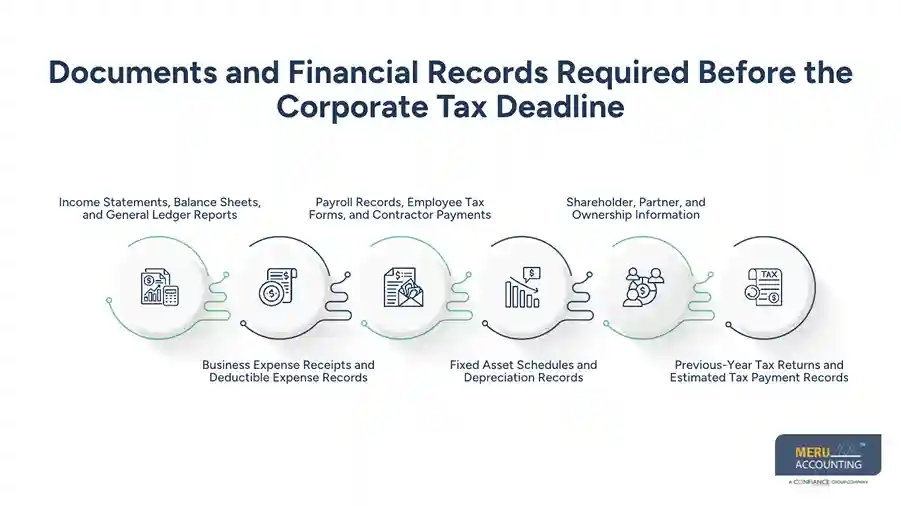
Fixed Asset Schedules and Depreciation Records
List business equipment, vehicles, furniture, and other assets with their cost and purchase date. Include depreciation details, asset sales, and disposals.
Shareholder, Partner, and Ownership Information
Prepare ownership percentages, capital contributions, distributions, and changes in ownership. These details are needed to report income correctly on K-1 forms before the corporate tax deadline.
Previous-Year Tax Returns and Estimated Tax Payment Records
Keep prior-year returns, IRS notices, payment confirmations, and tax carryover details. These records give the CPA a starting point for checking the current return.
Essential CPA Tips to Prepare for the 2026 Corporate Tax Deadline
A good CPA review should focus on areas where errors are most likely to occur. These checks should be completed before the return is sent to the IRS.
Reconcile Bank Accounts, Credit Cards, and Business Transactions
Match bank and card statements with accounting entries before the corporate tax deadline. Check missing deposits, duplicate charges, uncleared payments, and unusual transfers.
Review Financial Statements and Correct Reporting Discrepancies
Compare the balance sheet and income statement with the general ledger. Investigate old balances, incorrect entries, and differences in reported revenue or expenses.
Verify Eligible Business Deductions, Tax Credits, and Depreciation
Review expenses under current IRS rules and confirm that each claimed deduction has proper documentation. Check asset costs and depreciation before finalizing taxable income.
Reconcile Payroll Taxes and Contractor Payments
Compare payroll reports with Forms 941 and W-2, and review contractor payments against invoices and required information returns. Resolve differences before filing.
Review Estimated Tax Payments and Outstanding Liabilities
During corporate tax preparation services, check each installment date, payment amount, and confirmation number. Review unpaid balances and IRS notices before calculating the final amount due.
Verify IRS Tax Forms and Filing Deadlines Before Submission
Confirm the entity type, tax year, return form, identification numbers, and applicable corporate tax deadline. Review all schedules and retain the submission confirmation.
Common Corporate Tax Filing Mistakes That Lead to IRS Penalties
Small errors can create extra work and unexpected costs. These are the filing issues businesses should check before submission.
Missing Entity-Specific Filing Deadlines
Using April 15 for every business can cause a late return. Calendar-year S corporations and partnerships generally have a March 16, 2026, deadline.
Reporting Inaccurate Income or Business Expenses
Missing sales, duplicate costs, and personal expenses in business accounts can lead to incorrect tax figures. Match the return with source records before the corporate tax deadline.
Overlooking Estimated Tax Payment Obligations
Some businesses must pay tax in quarterly installments. Check the payment schedule instead of waiting until the annual return is due.
Filing Incorrect or Incomplete IRS Forms
A wrong return type or missing schedule can delay processing. Check the entity’s tax classification and current IRS instructions before submission.
Assuming an Extension Delays Tax Payments
Form 7004 extends the filing period beyond the corporate tax deadline, not the payment period. Pay the expected tax by the original due date to avoid extra charges.
Failing to Distribute Schedule K-1 Forms on Time
Partnerships and S corporations must provide K-1 information to owners by the applicable due date. Check names, ownership shares, and reported amounts before issuing each form.
Meru Accounting Services for Corporate Tax Preparation
Tax filing starts with clean financial records, not just the final tax form. Missing invoices, unreconciled accounts, or incorrect payroll entries can delay CPA reviews and affect the figures reported to the IRS.
Meru Accounting provides accounting and bookkeeping services, including general ledger management, bank reconciliation, payroll accounting, accounts payable, accounts receivable, and financial reporting. These services give businesses an organized record set before the corporate tax deadline.
Businesses can include corporate tax preparation services in their year-end accounting plan to review financial data, check outstanding entries, and prepare records for tax professionals. Meru Accounting’s accounting services are designed to meet the financial record and reporting needs of businesses across different industries.
Our Expert Perspective
One issue that often goes unnoticed during tax season is the gap between the date a business closes its accounts and the date its records are ready for tax review. A company may finish its year-end reports but still have missing expense proofs, open payroll entries, or unclear owner transactions.
Our recommendation for businesses using corporate tax preparation services is to set an internal closing date four to six weeks before the filing deadline. This gives the finance team enough time to check reports, resolve missing entries, and review estimated payments with a CPA. A fixed review schedule can also reduce last-minute filing pressure and keep financial records ready well before the next corporate tax deadline.
Key Takeaways
- C corporations generally file Form 1120 by April 15, 2026.
- S corporations and partnerships generally file by March 16, 2026.
- LLC filing dates depend on their federal tax classification.
- Form 7004 extends filing time but not the tax payment date.
- C corporations generally make four estimated tax payments during 2026.
- Financial statements, payroll reports, receipts, and ownership records should be ready before filing.
- Corporate tax preparation services include reviewing deductions, tax credits, depreciation, and estimated payments before filing.
- Businesses should track every corporate tax deadline separately to avoid late filing and payment charges.
FAQs
Calendar-year C corporations must file Form 1120 by April 15, 2026, for the 2025 tax year. Any outstanding federal income tax must also be paid by this date.
S corporations filing Form 1120-S and partnerships filing Form 1065 must submit their returns by March 16, 2026. Both entity types must also provide the required Schedule K-1 forms to their owners.
Businesses using corporate tax preparation services can coordinate Form 7004 filing to secure an automatic six-month extension for eligible returns, provided they submit the form on time.
C corporations generally must pay estimated taxes by April 15, June 15, September 15, and December 15, 2026. Late or insufficient payments may result in IRS penalties and interest.
Businesses should prepare financial statements, general ledger reports, expense receipts, payroll records, depreciation schedules, ownership details, and previous tax returns. These records allow CPAs to review tax figures and complete the required IRS forms accurately.
optional anymore
on running the business