When homeowners question a rise in monthly dues or ask why the HOA has so little money set aside for repairs, the board needs more than a budget sheet to explain its decisions. It needs financial records that can stand up to scrutiny. A CPA for HOA audit helps provide that confidence by taking an independent look at the association’s financial statements, transactions, and accounting practices.
An HOA audit is also a chance to look beyond the numbers and see how well the association manages homeowners’ money. It can reveal gaps in reporting, highlight weak financial controls, and give board members a clearer basis for decisions. Most importantly, it helps build trust by making the association’s financial position easier to understand and explain.
What You Will Learn From This Blog
- What a CPA does during a homeowners association audit.
- How an independent audit supports financial transparency.
- What HOA audit CPA services typically cover.
- How audit findings help board members make sound financial decisions.
- Common financial reporting issues found during HOA audits.
- How to prepare financial records for an HOA audit.
What Is a CPA for HOA Audit?
A CPA for HOA audit is a Certified Public Accountant who examines a homeowners association’s financial records and statements. The purpose is to provide an independent opinion on whether the financial statements are fairly presented under the applicable accounting framework.
HOA audits cover more than checking income and expenses. They may also involve reviewing bank accounts, assessment collections, vendor payments, reserve funds, and financial controls. The CPA gathers evidence to support the audit opinion and reports any issues that need the board’s attention.
Role of a CPA in Homeowners Association Audits
A CPA reviews the association’s financial activity to check whether transactions are recorded and reported correctly. This may include:
- Checking assessment income against homeowner account records.
- Reviewing expenses and supporting invoices.
- Examining bank statements and account reconciliations.
- Reviewing reserve fund balances and related activity.
- Testing selected transactions for proper approval.
- Assessing how financial records are maintained.
The CPA does not take over the HOA’s accounting work or make financial decisions for the board. Instead, the audit provides an independent view of the association’s financial reporting.
Difference Between an HOA Audit, Review, and Compilation
HOA boards should understand the difference between these three services before hiring an accounting firm.
Service | What It Involves | Level of Assurance |
Audit | Examines financial statements and supporting evidence through audit procedures. | Reasonable assurance |
Review | Uses inquiry and analytical procedures to assess financial statements. | Limited assurance |
Compilation | Helps present financial information in financial statement form without providing assurance. | No assurance |
An audit provides the highest level of assurance among these three services, but it does not guarantee that every error or fraud will be found.
When Does an HOA Need an Independent CPA?
An HOA may need an independent CPA when its governing documents, state laws, lender agreements, or other requirements call for an audit or financial review.
Even when an audit is not required, an association may choose one when it manages large reserve funds, handles complex transactions, faces concerns about financial controls, or wants an independent review of its financial position.
optional anymore
on running the business
How a CPA for HOA Audit Promotes Financial Transparency
Financial transparency means that homeowners and board members can understand how association funds are collected, spent, and reported. An independent audit supports this goal by examining the records behind the financial statements.
Here are some ways a CPA helps improve transparency.
1. Verifying Financial Statements and Account Balances
A CPA examines financial statements to check whether reported balances are supported by accounting records and other evidence. This can include reviewing the balance sheet, income statement, and cash flow information.
For example, if an HOA reports $250,000 in reserve funds, the CPA may examine bank records, investment statements, and related accounting entries to verify the reported amount.
This gives board members a more reliable view of the association’s financial position.
2. Reviewing HOA Income, Expenses, and Vendor Payments
HOAs collect money through monthly or annual assessments, special assessments, and other charges. They also pay for landscaping, repairs, insurance, utilities, security, and other shared services.
A CPA may test selected income and expense transactions to check whether they are recorded in the right accounts and supported by proper documents.
For example, if the association pays a contractor $8,000 for common-area repairs, the CPA may review the invoice, payment record, contract, and approval documents.
This helps the board understand where association money goes and whether financial records support the reported expenses.
3. Checking Reserve Fund Balances and Transactions
Reserve funds help HOAs pay for major repairs and future replacements, such as roof work, road repairs, elevators, and other shared assets.
A CPA reviews reserve fund activity to check whether contributions, withdrawals, and reported balances are properly recorded. The CPA may also compare reserve fund activity with supporting bank or investment records.
This is important because using reserve funds for routine expenses without proper approval or documentation can create problems for future projects.
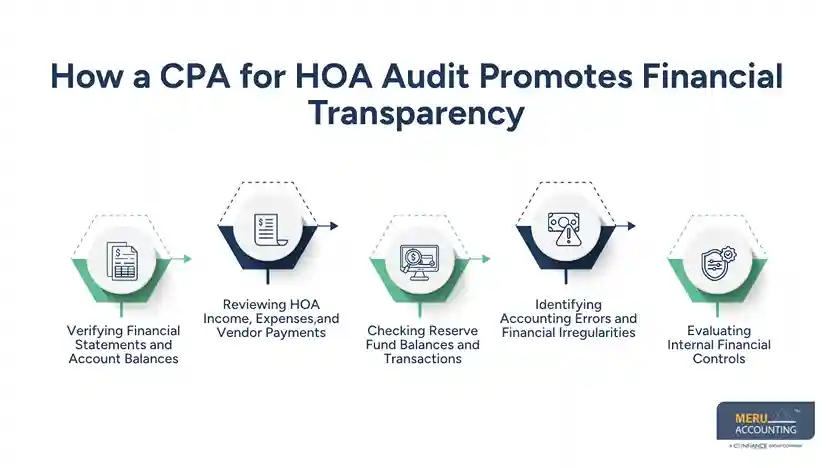
4. Identifying Accounting Errors and Financial Irregularities
Errors in financial records can affect budgets, reports, and decisions made by the board.
A CPA may identify issues such as duplicate payments, missing invoices, incorrect account entries, unreconciled balances, or expenses recorded in the wrong period.
These findings help the HOA correct its records and improve the way it handles financial transactions.
5. Evaluating Internal Financial Controls
Internal controls are the steps an HOA uses to protect its money and reduce the risk of errors or misuse.
A CPA may assess whether the association has clear procedures for approving payments, handling bank accounts, recording transactions, and reviewing financial reports.
For example, if one person can approve vendor payments, issue checks, and reconcile the same bank account, the association may have a weak separation of duties. The CPA can report this concern and suggest ways to improve oversight.
What Do HOA Audit CPA Services Typically Include?
HOA audit CPA services cover the procedures needed to examine an association’s financial statements and related records. The exact scope depends on the engagement, the association’s size, and its financial activity.
Common areas include:
Reviewing Balance Sheets and Income Statements
The CPA checks reported assets, liabilities, income, and expenses. This includes comparing account balances with supporting records and reviewing unusual changes from prior periods.
Examining Bank Reconciliations and Financial Records
Bank reconciliations help confirm that accounting records match bank activity. The CPA may examine bank statements, outstanding checks, deposits in transit, and other reconciling items.
Testing Assessment Collections and Delinquent Accounts
Homeowner assessments are a major source of HOA income. The CPA may review assessment records, payment entries, outstanding balances, and selected homeowner accounts.
This helps determine whether assessment income and receivables are reported correctly.
Reviewing Accounts Payable and Vendor Transactions
Vendor payments can make up a large part of an HOA’s operating expenses. The CPA may examine invoices, contracts, payment records, and approval documents to check whether expenses are properly supported and recorded.
Evaluating Reserve Fund Reporting
The CPA reviews reserve fund balances and related transactions to determine whether they are fairly reported in the financial statements.
This may include examining transfers, contributions, withdrawals, and investment records.
How HOA Audit Findings Help Board Members Make Better Financial Decisions
An audit is useful not only for checking past financial activity but also for helping the board understand areas that need attention.
The findings can support better decisions in several ways.
Understanding the association’s financial position: Audited financial statements give board members a more reliable view of assets, liabilities, income, and expenses. This helps them understand what the HOA owns, what it owes, and how much money is available.
Identifying budget gaps: If actual expenses are higher than budgeted amounts, the audit may help the board understand the financial impact and review its budgeting process.
Improving reserve planning: Reserve fund findings can help the board identify reporting issues and make better plans for future contributions. A separate reserve study may still be needed to estimate the cost and timing of major repairs.
Addressing financial risks: Audit findings may point to weak payment controls, incomplete records, or unusual transactions. The board can use this information to improve its financial procedures.
Building homeowner confidence: When the board can share reliable financial statements and explain audit findings, homeowners have a clearer view of how their assessments are being used.
Common Financial Transparency Issues a CPA Can Identify in an HOA
Even associations with regular bookkeeping may have gaps in their financial records. Some issues become clear only when an independent CPA examines the supporting documents.
Common Issue | How It Affects the HOA |
Incomplete financial records | Makes it harder to verify income and expenses. |
Unreconciled bank accounts | Can hide errors and leave cash balances unclear. |
Incorrect expense classification | Affects financial reports and budget comparisons. |
Weak payment approval processes | Increases the risk of unauthorized payments. |
Poor reserve fund tracking | Makes it harder to understand available reserve funds. |
Unrecorded homeowner payments | Can lead to incorrect assessment balances. |
Identifying these problems gives the board a chance to correct its records and improve internal controls. However, an audit is not designed to find every instance of fraud or every accounting error. Its procedures provide reasonable, not absolute, assurance.
How to Prepare Your HOA for a CPA Audit
Good preparation can help the audit move forward with fewer delays. It also makes it easier for the CPA to access the records needed to complete the work.
Here are some steps HOA board members and property managers can follow.
- Organize financial statements and general ledgers: Keep the balance sheet, income statement, trial balance, and general ledger ready for the audit period.
- Gather bank statements and reconciliation reports: Collect statements for operating accounts, reserve accounts, and investment accounts. Include monthly bank reconciliations.
- Prepare assessment and delinquency records: Provide homeowner account ledgers, assessment schedules, payment records, and outstanding balance reports.
- Collect vendor invoices and payment records: Keep contracts, invoices, receipts, check copies, and electronic payment details in an organized format.
- Provide board minutes and approval records: Share meeting minutes, budget approvals, special assessment decisions, and records of major financial transactions.
- Prepare reserve fund documents: Gather reserve account statements, transfer records, and any available reserve study.
- Assign a point of contact: Choose a board member, treasurer, or property manager who can answer questions and provide documents during the audit.
Having these records ready helps the CPA understand the association’s financial activity and reduces the time spent requesting missing information.
Meru Accounting’s HOA Audit CPA Services
A CPA can only work with the financial records and supporting documents available to them. Missing invoices, unreconciled bank accounts, poorly tracked assessments, or unclear reserve fund entries can make an HOA audit more difficult. That’s why good accounting practices between audits matter just as much as the audit itself.
Meru Accounting helps homeowners associations keep their financial records audit-ready through organized bookkeeping, account reconciliations, and detailed financial reporting. Our team understands the different records involved in HOA accounting, from homeowner assessments and vendor expenses to operating budgets and reserve fund transactions.
Our HOA accounting support includes:
- HOA Bookkeeping: Recording assessments, expenses, deposits, and other financial transactions.
- Bank and Reserve Fund Reconciliation: Matching account balances with bank statements and tracking reserve activity.
- Assessment and Receivables Management: Maintaining homeowner account records, tracking dues, and monitoring outstanding balances.
- Accounts Payable Management: Recording vendor bills, tracking payments, and maintaining invoice records.
- Financial Statement Preparation: Preparing balance sheets, income statements, and other financial reports for board review.
- Accounting Cleanup and Catch-Up: Correcting incomplete records, resolving unreconciled balances, and bringing overdue books up to date.
- Audit Preparation Support: Organizing ledgers, bank statements, invoices, and supporting documents for the independent CPA.
Whether your HOA needs ongoing accounting support or help getting its books ready for an upcoming audit, Meru Accounting can help keep its financial records accurate, organized, and easier to review. We can also coordinate with your existing CPA or audit firm to help provide the records they need.
Our Expert Insight
One detail HOA boards should never overlook is the treatment of special assessments. When an association collects extra money for a major repair, that income should be clearly tracked and reported based on its purpose. Mixing it with regular assessment income can make it harder for homeowners to see how much was collected for a specific project and how those funds were used.
We recommend paying close attention to special assessment records, project-related expenses, and any unused funds after a project is completed. This level of detail makes financial reports more meaningful and helps the board answer questions about large homeowner contributions. A transparent record of these transactions also gives the independent CPA a clearer basis for reviewing the association’s financial activity.
Key Takeaways
- A CPA for HOA audit provides an independent examination of an association’s financial statements.
- Audits help improve transparency by checking financial records, account balances, and selected transactions.
- HOA audit CPA services may cover assessment income, vendor payments, reserve funds, and internal controls.
- Audit findings help board members identify reporting issues and make better financial decisions.
- Organized records, regular reconciliations, and clear approval procedures make audit preparation easier.
- Consistent bookkeeping supports accurate financial reporting between annual audits.
FAQs
An HOA may need an audit due to state laws, governing documents, lender requirements, or a board decision. Financial concerns or complex transactions may also prompt an independent audit.
The HOA board typically approves and hires an independent CPA on behalf of the association.
No. A bookkeeper maintains financial records, while an independent CPA examines the financial statements and provides an audit opinion.
A qualified opinion means the CPA identified a specific issue that affects the financial statements. The board should review the findings and address the issue.
In many cases, yes. Access depends on state laws and the association’s governing documents, which may give homeowners the right to inspect financial records and audit reports.
optional anymore
on running the business