A property manager collects rent from 20 tenants across four buildings. Some tenants pay late, one requests a deposit refund, and another reports an $800 repair. At month-end, the bank balance looks fine, but the manager cannot identify which property earned the most or had the highest costs. This problem often starts with poorly arranged financial records.
A well-planned property management chart of accounts gives every transaction a suitable place, from rental income and tenant deposits to mortgage payments and building upgrades.
QuickBooks allows property managers to organize these accounts and connect them with financial statements. This article explains how to build a property management chart of accounts, customize QuickBooks accounts, and prepare accurate property-wise financial reports.
What You Will Learn From This Blog
- How to structure accounts for different rental activities.
- Which asset, liability, equity, income, and expense accounts to include in a property management chart of accounts.
- How to organize property-wise accounts in QuickBooks.
- How to map accounts to financial statements.
- How to avoid common account classification errors.
- How to use a property management chart of accounts to prepare property-level and consolidated financial reports.
Understanding the Property Management Chart of Accounts
A property management chart of accounts is a list of financial accounts used to record and group business transactions. For example, rent received belongs under rental income, while a refundable tenant deposit belongs under liabilities.
Purpose of the Chart of Accounts
It provides a clear structure for recording rent, vendor payments, loans, and property purchases. Each transaction gets a suitable account, making financial reviews easier.
Role of Account Numbers
Account numbers give each account a unique code. Businesses may use 1000 for assets, 2000 for liabilities, 3000 for equity, 4000 for rental income, and 5000 for rental property expenses when organizing a chart of accounts for rental properties.
Importance of Consistent Account Names
Names such as Property A – Rental Income and Property A – Repairs make transactions easier to identify. Avoid vague names that do not explain the purpose of an account.
Connection With Financial Statements
Account types decide where balances appear. Assets, liabilities, and equity appear on the balance sheet, while income and expenses appear on the profit and loss statement.
Role in Property-Level Accounting
The property management chart of accounts gives managers a way to compare rental income and operating costs across buildings. This shows which properties earn more and which have higher expenses.
Essential Account Categories for Property Management Businesses
A Chart of accounts for rental properties should cover five main account groups. Each group records a different type of financial activity.
Assets: Cash, Bank Accounts, Security Deposits, and Property Assets
Assets include business bank balances, rent receivable, land, buildings, and equipment. Long-term property assets must remain separate from daily operating costs.
Liabilities: Tenant Deposits, Loans, and Outstanding Expenses
A property management chart of accounts classifies refundable tenant deposits, mortgage balances, unpaid bills, and accrued expenses under liabilities. A refundable deposit is not earned rental income.
Equity: Owner Contributions and Retained Earnings
Owner contributions record funds invested in the business. Retained earnings show profits kept over time, while owner withdrawals reduce equity.
Income: Rental Income, Late Fees, and Property Management Fees
Income accounts may include monthly rent, parking charges, late fees, storage income, and management fees. Separate accounts show where revenue comes from.
Expenses: Maintenance, Repairs, Insurance, Utilities, and Management Costs
A property management chart of accounts includes expenses such as repairs, cleaning, insurance, property taxes, utilities, and management fees. Separate accounts make cost reviews more useful.
Chart of Accounts for Rental Properties: Recommended Account Structure
A Chart of accounts for rental properties should match the number of units, ownership structure, and type of rental activity. A small landlord may need fewer accounts than a firm managing several buildings.
Property-Wise Income and Expense Accounts
Track income and expenses for each property. This makes it easier to compare rent, repairs, and other costs without mixing financial results.
Tenant Security Deposits and Other Liability Accounts
Create a separate liability account for refundable deposits. For example, a $1,000 deposit received from a tenant must not be recorded as rental income.
Rental Property Operating Expenses
Create separate accounts for repairs, cleaning, landscaping, insurance, utilities, and property taxes. This shows where operating costs are increasing.
Capital Improvements and Depreciation Accounts
Routine repairs are generally recorded as expenses, while qualifying improvements may need to be recorded as fixed assets. Depreciation must follow applicable accounting and tax rules.
Sample Chart of Accounts for Multiple Rental Properties
The following sample shows a property management chart of accounts for a business with two rental properties.
Account No. | Account Name | Account Type |
1000 | Business Bank Account | Bank |
1100 | Rent Receivable | Accounts Receivable |
1200 | Building – Property A | Fixed Asset |
1210 | Building – Property B | Fixed Asset |
2000 | Tenant Security Deposits | Liability |
2100 | Mortgage Payable | Long-Term Liability |
3000 | Owner’s Equity | Equity |
4000 | Rental Income – Property A | Income |
4010 | Rental Income – Property B | Income |
5000 | Repairs and Maintenance | Expense |
5100 | Property Insurance | Expense |
5200 | Property Taxes | Expense |
5300 | Utilities | Expense |
The final account list should match the business’s ownership structure and reporting needs.
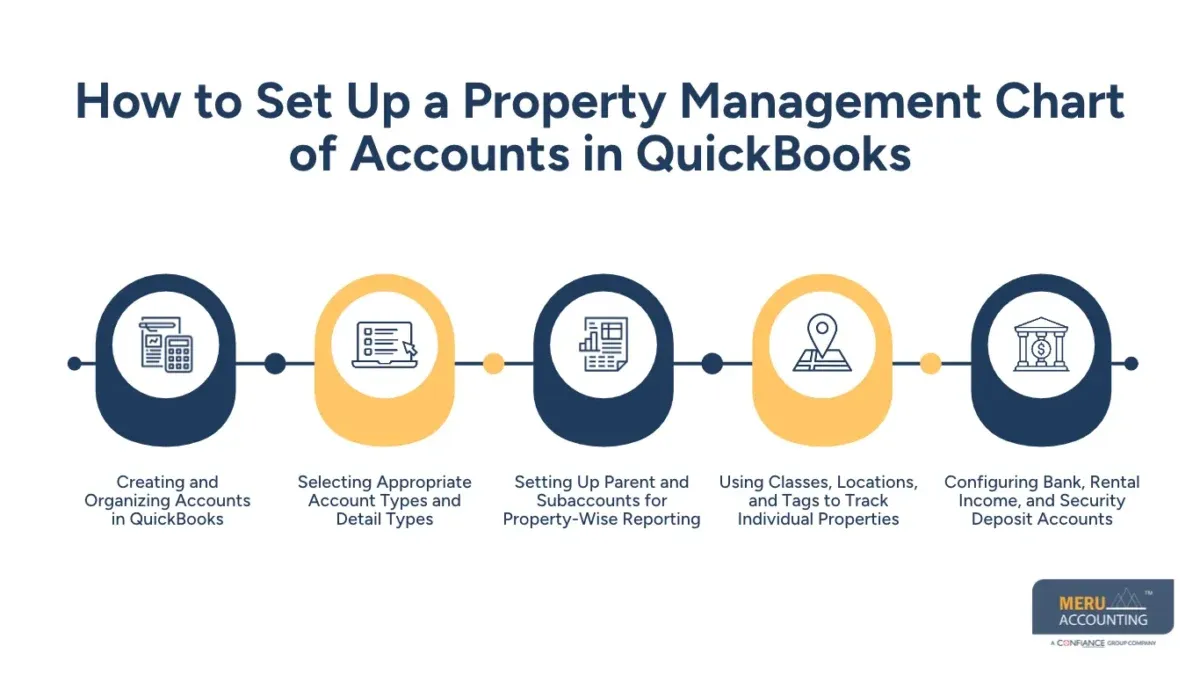
How to Set Up a Property Management Chart of Accounts in QuickBooks
Before setting up a chart of accounts for rental properties, decide whether reports must show results by building, unit, or business entity. This decision guides the QuickBooks setup.
Creating and Organizing Accounts in QuickBooks
Open the property management chart of accounts section in QuickBooks and select the option to create an account. Enter its name, number where applicable, and account type. Check for duplicate accounts before saving.
Selecting Appropriate Account Types and Detail Types
Choose the correct type, such as bank, fixed asset, liability, income, or expense. A mortgage balance should not be classified as an operating expense.
Setting Up Parent and Subaccounts for Property-Wise Reporting
Use parent accounts to organize the chart of accounts for rental properties and group related entries. For example, Rental Income can contain subaccounts for Property A and Property B. This keeps the account list organized.
Using Classes, Locations, and Tags to Track Individual Properties
QuickBooks tracking features for a property management chart of accounts depend on the product and plan. Classes or locations can identify property-level activity where available. Apply the selected method consistently.
Configuring Bank, Rental Income, and Security Deposit Accounts
Connect the correct bank accounts and create separate accounts for rent and tenant deposits. Reconcile bank balances regularly to check that recorded amounts match actual funds.
optional anymore
on running the business
Customizing QuickBooks Accounts for Financial Statement Mapping
Account creation is only one part of the process. A property management chart of accounts must also connect each account with the correct financial statement.
Mapping Chart of Accounts to the Balance Sheet
Map cash, receivables, buildings, and equipment to assets. Tenant deposits, loans, and unpaid bills belong under liabilities. Owner contributions and retained earnings belong under equity.
Mapping Rental Income and Operating Expenses to the Profit and Loss Statement
Rental income, late fees, and management fees appear as revenue. Repairs, insurance, utilities, and property taxes appear as expenses. Their difference shows the period’s profit or loss.
Mapping Cash Flow Accounts to the Statement of Cash Flows
The cash flow statement groups transactions into operating, investing, and financing activities. Rent received is generally an operating inflow, building purchases are investing outflows, and loan proceeds are financing inflows.
Aligning Account Categories With Financial Reporting Requirements
Account mapping in a Chart of accounts for rental properties should match the business’s accounting basis and reporting needs. Property owners must consider applicable accounting standards and tax rules when recording depreciation and capital improvements.
Avoiding Common Financial Statement Mapping Errors
Recording refundable deposits as income overstates revenue. Treating major improvements as repairs may understate assets. Loan principal and interest must also be recorded separately.
Property-Wise Financial Reporting Using QuickBooks
Once accounts and tracking features are set up, managers can review each property’s income, costs, and outstanding balances.
Generating Property-Level Profit and Loss Reports
Run separate profit and loss reports using available property tracking filters. Compare the same reporting periods to identify differences in property performance.
Tracking Rental Income and Operating Expenses by Property
Use the property management chart of accounts to compare rent due with rent received. Review unpaid balances, repair bills, and recurring costs to identify reasons for changes in monthly profit.
Monitoring Security Deposits and Outstanding Liabilities
Compare tenant deposit balances with the amounts held in relevant bank accounts. Also review unpaid bills, mortgage balances, and other outstanding liabilities.
Comparing Property Performance Across Multiple Locations
Suppose Property A earns $5,000 in rent and has $1,500 in operating costs. Property B earns $4,500 but has only $900 in costs. Comparing both results gives owners a clearer view of operating performance.
Preparing Consolidated Financial Statements
Combine financial results recorded through the Chart of accounts for rental properties into consolidated reports when required. Review transactions between properties and remove duplicate amounts where applicable.
QuickBooks Accounting and Financial Reporting Services by Meru Accounting
Setting up rental income, tenant deposit, property asset, and expense accounts requires proper accounting knowledge. At Meru Accounting, we provide QuickBooks accounting and bookkeeping services covering account setup, transaction classification, bank reconciliation, and financial reporting.
Our services for property management businesses include:
- Chart of Accounts Setup: Creating suitable income, expense, asset, liability, and equity accounts based on property accounting needs.
- QuickBooks Account Mapping: Classifying accounts under the correct balance sheet, profit and loss, and cash flow categories.
- Property-Wise Bookkeeping: Recording rental income, maintenance costs, vendor payments, and other transactions by property.
- Bank Reconciliation: Matching recorded transactions with bank statements and reviewing differences.
- Financial Reporting: Preparing profit and loss reports, balance sheets, and cash flow statements for financial review.
We follow the client’s accounting structure and reporting requirements to maintain accurate records and consistent financial reports.
Our Expert Perspective
Creating too many accounts can make financial records hard to manage, while using only broad income and expense accounts can hide property-level results. A better approach is to maintain a consistent property management chart of accounts and use suitable tracking features for each property.
Review the setup whenever the business purchases another property, changes ownership, or adds a new income source. Regular checks of bank balances, tenant deposits, and fixed assets can prevent larger corrections at year-end.
Key Takeaways
- Build a property management chart of accounts around actual rental activities.
- Separate rental income, tenant deposits, and operating expenses.
- Use property-level tracking to compare financial results.
- Select the correct QuickBooks account and detail types.
- Map accounts to the right financial statements.
- Record repairs and capital improvements correctly.
- Reconcile bank accounts and review outstanding liabilities regularly.
FAQs
Create separate accounts for rental income, property expenses, assets, liabilities, and tenant deposits, then assign the correct QuickBooks account types.
Include bank accounts, rent receivable, buildings, tenant deposits, mortgage payable, rental income, repairs, insurance, utilities, and property taxes.
Use classes, locations, or suitable subaccounts to record and compare rental income and expenses for each property.
Record rental income on the profit and loss statement and refundable tenant security deposits as liabilities on the balance sheet.
Map assets, liabilities, and equity to the balance sheet, while rental income and operating expenses belong on the profit and loss statement.
optional anymore
on running the business