
Managing several companies under one group is not simple. Financial data, tax rules, and reporting needs often differ across each unit. This is where accounting & bookkeeping services play a key role in keeping records clear, accurate, and easy to manage across all entities. Without a strong system, errors in one entity can affect the full group.
Multi-entity businesses often operate in different regions, currencies, or tax systems. In such cases, financial confusion can grow quickly if records are not structured well. With proper support, leaders can see the full financial picture and also understand each entity separately. This helps in better control, planning, and reporting.
What You Will Learn From This Blog
- How multi-entity business structures work in real practice
- Why financial management becomes complex across multiple companies
- How accounting & bookkeeping services reduce errors and improve clarity
- The role of structured financial control in group businesses
- How bookkeeping and controller services support better reporting and compliance
- Benefits of central financial systems for decision-making
- How expert support improves audit readiness and reduces risk
- Practical ways Meru Accounting supports global multi-entity firms
Understanding Multi-Entity Business Structures
What Multi-Entity Structures Mean
A multi-entity structure is when one business group owns or controls several companies. Each entity may have its own books, bank accounts, and tax rules. However, all entities are connected at the group level for reporting.
Types of Business Entities in a Group
These can include parent companies, subsidiaries, joint ventures, or branch offices. Each structure has different financial reporting needs and legal responsibilities.
Financial Separation Between Entities
Each entity must maintain separate financial records. This ensures transparency and helps avoid confusion during audits and tax filing.
Group Level Reporting Needs
Even though records are separate, leaders need consolidated reports supported by accounting & bookkeeping services. This helps in understanding total profit, cost flow, and financial health.
Role of Standardized Processes
Using accounting & bookkeeping services ensures all entities follow the same method for recording transactions. This improves accuracy and reduces mismatch in reports.
Risk of Poor Structure
Without proper systems, data duplication, missed entries, and tax errors can occur. This can lead to compliance issues and financial loss.
Why Multi-Entity Organizations Need Professional Accounting & Bookkeeping Services
Need For Consistent Reporting
Accounting & bookkeeping services ensure every entity follows the same reporting format, making group-level reporting easier and more accurate. This consistency also supports consolidated financial statement preparation and improves audit readiness.
Complexity Of Financial Data
Each entity has its own income, expenses, and tax rules. Managing these without expert support increases the risk of errors. Small errors in one entity can quickly affect group-level financial accuracy and create reporting gaps.
Time Savings For Management
Instead of managing records manually, leadership teams can focus on business growth while experts handle financial tracking. This reduces operational burden and allows management to spend more time on strategy and expansion.
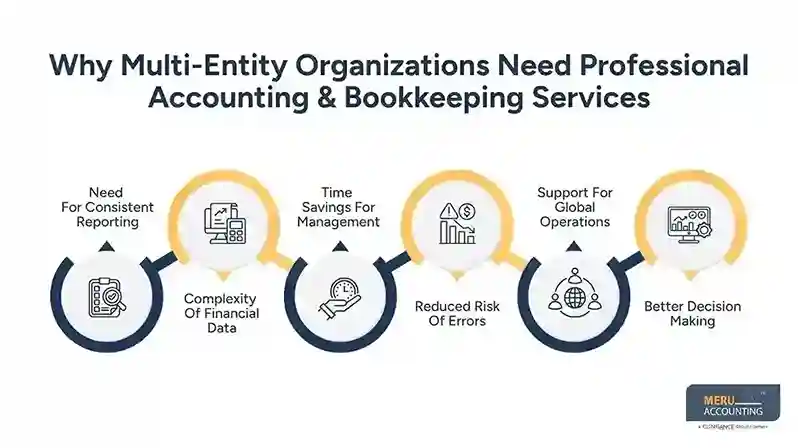
Reduced Risk Of Errors
Professional systems reduce duplication and missing entries. This improves trust in financial reports. Regular checks and reconciliations further ensure that financial data stays clean and reliable across all entities.
Support For Global Operations
For companies operating in multiple countries, accounting rules differ. Expert accounting & bookkeeping services help align records with local laws. This also helps in managing currency differences and cross-border compliance requirements without confusion.
Better Decision Making
Clean financial data helps management understand which entity is performing well and which needs support. It also allows faster response to financial issues by giving clear visibility into performance trends.
Key Challenges in Managing Finances Across Multiple Entities
Data Fragmentation
Financial data is often stored in different systems. This creates gaps in understanding overall performance. In the absence of proper accounting & bookkeeping services, it becomes difficult to connect scattered financial information into one clear view.
Currency Differences
Global businesses deal with multiple currencies. This makes consolidation more complex. Exchange rate changes can also affect profit reporting if records are not updated correctly and consistently.
Different Tax Rules
Each region has its own tax laws. Managing compliance becomes difficult without expert support. An incorrect understanding of local tax rules can lead to penalties and compliance risks across entities.
Lack Of Real-Time Data
Delayed updates lead to poor decision-making and financial blind spots. Management may act on outdated figures, which can affect cash flow planning and budgeting accuracy.
Audit Difficulties
Without structured records, audits become time-consuming and stressful. Missing documentation or inconsistent entries often increase audit queries and delay final reports.
Internal Miscommunication
Different teams may follow different methods, leading to mismatched financial reports. This creates confusion during consolidation and reduces trust in financial statements across the group.
How Accounting & Bookkeeping services Simplify Multi-Entity Financial Management
Transactions are recorded as theyStandard Financial Systems
Accounting & bookkeeping services create a single system for all entities, making records consistent and easy to compare. Uniform processes across entities reduce confusion during consolidation and reporting.
Real-Time Record Updates happen, helping businesses avoid outdated financial data. This keeps management decisions based on the most current financial position of each entity.
Centralized Reporting Structure
All entity reports are combined into one clear dashboard for management review. Leadership teams can view group performance without switching between multiple systems or files.
Error Reduction Systems
Automated checks within accounting & bookkeeping services reduce human errors and improve financial accuracy. These checks also identify mismatches early, before they affect final reports.
Better Cash Flow Tracking
Group-level cash flow becomes easier to manage with structured bookkeeping. It supports better planning of payments, investments, and funding across all entities.
Stronger Financial Visibility
Business leaders can see both individual and combined financial performance clearly. This helps in understanding which entities contribute most to overall financial growth.
Role of Bookkeeping and Controller Services in Strengthening Financial Control Systems
Internal Control Support
Bookkeeping and controller services help build strong checks within financial systems to prevent fraud or errors. Strong verification steps ensure that every financial entry is properly reviewed before it is finalized.
Budget Monitoring
These services track spending against budgets and highlight any deviations early. Early alerts on budget gaps help management control costs before they grow beyond limits.
Financial Analysis Support
Controllers review financial data to ensure accuracy and consistency across entities. This review process helps identify unusual patterns and improves overall reporting quality.
Monthly Closing Processes
Accounting & bookkeeping services help close books on time, ensuring reports are ready for management review. Timely closures make it easier to prepare accurate monthly and quarterly financial summaries.
Compliance Tracking
They ensure each entity follows required financial rules and standards. Regular monitoring reduces the chance of missing regulatory requirements across regions.
Risk Identification
Early detection of financial risks helps prevent bigger problems later. Identifying issues early allows businesses to take corrective steps before losses increase.
Cash Flow Monitoring
Continuous tracking of inflows and outflows helps maintain financial stability across all entities. Strong cash visibility supports better planning for operational and investment needs.
Reporting Accuracy Control
Regular review of financial reports ensures consistency between different business entities. Accurate reporting improves trust in consolidated financial statements and decision-making.
Benefits of Centralized Financial Management for Multi-Entity Businesses
Unified Financial View
Centralized financial management supported by accounting & bookkeeping services ensures accurate consolidation of financial data across multiple entities, improving visibility and control for leadership teams.
Easier Decision Making
Comparative analysis across entities becomes faster and more structured for leadership teams. Quick access to consolidated data supports more accurate and timely business decisions.
Cost Control
Unnecessary expenses across different entities become easier to identify and monitor. Stronger visibility over spending patterns helps improve overall financial efficiency.
Better Resource Allocation
Capital distribution across business units can be evaluated with greater clarity. Funds can be directed toward entities that demonstrate stronger performance and growth potential.
Improved Reporting Speed
Financial reports across all entities can be generated in a shorter time frame. Faster reporting cycles support timely reviews and reduce delays in strategic planning.
Strong Financial Discipline
Standardized financial practices across entities encourage consistency in record-keeping and reporting. Uniform control systems reduce irregularities and improve overall financial governance.
How bookkeeping and controller services Improve Compliance and Audit Readiness
Clean Financial Records
Bookkeeping and controller services ensure all entries are accurate and well-organized. Well-maintained records reduce confusion during financial reviews and audits.
Tax Compliance Support
They help businesses follow local and international tax laws correctly. Proper guidance reduces the risk of penalties and filing errors across regions.
Audit Trail Maintenance
Every transaction recorded through accounting & bookkeeping services includes proper details for easy audit tracking. Clear audit trails make verification faster and more reliable for auditors.
Error Detection Before Audit
Mistakes are identified and corrected early, reducing audit risks. Early correction helps prevent last-minute adjustments during audit periods.
Documentation Management
All financial documents are stored in a structured format for easy access. Organized documentation ensures quick retrieval during compliance checks.
Why Choose Meru Accounting?
Meru Accounting provides structured financial support designed for businesses with multiple entities across regions. Our team focuses on clarity, accuracy, and control across all financial systems.
- We design financial systems that connect all entities while keeping records separate and clear. This ensures smooth group-level reporting.
- Our accounting & bookkeeping services ensure every entity follows the same method for recording and reporting transactions.
- We offer bookkeeping and controller services that help businesses maintain strong internal control and reduce reporting errors.
- We help businesses access updated financial data that supports faster and better decision-making.
- Our team ensures each entity follows local tax and financial rules, reducing legal and audit risks.
- Meru Accounting works with clients in the US, UK, and other regions, handling complex multi-entity setups with consistent accuracy.
Our Expert Perspective
In multi-entity businesses, financial challenges often arise not from revenue issues but from weak structure and misaligned records across entities. Implementing structured accounting & bookkeeping services, along with bookkeeping and controller services, helps streamline reporting, reduce month-end confusion, and strengthen financial control.
Key Takeaways
- Multi-entity structures need clear and separate financial records
- Accounting & bookkeeping services improve accuracy and consistency
- Centralized systems help leaders understand group performance
- Bookkeeping and controller services strengthen internal control and compliance
- Real-time financial data supports better decisions
- Proper systems reduce audit stress and reporting errors
- Expert support improves financial stability across all entities
FAQs
Because each entity has different transactions, taxes, and rules, structured systems help avoid errors and confusion.
They improve internal control, review financial records, and ensure reports are accurate and ready for audits.
Yes, centralized systems give a full view of all entities, helping leaders make better financial decisions.
Yes, without expert support, errors, delays, and compliance issues are more likely to happen due to complex data.
Tools like Xero, QuickBooks, NetSuite, and Odoo are used with accounting & bookkeeping services to manage multi-entity financial operations efficiently.