




Accounting for manufacturing firms plays a vital role in maintaining financial clarity across every stage of production. Manufacturing businesses deal with raw materials, labor costs, overheads, and inventory movement, all of which require accurate tracking.
Without proper accounting systems, cost control becomes difficult and profit margins suffer. This blog explains how accounting supports manufacturing firms in building financial accuracy from start to finish.
It also highlights how structured accounting helps manufacturers plan better and reduce financial stress.
What You Will Learn From This Blog
- Understand why accounting for manufacturing firms is different from other industries and why accuracy matters at every stage
- Learn how proper accounting helps avoid cost gaps and reporting issues
- Know how costs are tracked during raw material purchase, production, and finished goods stages
- See how correct cost tracking supports steady profit margins
- Learn how a cost accountant helps manufacturing firms calculate product costs correctly
- Understand how accurate costing supports better pricing decisions
- See how technology and ERP systems improve accounting for manufacturing firms without adding complexity
Understanding Accounting for Manufacturing Firms
Industry-Specific Accounting Needs
Accounting for manufacturing firms focuses on production costs, inventory valuation, and overhead allocation. These areas require regular monitoring to maintain accuracy.
Difference From Service Accounting
Manufacturing accounting tracks physical goods, work-in-progress, and finished inventory, unlike service businesses. This adds extra layers to financial reporting.
Focus On Cost Accuracy
Accurate cost tracking ensures that product pricing reflects true production expenses. It also prevents underpricing or overpricing of goods.
Compliance And Reporting
Manufacturers must follow accounting standards related to inventory and cost reporting. Proper records help during audits and reviews.
Support For Decision-Making
Reliable financial data helps owners plan production levels and control waste. It also supports informed budgeting decisions.
Why Accounting for Manufacturing Firms Is Critical Across the Production Cycle
Cost Visibility At Each Stage
Accounting for manufacturing firms provides clear cost data from raw material purchase to final sale. This visibility helps identify cost increases at early stages.
Better Inventory Management
Accurate records prevent overstocking and shortages that affect production schedules. Balanced inventory improves cash flow and production planning efficiency.
Profit Margin Control
Tracking costs helps identify areas where expenses exceed planned limits. Timely corrective actions help protect expected profit margins.
Cash Flow Planning
Production cycles often involve delayed payments, making cash planning essential. Accurate accounting data supports proper payment timing and planning.
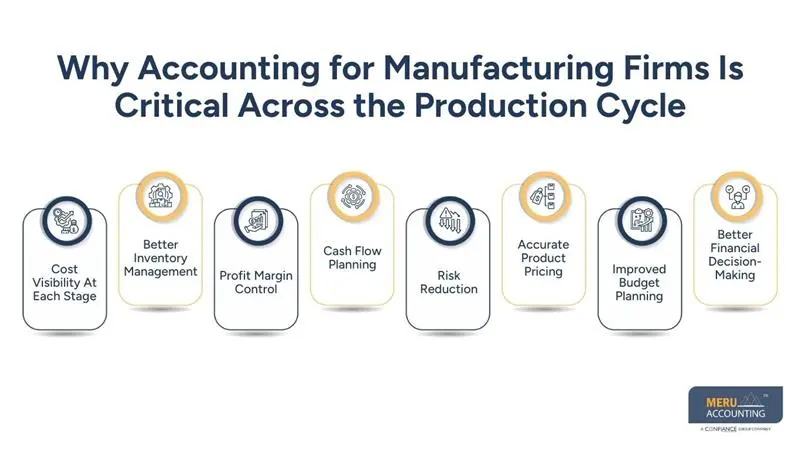
Risk Reduction
Proper accounting reduces errors that can lead to tax or compliance issues. It improves financial confidence and reduces compliance-related risks.
Accurate Product Pricing
Accounting for manufacturing firms helps calculate the true cost of each product. This ensures prices cover all production expenses.
Improved Budget Planning
Detailed cost records support realistic production budgets. This helps manufacturers avoid unexpected cost overruns.
Better Financial Decision-Making
Reliable accounting data helps management make informed decisions about production levels and resource use. This supports stable business operations.
Understanding the Manufacturing Production Cycle from a Financial Perspective
Raw Material Procurement
Accounting for manufacturing firms records purchase costs, freight, and storage expenses. This ensures materials are valued correctly for financial records.
Work-In-Progress Tracking
Costs incurred during production are tracked to measure partial completion accurately. This prevents incorrect profit calculation during reporting periods.
Labor Cost Allocation
Direct labor costs are assigned to specific products or batches. This improves product-level cost accuracy and pricing decisions.
Overhead Distribution
Indirect costs such as utilities and maintenance are spread across production units. This avoids cost understatement across manufactured products.
Finished Goods Valuation
Final product costs are calculated before inventory is moved to sales. This supports accurate inventory reporting and valuation.
Production Cost Reconciliation
Recorded production costs are matched with actual output figures. This helps identify cost differences and reporting inconsistencies early.
The Role of Accounting for Manufacturing Firms in Raw Material Cost Tracking
Purchase Price Recording
Accounting for manufacturing firms captures actual material costs, including supplier charges. This prevents under-recording of material-related expenses in accounts.
Freight And Handling Costs
Additional expenses are added to the material cost for accurate valuation. These costs directly affect product pricing and profit margins.
Material Usage Monitoring
Usage records help identify wastage or theft within the production process. This supports tighter cost control during daily production activities.
Supplier Cost Comparison
Historical data helps manufacturers negotiate better supplier pricing. It supports supplier performance review and informed purchasing decisions.
Stock Reconciliation
Regular checks ensure recorded stock matches physical inventory. This reduces inventory discrepancies and reporting errors.
Material Cost Variance Review
Planned material costs are compared with actual purchase costs. This helps identify price changes and purchasing inefficiencies early.
How a Cost Accountant Supports Accurate Product Costing
Product Cost Calculation
A cost accountant calculates per-unit costs using material, labor, and overhead data. Accurate calculations help determine true product value for pricing.
Cost Sheet Preparation
Detailed cost sheets help management understand where money is spent. Internal reviews become easier with clear and organized cost sheets.
Variance Analysis
A cost accountant compares planned costs with actual figures to identify gaps. Unexpected expenses are controlled through regular variance monitoring.
Pricing Support
Accurate costing helps firms price products fairly while maintaining profit. Pricing decisions improve with reliable product cost information.
Budget Control
A cost accounting expert helps control spending by monitoring production budgets. Financial stability improves through consistent budget oversight.
Profitability Review
Product-level costs are reviewed against actual sales performance. Profit trends become clearer across different product categories.
How Technology and ERP Systems Improve Accounting for Manufacturing Firms
Centralized Data Management
Accounting for manufacturing firms becomes easier when data is stored in one system. Central storage reduces data duplication and record mismatches.
Real-Time Cost Tracking
ERP systems provide instant updates on material and labor costs. Timely cost visibility allows quicker management responses.
Automated Inventory Updates
Stock levels adjust automatically as materials move through production. Inventory records remain accurate throughout production activities.
Reduced Manual Errors
Automation lowers the risk of data entry mistakes. Fewer manual entries reduce errors and save staff effort.
Faster Financial Reporting
Reports are generated quickly, helping management respond faster. Faster reports support timely financial reviews and planning.
System Integration Support
ERP systems connect accounting with production and inventory modules. Integrated systems improve coordination between finance and operations.
How a Cost Accountant Helps Improve Financial Accuracy and Cost Efficiency
Standard Cost Setting
A cost accountant sets standard costs for materials and labor. Standard benchmarks guide consistent production planning and cost control.
Waste Control
Tracking helps identify excess usage and reduce unnecessary expenses. Reduced waste leads to improved overall cost efficiency.
Process Improvement Support
Cost data highlights inefficient production steps. Clear cost insights support logical process improvement planning.
Compliance Assistance
A cost accounting expert ensures that costing methods meet accounting standards. Regulatory compliance risks are reduced through accurate cost practices.
Profit Analysis
Accurate cost reports help measure true product profitability. Profit trends become clearer across products and production lines.
Cost Efficiency Review
Production costs are reviewed against output and performance levels. Efficiency gaps become visible for corrective cost management actions.
Why Choose Meru Accounting for Manufacturing Accounting Services
Choosing the right accounting partner is essential for maintaining cost accuracy and financial clarity in manufacturing operations.Meru Accounting offers specialized support designed to meet the unique accounting needs of manufacturing businesses.
Manufacturing Accounting Expertise
Meru Accounting specializes in accounting for manufacturing firms across various sectors. Industry-focused knowledge supports accurate production and cost reporting.
Skilled Cost Accounting Support
Our experienced cost accountant professionals handle detailed cost tracking and analysis. Reliable costing reports support informed financial and pricing decisions.
Customized Accounting Solutions
At Meru Accounting, we tailor systems based on your production process and business size. Customized setups improve accuracy and day-to-day usability.
Technology-Driven Approach
We support ERP-based accounting for better accuracy and control. ERP adoption reduces manual work and reporting delays.
Reliable Financial Reporting
Our team ensures timely, accurate reports to support better business decisions. Clear financial reports build confidence in management decisions.
Ongoing Accounting Support
At Meru Accounting, we provide continuous accounting assistance as your manufacturing business grows. Ongoing support ensures consistent financial accuracy and system reliability.
Key Takeaways
- Accounting for manufacturing firms supports accurate cost tracking across production
- It helps improve pricing, inventory control, and profit visibility
- A cost accountant plays a key role in product costing and budget control
- Technology improves accuracy and reporting speed
- Professional support allows manufacturers to focus on operations
FAQs
Accounting for manufacturing firms is the process of tracking production costs, inventory, labor, and overhead expenses. It helps manufacturers understand the true cost of making goods.
Accounting is important because it tracks costs from raw material purchase to finished goods. This ensures accurate pricing and better profit control.
A cost accountant calculates product costs, prepares cost reports, and monitors production expenses. This helps manufacturers control costs and improve financial accuracy.
Accounting helps identify material waste, high labor costs, and overhead issues. This allows manufacturers to take action before costs increase further.
Yes, outsourced accounting helps manufacturing firms maintain accurate records and reduce errors. It also provides access to experienced cost accountant support.


