Accounting for property managers covers much more than rent records and monthly reports. It also includes vendor bills, W-9 forms, 1099 filings, payment checks, bank records, and property-level expense tracking. When these tasks are not kept in order, a manager may face missing tax forms, wrong vendor data, duplicate payments, or hard-to-trace costs. A clear process for accounting for property managers gives each payment a proper record from the time a vendor is hired to the time the payment is shown in the books.
What You Will Learn From This Blog
- How accounting for property managers covers vendor bills, records, W-9 forms, 1099s, and payment checks.
- How to collect and store W-9 forms before making vendor payments.
- Which vendor payments may need Form 1099-NEC under current IRS rules.
- How property management accounting can track vendor costs by property and vendor.
- How to match invoices, payments, bank records, and 1099 data.
- How a clear process can reduce errors in year-end vendor reporting.
Key Accounting Responsibilities Of Property Managers
Track Income And Costs
Accounting for property managers starts with clean records for rent, fees, repairs, utilities, insurance, and other property costs. Each item should be posted to the right property and account, so reports show where money came from and where it went.
Keep Vendor Records
Vendor records should include the legal name, business type, tax ID details, address, payment terms, and W-9 status. This data gives the accounting team a clear base for payment and tax reporting work.
Review Bills Before Payment
Every bill should be checked against the work done, contract terms, approval, and property code. This step can catch duplicate bills, wrong amounts, or charges assigned to the wrong property.
Reconcile Bank Activity
Within property management accounting, bank reconciliation checks whether recorded payments match the cash that left the bank. Any open or unmatched item should be reviewed before the month is closed.
Prepare Year-End Data
Year-end work includes checking vendor totals, tax forms, addresses, and payment records. The IRS says Form 1099-NEC is used for reportable nonemployee compensation, with the reporting threshold for payments made in 2026 set at $2,000.
How Property Managers Should Collect And Track W-9 Forms
Ask Before The First Payment
A key step in accounting for property managers is requesting a W-9 from an independent contractor when the vendor relationship begins. The IRS says Form W-9 is used to obtain the payee’s correct name and taxpayer identification number.
Check The Form
Review the name, address, tax classification, and taxpayer identification number for completeness. A blank or unclear W-9 should not be treated as a complete vendor record.
Link W-9 To The Vendor
The W-9 should be tied to the same vendor record used for invoices and payments. This makes it easier to match tax details with year-end payment data.
Keep W-9 Records Safe
The IRS states that W-9 forms should be kept in business files for four years for future reference. Property managers should limit access because these forms contain sensitive taxpayer data.
Review Vendor Changes
In accounting for property managers, vendor records should be reviewed when a vendor changes its legal name, tax status, or other key details. Do not simply overwrite old data without checking which payments relate to the prior information.
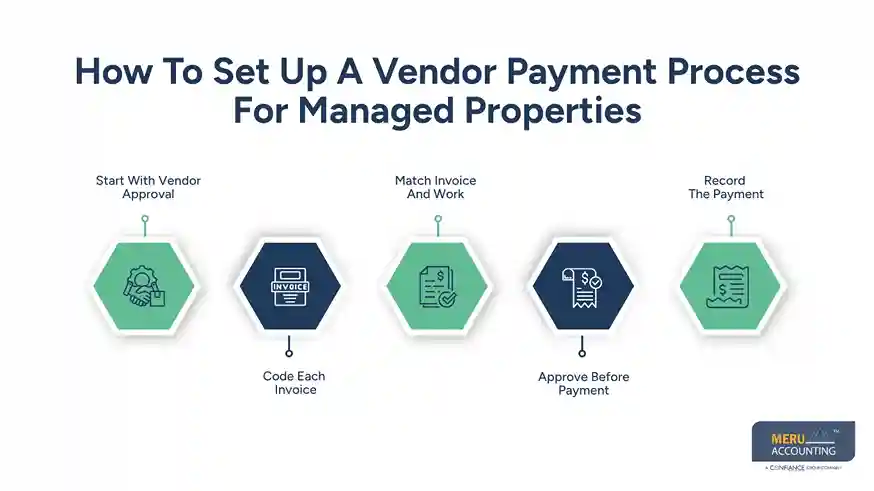
How To Set Up A Vendor Payment Process For Managed Properties
Start With Vendor Approval
Before a vendor enters the payment process, confirm the service, property, contract terms, and W-9 status. This creates a clear record before any cash is paid.
Code Each Invoice
Accurate property management accounting starts with invoices that clearly show the property, service type, invoice date, amount, and due date. Accurate accounting for property managers keeps costs tied to the property that received the service.
Match Invoice And Work
A repair bill, for example, should match the approved work order or service record. For large repairs, the manager may also review the contract, scope of work, and final invoice.
Approve Before Payment
Set a clear approval rule based on payment size or service type. A second review can be used for high-value repairs, unusual charges, or bills that do not match the agreed terms.
Record The Payment
After approval, record the payment with the correct vendor and property code. Keep the invoice number and payment reference so the transaction can be traced later.
Accounting for Property Managers: Which Vendor Payments Require a 1099-NEC?
Nonemployee Services
In accounting for property managers, Form 1099-NEC generally covers qualifying payments for services made to people who are not employees. The IRS lists contractors, accountants, architects, engineers, and similar service providers as examples.
The 2026 Threshold
For payments made in 2026, the general threshold for reportable nonemployee compensation is $2,000. For payments made before 2026, the threshold was generally $600.
Contractors And Repair Firms
In accounting for property managers, these vendor payments should be recorded consistently and reviewed through property management accounting processes for potential 1099-NEC reporting before year-end.
Whether a payment needs a 1099-NEC depends on the payee, service, payment method, entity type, and other IRS rules.
Corporation Exceptions
For accounting for property managers, knowing how each vendor is classified can prevent the same payment from being treated incorrectly during 1099 preparation. For example, attorney fees remain reportable under the applicable 1099 rules.
Check The Current IRS Rules
Do not rely only on a past year’s threshold or a simple vendor list. IRS reporting rules can change, so property managers should check the current instructions when preparing year-end forms.
optional anymore
on running the business
W-9 Vs. 1099-NEC: What Property Managers Need To Know
W-9 Comes First
A W-9 collects the vendor’s tax information, which is an important part of accounting for property managers. It is not a tax return, and it is not sent to the IRS as a normal filing.
1099-NEC Comes Later
A 1099-NEC reports certain payments made during the year. The information on the vendor’s W-9 can be used when preparing the form.
They Serve Different Jobs
Property management accounting treats the W-9 as a vendor setup record and the 1099-NEC as a year-end reporting form. Keeping these roles clear reduces confusion during tax work.
Payment Data Still Matters
A correct W-9 does not by itself prove that a payment needs a 1099-NEC. The type of payment, payee, amount, and other IRS rules must also be reviewed.
Keep Both Records Linked
In accounting for property managers, linking these records creates a clear trail from vendor onboarding to the final 1099-NEC review.
How To Track Vendor Payments For Accurate 1099 Reporting
Use One Vendor Name
Avoid creating several vendor records for the same business. Small name differences can split payment totals and make year-end review harder.
Track Payment Dates
Record the actual payment date, not just the invoice date. Tax reporting is based on applicable payment rules, so the date paid can matter.
Separate Property Costs
If one contractor works at five properties, record each cost by property while keeping the same vendor record. This gives managers both vendor totals and property-level expense data.
Review Payment Methods
Payment cards and third-party networks may have different reporting rules. A payment should not be added to a 1099 total without checking the applicable IRS treatment.
Compare Before Filing
Before forms are prepared, compare the vendor ledger with bank payments and other payment records. IRS guidance says information returns must report payments in the proper box, making a final review important.
How Property Management Accounting Handles Vendor Payment Reconciliation
Match The Bank
Property management accounting should compare recorded payments with bank activity for each managed property. Unmatched items need a clear reason before the books are closed.
Check Open Bills
An unpaid invoice should not be treated as a paid vendor cost. The accounts payable list should be checked against the payment register.
Find Duplicate Payments
A vendor may send two invoices for the same repair or a corrected bill may be entered twice. Comparing invoice numbers, dates, and amounts can flag these issues.
Review Property Codes
In accounting for property managers, reviewing property codes helps ensure that vendor expenses are reflected in the correct property’s financial records. Regular review of property codes keeps owner reports and property results more useful.
Tie Out Year-End Totals
In property management accounting, the final vendor totals should agree with the payment records used for 1099 work. This gives the tax preparer a cleaner set of data and creates a clear audit trail.
How Meru Accounting Can Manage Property Accounting Work
Vendor Data Review
Meru Accounting provides services for vendor data review, payment records, account coding, and bookkeeping work for property managers. The process can keep vendor information tied to the right property and account.
W-9 And 1099 Data
We provide services for organizing W-9 data and reviewing vendor payment records used for 1099 reporting. Tax filing decisions should still follow current IRS rules and the needs of the property owner or manager.
Property-Level Books
Accounting for property managers needs clear records for each managed property. Meru Accounting provides services for transaction entry, reconciliation, accounts payable records, and monthly bookkeeping based on the reporting structure used by the client.
Monthly Reconciliation
At Meru Accounting, we provide services for bank and payment reconciliation so recorded transactions can be checked against financial activity. Unmatched items can then be flagged for review.
Our Expert Perspective
Vendor tax work should not start in January. Accounting for property managers works better when W-9 collection, vendor setup, invoice coding, payment records, and monthly checks are part of one process from the start. Regular reviews can identify missing vendor information, duplicate payments, and incorrectly coded expenses before year-end reporting. Keeping these records organized throughout the year also makes 1099 preparation more efficient.
Key Takeaways
- Accounting for property managers includes vendor setup, invoice review, payment records, reconciliation, and tax reporting data.
- Collect a completed W-9 when an independent contractor relationship begins.
- Keep vendor names and taxpayer details consistent across invoices, payments, and tax records.
- For payments made in 2026, the general 1099-NEC threshold for qualifying nonemployee compensation is $2,000.
- Not every vendor payment requires a 1099-NEC, so the payment type and payee status must be checked.
- Property management accounting should reconcile vendor payments before year-end forms are prepared.
FAQs
Accounting for property managers includes tracking rent, vendor bills, property expenses, payments, bank activity, and financial records for each managed property.
A property manager should request a W-9 when setting up a vendor that may require information reporting, so the vendor’s legal name and taxpayer ID are available for tax reporting.
Property management vendors that receive qualifying payments for services may need a 1099-NEC, based on the payment amount, vendor type, payment method, and IRS rules.
For payments made in 2026, the general reporting threshold for qualifying nonemployee compensation is $2,000, subject to IRS rules and exceptions.
Property managers should track each vendor’s name, W-9 details, invoice, payment date, payment amount, property, and payment method to prepare accurate 1099 data.
optional anymore
on running the business