
Accounting in real estate becomes more demanding as investors and businesses grow their property holdings across different locations and asset types. What starts as a simple income and expense tracking process quickly turns into a multi-layered financial system that requires accuracy, structure, and constant monitoring.
As portfolios expand, accounting for vacation rental properties becomes more challenging due to frequent income fluctuations, operational costs, and dynamic booking cycles. This increases the risk of errors and makes financial visibility harder to maintain without a structured approach.
In this blog, we will explore how and why financial management becomes more complex in real estate as portfolios grow, along with practical challenges, differences across property types, and ways to manage accounting more effectively.
What You Will Learn From This Blog
- How accounting in real estate financial tracking changes with portfolio growth
- Why managing multiple properties increases accounting difficulty
- Key differences between residential, commercial, and mixed assets
- Common mistakes in large-scale property accounting
- Challenges in handling vacation rental income and expenses
- Best practices to manage expanding property portfolios
- Why expert support improves financial clarity and control
Introduction To Accounting In The Real Estate Industry
Property-Level Financial Tracking
Accounting in real estate focuses on tracking income, expenses, taxes, loans, and asset value for each property. Every unit behaves like a separate financial entity.
Cash Flow Management
In accounting in real estate, rental income, maintenance costs, mortgage payments, and taxes must be monitored closely to understand real performance. Consistent monitoring helps identify cash gaps early and supports better financial planning.
Tax Compliance Requirements
Different property types often fall under different tax rules, requiring accurate reporting and classification.
Correct classification also reduces the risk of penalties during audits and filings.
Asset Value Monitoring
Property values change over time due to market conditions, repairs, and depreciation, affecting financial statements.
Regular valuation updates help in reflecting true asset worth in financial reports.
Investment Performance Analysis
Investors use accounting for vacation rental properties data to measure short-term rental returns and overall portfolio performance. This analysis also helps compare performance across different properties in a portfolio.
Documentation and Record Keeping
Invoices, lease agreements, and payment records must be properly organized for audits and reporting.
Well-maintained records also speed up financial reviews and decision-making processes.
Why Real Estate Accounting Becomes Complex As Portfolios Expand
Multiple Income Streams
As properties increase in accounting in real estate, rental income comes from various tenants, contracts, and payment schedules, making tracking more detailed.
Diverse Expense Structures
Each property may have different repair costs, insurance, taxes, and service charges that need separate recording. These variations make it harder to create a single uniform expense model across the portfolio.
Financing Variations
In accounting in real estate, different mortgages, interest rates, and loan terms add layers of financial calculations. Even small changes in interest structure can significantly affect overall profitability tracking.
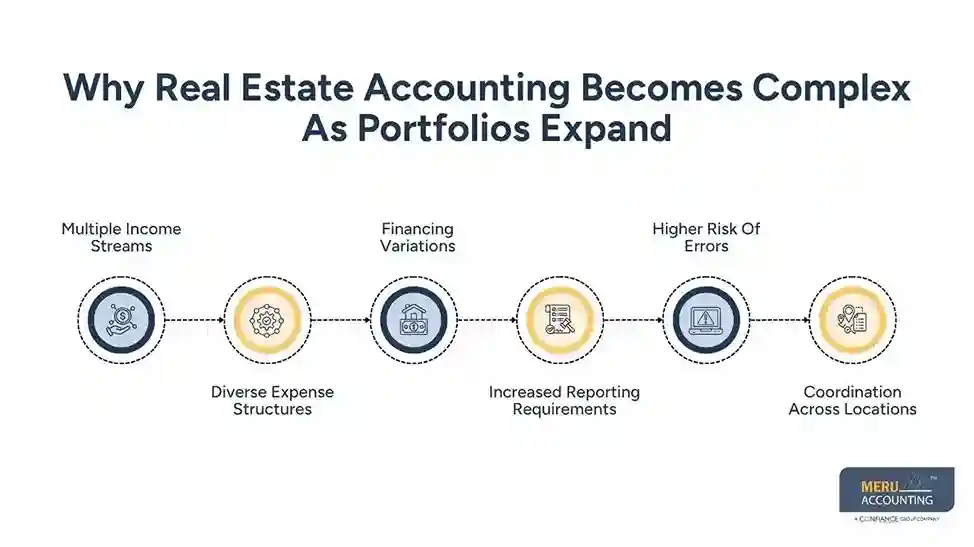
Increased Reporting Requirements
Larger portfolios require consolidated reports while still maintaining property-level detail. This dual reporting requirement increases both time and complexity in financial preparation.
Higher Risk Of Errors
Manual tracking becomes difficult, increasing the chances of missed entries or incorrect classification. Even minor mistakes can lead to distorted profit and loss reporting across multiple properties.
Coordination Across Locations
Managing properties across cities or states introduces differences in rules and operational processes. Local regulatory variations also require adjustments in accounting methods for each region.
Challenges In Managing Multiple Property Transactions
High Transaction Volume
Every rent payment, repair bill, and service charge must be recorded accurately for each property. This creates continuous data entry work that demands strong attention to detail.
Tenant Payment Variability
In accounting for vacation rental properties, frequent guest turnover and platform payouts can create timing differences in cash flow records. Such variations also make it harder to predict monthly income with accuracy.
Maintenance And Repair Tracking
Unexpected repairs make expense forecasting difficult and require constant updates. Emergency costs can also disrupt planned budget allocations for the property.
Lease Agreement Differences
Each tenant agreement may have different terms, affecting income recognition timing. This requires careful review to ensure revenue is recorded in the correct period.
Vendor Payment Management
Multiple service providers increase the complexity of outgoing payments. Different billing cycles also make payment scheduling more challenging to manage.
Data Organization Issues
Accounting in real estate becomes difficult to manage without a structured system, leading to scattered and inconsistent financial data. Disorganized records often lead to delays during reporting and audits.
Impact Of Scaling Property Portfolios On Financial Tracking
Reduced Financial Visibility
As accounting in real estate scales with more properties, it becomes harder to see overall performance without consolidated reporting. This often forces managers to rely on summarized data instead of detailed property insights.
Time-Consuming Reconciliation
Matching payments, invoices, and bank statements becomes more labor-intensive. The process also increases the need for repeated checks to avoid mismatched entries.
Difficulty In Profit Analysis
Understanding which property performs best requires deeper financial segmentation. Without proper breakdowns, hidden losses in underperforming assets may go unnoticed.
Delayed Decision Making
Slow reporting affects investment decisions such as buying or selling properties. This delay can reduce opportunities in competitive real estate markets.
Inconsistent Data Quality
Different tracking methods across properties lead to uneven data accuracy. This inconsistency makes it difficult to trust consolidated financial reports.
Pressure On Financial Systems
Basic tools may not handle large datasets effectively, affecting reliability. System slowdowns or failures can further interrupt daily accounting operations.
Key Differences In Accounting For Residential, Commercial, And Mixed Properties
Residential Property Accounting
Accounting in real estate for residential properties focuses on rental income, basic maintenance costs, and tenant management.
It usually involves shorter lease cycles with more frequent tenant changes.
Commercial Property Accounting
Includes lease structures, long-term contracts, and additional operational expenses. These agreements often require tracking of complex payment schedules and adjustments.
Mixed Property Accounting
Combines residential and commercial rules, increasing complexity in classification. This requires careful separation of income streams to avoid reporting errors.
Lease Term Variations
Commercial leases often include escalation clauses, while residential leases are simpler. These clauses require periodic updates in rent calculations and financial records.
Expense Responsibility Differences
Maintenance responsibilities vary depending on property type and lease agreement. Clear agreements are needed to avoid disputes over cost allocation.
Reporting Requirements
Commercial properties often require more detailed financial disclosures. These reports are also reviewed more frequently by investors and stakeholders.
Accounting For Vacation Rental Properties And Its Unique Challenges
Short-Term Rental Cycles
In accounting for vacation rental properties, frequent guest turnover creates high transaction volume and short income cycles. This also requires daily or weekly updates to keep records accurate and current.
Platform-Based Income Tracking
In accounting for vacation rental properties, payments from booking platforms require reconciliation with bank deposits. Differences in payout timing can make it harder to match actual cash inflows.
Seasonal Income Fluctuations
Revenue changes based on tourism demand and seasonal trends. Off-season periods often require stronger cash flow planning to manage expenses.
High Maintenance Frequency
Cleaning, repairs, and guest services increase recurring expenses. These costs are often higher than traditional rental properties due to frequent usage.
Tax Treatment Complexity
Accounting for vacation rental properties requires careful handling of varying tax rules compared to traditional rental arrangements. This requires careful classification of income to ensure correct tax reporting.
Multiple Fee Deductions
Service fees from platforms reduce net income and must be tracked carefully. These deductions can significantly impact final profitability if not monitored closely.
Common Errors In Large-Scale Real Estate Accounting
Misclassified Expenses
In accounting in real estate, incorrect categorization affects financial reports and tax filings. This often leads to incorrect profit calculations across individual properties.
Missing Transaction Entries
Small overlooked payments accumulate into major discrepancies. Over time, these gaps can create significant mismatches in final accounts.
Poor Reconciliation Practices
Bank statements not matched regularly lead to inaccurate balances. This also increases the risk of undetected errors in cash flow records.
Inconsistent Data Entry
Different methods used across properties reduce reporting accuracy. Such inconsistency makes consolidated financial analysis less reliable.
Ignoring Depreciation
Failure to account for asset depreciation distorts profitability analysis. It can also result in overstated asset values on financial statements.
Weak Audit Preparation
Incomplete documentation creates challenges during financial reviews. This often leads to delays and additional scrutiny during audits.
Best Practices To Streamline Accounting In Real Estate Portfolios
Standardized Accounting System
Using a unified system in accounting in real estate ensures consistency across all properties. This also makes it easier to compare financial data across different assets.
Regular Financial Reviews
Monthly reviews help detect issues early and maintain accuracy. They also support faster correction of small errors before they grow larger.
Separate Property Accounts
Each property should have clear financial tracking for better clarity. This separation helps in understanding individual property performance more clearly.
Automation Of Repetitive Tasks
Automation is especially useful in accounting for vacation rental properties where frequent transactions increase the risk of manual errors. It also saves significant time in daily financial operations.
Strong Documentation Process
Maintaining organized records in accounting in real estate supports audits and compliance. Proper documentation also improves transparency during financial reviews.
Periodic Portfolio Analysis
Regular performance reviews help in better investment decisions. This analysis also highlights underperforming properties that need attention.
Importance Of Professional Support In Managing Expanding Property Accounts
Expertise In Property Accounting
Professionals specializing in accounting in real estate understand the structure and complexity of real estate finance. This experience helps in handling multi-property records with better accuracy.
Accurate Financial Reporting
Ensures the correct classification of income and expenses in accounting in real estate across portfolios. It also improves consistency in reporting across different property types.
Tax Efficiency Support
Helps in compliance with local and international property tax rules. This reduces the risk of penalties and improves filing accuracy.
Scalable Accounting Systems
Experts implement systems that grow with the property portfolio. These systems support smoother handling of increasing transaction volumes.
Risk Reduction
Reduces the chances of errors that can lead to financial or legal issues. Early detection of issues helps avoid long-term financial losses.
Better Investment Insights
Provides clear reports for smarter property decisions. These insights help investors identify growth opportunities more effectively.
How Meru Accounting Supports Real Estate Financial Management
Meru Accounting helps property owners, investors, and real estate firms manage accounting in real estate with structured financial systems.
This support helps reduce complexity as property portfolios continue to grow.
Portfolio Accounting Support
In accounting in real estate, detailed property-wise tracking ensures full visibility of income and expenses. This ensures that the performance of every asset can be reviewed independently and accurately.
Real Estate Bookkeeping Services
In accounting for vacation rental properties, daily transaction recording is critical due to high booking frequency and short rental cycles. This helps prevent gaps or errors in long-term financial records.
Tax Compliance Assistance
Supports clients in managing property tax rules across different regions. It also helps ensure timely filing and proper documentation for compliance needs.
Scalable Financial Systems
Accounting structures are designed to grow as portfolios expand. These systems adjust easily as transaction volumes and property counts increase.
Multi-Property Reporting
In accounting in real estate, consolidated and property-level reports help in better decision-making. This allows investors to compare performance across different assets with clarity.
Technology-Driven Approach
Modern accounting tools are used to improve accuracy and efficiency. This reduces manual effort and improves speed in financial reporting.
Our Expert Perspective
From our experience working with expanding real estate portfolios, financial tracking often starts simple but becomes harder to manage as the number of properties increases and transactions grow across different locations. A common issue we see is inconsistent expense recording and lack of standard classification, which leads to unclear profit results and gaps in reporting. In many cases, the need for structured accounting is only realized after scaling has already created delays and confusion in financial data. Setting up a consistent system early, along with regular reviews, helps maintain accuracy, reduce errors, and provides a clearer view of overall portfolio performance as it grows.
Key Takeaways
- Accounting in real estate becomes more complex as properties increase
- Each property adds separate income, expenses, and reporting needs
- Different property types require different accounting methods
- Vacation rentals create unique financial tracking challenges
- Errors increase when systems are not standardized
- Professional support improves accuracy and financial control
- Structured systems help manage large portfolios efficiently
FAQs
Because in accounting in real estate, each new property adds more transactions, tenants, expenses, and financial records that must be tracked separately.
In accounting for vacation rental properties, it involves short stays, frequent payments, platform fees, and seasonal income changes that require detailed tracking.
Yes, but it must support property-level tracking and consolidated reporting for accurate results.
Common issues include missing entries, misclassified expenses, and poor reconciliation of bank records.
Experts in accounting in real estate help maintain accuracy, reduce errors, and provide clearer financial insights for better decisions