
AI bookkeeping software is reshaping how service businesses record, manage, and review financial data. Many firms that once relied on manual entries and delayed reporting are now shifting to automated systems that process transactions in real time. This shift is improving bookkeeping practices through better accuracy, stronger control, and improved financial awareness.
For scaling service businesses, financial clarity becomes more important as client numbers grow and operations expand.
AI bookkeeping software brings structure to large volumes of data, reduces repetitive tasks, and creates a more stable system for financial tracking. It also allows teams to focus more on analysis rather than routine data entry.
What You Will Learn From This Blog
- How AI bookkeeping software works in real business settings
- Ways it changes traditional bookkeeping practices
- Its role in reducing human errors in finance records
- How it supports multi-client service firms
- Integration with accounting and ERP systems
- Challenges faced while adopting AI-based systems
- Practical use cases in service-based industries
- How firms like Meru Accounting use modern tools for clients
What is AI Bookkeeping Software and How Does it Work
Data Capture And Transaction Reading
AI bookkeeping software collects financial data from bank feeds, invoices, emails, and digital receipts in real time.
Information is pulled directly into the system and converted into structured accounting entries without manual typing. This reduces dependency on manual entry and keeps financial records continuously updated.
Machine Learning For Categorization
Machine learning models study past transactions and assign them to the correct accounts based on patterns.
Over time, the system learns common expense types such as travel, payroll, utilities, or vendor costs. Accuracy improves as more data flows through the system, helping businesses maintain consistent bookkeeping practices.
Real-Time Processing Engine
Financial transactions are processed instantly instead of waiting for end-of-month updates. Businesses gain a live view of cash flow, income, and expenses at any point in time.
Faster updates allow quicker financial decisions and reduce reporting delays.
Rule-Based Financial Mapping
Custom rules can be created for repeating transactions such as subscriptions, rent, or vendor payments.
Once rules are set, similar entries are automatically mapped to the correct accounts. Repetitive manual posting is reduced significantly, improving consistency in records.
Cloud-Based Access System
Cloud infrastructure allows financial data to be accessed from multiple locations and devices.
Service teams working across regions can collaborate on the same dataset without version conflicts. Remote access also supports distributed service businesses with global clients.
Audit Trail And Record Tracking
Every financial entry is logged with a time-stamped history of changes. Clear tracking of edits, approvals, and updates supports internal reviews and external audits.
Strong audit trails strengthen financial control and reduce compliance risks.
Key Ways AI Bookkeeping Software is Transforming Bookkeeping Practices
Shift From Manual Entry To Automated Recording
Traditional bookkeeping practices depend heavily on manual entry of invoices, receipts, and bank data. AI systems now record most transactions automatically by pulling structured data from multiple sources.
Faster Month-End Closing Cycles
Financial closing cycles become shorter because transactions are organized continuously throughout the accounting period. Finance teams spend less time collecting missing records and more time reviewing final reports and adjustments before closing.
Better Financial Visibility
Income, expenses, and cash flow remain visible in real time through AI-driven dashboards. Business owners gain continuous insight into financial performance instead of waiting for periodic reports.
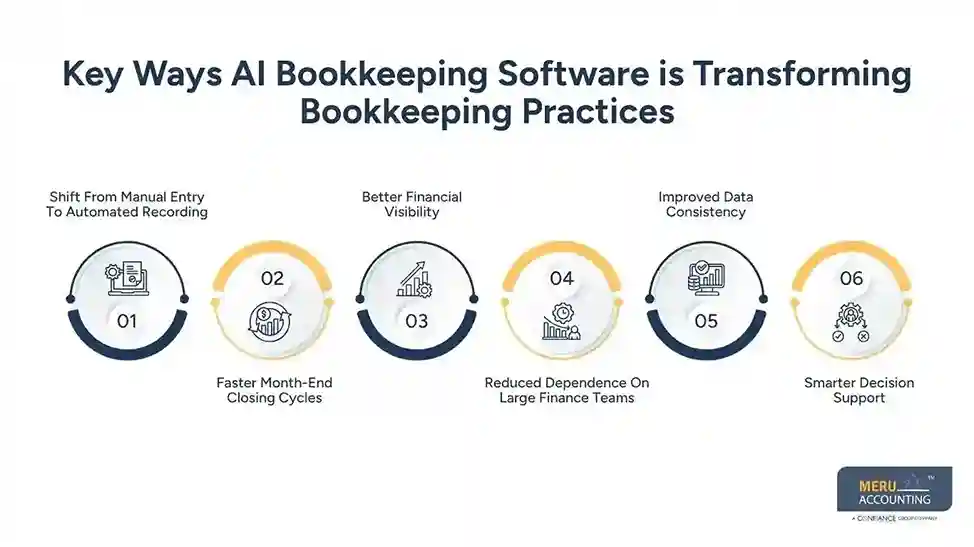
Reduced Dependence On Large Finance Teams
Smaller accounting teams manage higher workloads due to the automation of routine tasks. Service-based firms handling multiple clients can scale operations without proportional hiring increases.
Improved Data Consistency
Standardized logic applied by AI systems ensures uniform treatment of financial entries. Reporting differences across departments or periods are reduced significantly.
Smarter Decision Support
Financial data becomes easier to interpret through structured reports and categorized insights. Business leaders rely on updated numbers rather than delayed summaries.
How AI Bookkeeping Software Improves Accuracy and Reduces Human Errors
Elimination of Manual Entry Mistakes
Manual typing often leads to errors in amounts or categories. AI systems reduce these risks by automating data input. Reduced dependency on human entry lowers the chances of incorrect posting in financial records.
Duplicate Transaction Detection
The system identifies repeated entries and flags them before they affect financial reports. Early detection of duplicates prevents overstatement of expenses or income in books.
Smart Matching Of Records
Bank statements and invoices are matched automatically. This reduces reconciliation errors and missing entries. Matching rules connect related transactions with higher speed and consistency.
Continuous Error Checks
The software scans data for unusual patterns and alerts users when something does not match expected behavior. Ongoing monitoring helps identify issues before they spread into final reports.
Standardized Data Processing
All transactions follow the same process, which reduces variation in how data is recorded across teams. Uniform processing ensures consistency even when multiple users handle entries.
Reliable Financial Reporting
Reports generated from clean and structured data provide more accurate insights for business planning. Stronger data quality supports better forecasting and more reliable bookkeeping practices.
Role of AI Bookkeeping Software in Multi-Client Service Environments
Handling Large Client Volumes
Service firms managing many clients benefit from automation, as it allows them to process multiple books at the same time. Batch processing of transactions reduces delays even when workload increases across clients.
Centralized Dashboard Control
Teams can monitor all client accounts from a single dashboard, reducing the need to switch between systems. Unified access improves tracking of financial status across different client portfolios.
Faster Client Reporting
Reports can be generated quickly for different clients without rebuilding data from scratch. Standardized reporting templates ensure consistency across all client deliverables.
Reduced Workload On Staff
Employees spend less time on repetitive entry tasks and more time on review and analysis. Work focus shifts toward financial insights rather than routine bookkeeping activities.
Scalable Work Structure
As client numbers increase, the same system can handle additional workload without major staffing changes. Automation allows service firms to grow operations without proportional increases in headcount.
Better Client Communication
Updated financial data allows firms to respond to client queries with more accurate information. Real-time access to records strengthens response speed during client discussions.
Integration of AI Bookkeeping Software With Accounting and ERP Systems
Connection With Accounting Platforms
Integration with accounting platforms allows automatic syncing of financial records across systems. Manual posting work reduces as entries flow directly into accounting software.
ERP System Alignment
ERP systems connect operations, sales, and finance data into a single structured environment. Consistent records across departments strengthen bookkeeping practices and improve financial coordination.
Bank Feed Integration
AI Bookkeeping Software uses direct bank connections to allow real-time transaction updates without manual imports. Live bank feeds keep financial records updated without delay or missing entries.
Payroll And Billing Sync
Salary payments and client billing entries are recorded directly into financial books. Reduced mismatch between payroll records and accounting books strengthens accuracy.
Data Exchange Between Tools
Information flows smoothly between systems, reducing duplication of work. Connected platforms ensure updates reflect across all linked financial tools.
Unified Financial View
Consolidated financial dashboards provide a single view of performance across departments. Business leaders gain clearer visibility into overall financial health in one place.
How AI Bookkeeping Software Streamlines Expense Tracking For Service Businesses
Automated Expense Capture
Receipts and invoices are scanned and recorded automatically, reducing manual filing work. Financial data is extracted from documents and posted into correct expense heads without manual entry.
Category-Based Expense Sorting
Expenses are grouped into categories like travel, utilities, or operations based on learned patterns. Classification accuracy improves over time as the system studies past transaction behavior.
Real-Time Expense Monitoring
Businesses can track spending as it happens instead of waiting for reports. Live dashboards show updated expense positions for faster financial awareness.
Budget Comparison Tools
Actual spending is compared with planned budgets to identify gaps early. Overspending areas are highlighted to support better cost control decisions.
Mobile Receipt Uploads
Employees can upload receipts through mobile apps, keeping records updated on the go. Uploaded receipts are matched instantly with related transactions for faster processing.
Expense Approval Workflows
Digital approval systems reduce delays in processing company expenses. Expense requests are routed to the right managers for quicker approval cycles.
Challenges in Adopting AI-Based Bookkeeping Practices
Initial Setup Complexity
Setting up AI bookkeeping software automation rules and integrations can take time and careful planning. System configuration must match business workflows for smooth financial processing.
Data Quality Issues
Poor historical data can affect how well AI systems learn and classify transactions. Clean and structured data is needed for accurate financial categorization.
Staff Training Needs
Teams need training to adapt their bookkeeping practices to new AI-driven systems correctly. Proper user understanding reduces errors during system adoption.
System Dependency Risks
Over-reliance on automation may reduce manual review habits if not managed properly. Periodic human checks remain important to maintain financial accuracy.
Cost Of Implementation
Some advanced systems require investment, which may be difficult for smaller firms at the start. Pricing depends on features, scale, and integration requirements.
Data Security Concerns
Financial data must be protected with strong security systems to avoid risks. Encryption and access controls safeguard sensitive financial information.
Why Choose Meru Accounting?
Meru Accounting provides accounting and bookkeeping services for global service businesses that need structured financial systems while scaling operations. The focus remains on combining trained accounting professionals with modern tools to manage complex bookkeeping work with consistency and accuracy.
The approach includes:
- Setting up automated bookkeeping workflows for clients
- Integrating accounting tools with ERP and cloud systems
- Managing multi-client financial records with controlled review systems
- Supporting US and global clients with updated financial reporting
- Reducing manual work so teams can focus on financial analysis and advisory
This model allows businesses to maintain financial order even as transaction volume increases. It also gives decision-makers clearer financial visibility across multiple business units.
Our Expert Perspective
Our Expert Perspective comes from practical work in delivering accounting and bookkeeping services across different service-based industries. One clear finding is that automation alone cannot maintain financial accuracy without structured accounting review and control.
This perspective also highlights that many businesses expect quick results after adopting new systems, but real performance depends on proper setup, clean financial data, and continuous monitoring. It further shows that firms combining automated systems with professional oversight achieve more reliable financial records, fewer reporting gaps, and stronger financial control across operations.
Key Takeaways
- AI bookkeeping software reduces manual data entry and repetitive work
- Financial records become more accurate and updated in real time
- Service businesses can manage more clients with the same team size
- Integration with accounting and ERP systems creates unified financial control
- Expense tracking becomes faster and more structured
- Adoption requires planning, training, and data quality checks
- Human review remains important for financial accuracy
FAQs
AI bookkeeping software records financial transactions, tracks expenses, and generates reports automatically with minimal manual effort for service businesses.
Small service firms can manage bookkeeping efficiently without large accounting teams by using automated financial tools for daily records.
Routine bookkeeping tasks are automated, while accountants remain essential for review, analysis, compliance, and financial planning.
Most platforms use encryption, secure cloud storage, and access controls to protect sensitive financial information.
Receipts are scanned, categorized, and updated in real time to maintain accurate expense tracking and financial records.