Amazon’s Seller Central can tell you how many units you’ve sold, which products are moving, and how much revenue you’ve brought in. But it won’t always tell you which products are actually making money or where your margins are slipping. That’s where an Amazon specialist accountant comes in. They look beyond sales figures to understand the costs, fees, and financial details that shape your bottom line.
From a product launch to a busy holiday season, every stage of an Amazon business brings new financial demands. A sudden rise in storage fees, an incorrect inventory count, or an overlooked reimbursement can throw off your books. In this blog, we’ll look at seven common accounting challenges Amazon sellers face and how the right accounting support can help solve them.
What You Will Learn From This Blog
- Seven common accounting challenges Amazon sellers face.
- How an Amazon specialist accountant can help solve them.
- Why settlement reports, FBA fees, and inventory records need close review.
- When to hire an accounting expert for your Amazon business.
- What to look for in an Amazon accounting service.
- How outsourced accounting can support long-term business growth.
7 Accounting Challenges an Amazon Specialist Accountant Can Help Solve
Amazon sellers deal with a mix of sales, fees, refunds, inventory costs, and cash payments. Here are seven common problems that need close attention.
1. Reconciling Amazon Seller Settlements and Payouts
Amazon does not send sellers the full value of their sales as one bank deposit. It first deducts fees, refunds, reserves, and other charges. The remaining balance is then sent to the seller’s bank account.
This can make it hard to match sales records with actual cash received. For example, a seller may record $20,000 in sales but receive only $14,500 in a settlement. The gap may include selling fees, refunds, ads, and other costs.
An Amazon specialist accountant reviews settlement reports and matches each payout with the related sales and expense records.
This process helps sellers:
- Match Amazon payouts with bank deposits.
- Review fees, refunds, and other deductions.
- Find missing or duplicate entries.
- Check settlement reserves and balance changes.
- Keep sales and cash records in line.
Without proper reconciliation, sellers may report the wrong income or miss costs that reduce their profit.
2. Tracking FBA Fees and Other Selling Costs
Amazon charges sellers for many services. These may include referral fees, fulfillment fees, storage fees, removal fees, and long-term storage charges. Sellers who run ads may also have costs for sponsored listings and other campaigns.
These costs can change based on product size, weight, sales volume, and storage time. If sellers record only total fees, they may not know which products bring in the best returns.
An Amazon accounting expert can sort these costs into the right accounts and review them against sales data.
For example:
Cost type | What it covers |
Referral fee | Fee charged on each sale |
FBA fulfillment fee | Pick, pack, and ship costs |
Storage fee | Cost of holding stock in Amazon warehouses |
Removal fee | Cost to remove or dispose of stock |
Advertising cost | Spend on Amazon ad campaigns |
A specialist can also review fee reports and flag charges that need further checks. This gives sellers a better view of product costs and helps them set prices with more care.
3. Managing Inventory Valuation and Cost of Goods Sold (COGS)
Inventory is one of the highest costs for many Amazon sellers. Yet it can be hard to track stock when goods move between suppliers, warehouses, and Amazon fulfillment centers.
Sellers must also account for stock that is lost, damaged, returned, or no longer fit for sale. If these changes are not recorded, the value of stock on the balance sheet may be wrong.
An Amazon specialist accountant can help set up a clear inventory tracking process. This includes:
- Recording stock purchases and freight costs.
- Tracking stock sent to Amazon warehouses.
- Updating records for returns and damaged goods.
- Calculating the cost of goods sold.
- Checking stock values at the end of each period.
For example, if a seller buys 1,000 units at $8 each, the base stock cost is $8,000. If 300 units are sold, the COGS is $2,400, before any other costs included in the inventory valuation method.
Accurate stock records help sellers understand gross profit and avoid overstating the value of goods they still own.
4. Handling Product Returns, Refunds, and Chargebacks
Returns are part of selling online. But they can create accounting issues when sellers do not record them in the right way.
A customer may return an item, receive a refund, and send the product back to Amazon. The item may then be placed back into sellable stock, marked as damaged, or removed from inventory. Each outcome can affect the seller’s records in a different way.
An accountant can review return and refund reports to make sure each event is recorded correctly.
This may include:
- Recording refunds against sales.
- Updating inventory for returned goods.
- Tracking damaged or unsellable items.
- Reviewing Amazon reimbursements.
- Checking chargebacks and related fees.
Amazon may issue a reimbursement for lost or damaged stock in some cases. Sellers should track these payments and match them to the related claim. Otherwise, they may miss money owed to the business or record income twice.
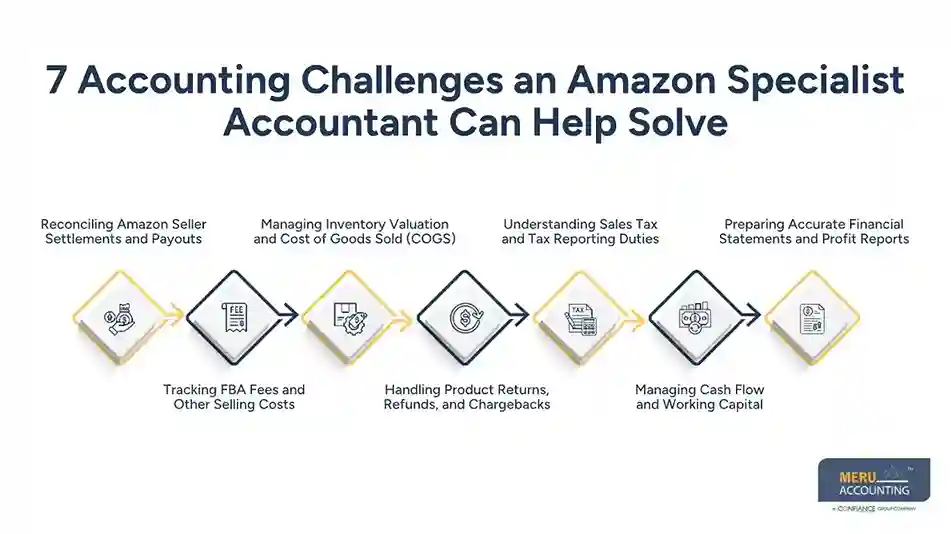
5. Understanding Sales Tax and Tax Reporting Duties
Sales tax can be hard to manage for sellers who ship products across state lines. In many US states, Amazon acts as a marketplace facilitator and collects and sends sales tax on behalf of sellers.
However, this does not mean sellers have no tax duties. They may still need to review their sales tax records, check registration rules, file required returns, and meet other state tax duties.
An Amazon specialist accountant can help sellers keep tax records in order and review reports from Amazon.
Key tasks may include:
- Reviewing marketplace sales tax reports.
- Separating sales tax from business revenue.
- Tracking sales across states.
- Keeping tax records for filing and review.
- Working with tax experts when a seller has more complex needs.
Tax rules vary by state and business setup. Sellers should not assume that Amazon’s tax collection covers every tax duty they may have.
6. Managing Cash Flow and Working Capital
A business can show a profit and still run short on cash. This is common for Amazon sellers who need to buy stock before they receive money from sales.
For example, a seller may need to pay a supplier $15,000 for a new order while Amazon still holds part of the sales balance. At the same time, the seller may need to pay for ads, shipping, and storage.
An accountant can help sellers plan for these cash needs by reviewing:
- Cash coming in from Amazon payouts.
- Supplier bills and payment dates.
- Stock purchase plans.
- Ad spend and other running costs.
- Seasonal changes in sales and demand.
A cash flow report can show when money is likely to come in and when bills are due. This helps sellers plan stock orders, avoid late payments, and keep enough cash on hand.
7. Preparing Accurate Financial Statements and Profit Reports
Sales data alone cannot show how well an Amazon business is doing. Sellers need clear reports that show income, costs, assets, debts, and profit.
Poor records can lead to wrong figures in the income statement and balance sheet. They can also make it hard to compare products, sales channels, or time periods.
An Amazon specialist accountant can prepare and review key financial reports, such as:
- Income statement: Shows revenue, expenses, and profit over a set period.
- Balance sheet: Shows what the business owns and owes.
- Cash flow statement: Tracks cash coming in and going out.
- Profit reports: Help sellers review margins by product or sales channel.
These reports help sellers see which products perform well, where costs are rising, and whether the business has enough cash to grow.
optional anymore
on running the business
How an Amazon Specialist Accountant Approaches These Challenges
Solving Amazon accounting issues takes more than entering sales and bills into software. An accountant needs to understand how Amazon reports connect with the seller’s books.
A sound process often includes these steps:
- Review existing records: Check Seller Central reports, bank statements, supplier bills, and current books to find gaps.
- Set up clear account categories: Group sales, fees, refunds, ads, inventory costs, and other expenses under the right accounts.
- Reconcile sales and payouts: Match Amazon settlements with bank deposits and review any gaps.
- Check inventory and COGS: Review stock purchases, returns, damaged goods, and the cost of units sold.
- Prepare monthly reports: Share clear financial statements and explain major changes in costs, cash, and profit.
The right process helps sellers keep their books up to date and use their financial data with more confidence.
When Should You Hire an Amazon Specialist Accountant?
Not every new seller needs a full accounting team. But as sales and order volume grow, manual records can become harder to manage.
You may need an Amazon specialist accountant when:
- You cannot match Seller Central sales with bank deposits.
- Your fees and refunds are hard to track.
- You sell through more than one Amazon marketplace.
- Your stock records do not match the actual inventory.
- You are unsure about your true profit margins.
- Tax filing and month-end reports take too much time.
- You plan to grow your product range or sales volume.
Getting expert help early can prevent small record gaps from turning into larger accounting problems.
What to Look for When Choosing an Amazon Accounting Specialist
Choosing an accountant is not just about finding someone who can use bookkeeping software. They should understand how Amazon sales and fees affect your books.
Here are some points to check before hiring:
Factor | What to look for |
Amazon experience | Work with Seller Central, FBA, and marketplace reports |
Reconciliation skills | Ability to match settlements, fees, and bank deposits |
Inventory knowledge | Experience with stock valuation and COGS |
Tax knowledge | Understanding of US sales tax and business tax records |
Reporting skills | Clear monthly reports and profit reviews |
Quality checks | Review steps to help keep records accurate |
Software knowledge | Experience with tools that fit your business needs |
Ask how the accountant handles settlement gaps, inventory changes, and month-end close. Their answers can help you judge whether they understand the real needs of an Amazon business.
Outsourced Accounting for Amazon Sellers by Meru Accounting
A profitable Amazon business needs more than a record of orders and payouts. It needs someone who can connect Seller Central activity with inventory costs, supplier bills, marketplace fees, and financial reports. That’s the kind of accounting support we provide at Meru Accounting.
Our team helps Amazon sellers manage the financial work that often gets overlooked when attention is focused on sales and order fulfillment.
Our Amazon accounting services include:
Service | What We Handle |
Amazon Bookkeeping | Recording sales, refunds, fees, and other marketplace transactions. |
Settlement Reconciliation | Matching Amazon settlement reports with bank deposits and identifying unexplained differences. |
FBA Fee Accounting | Tracking fulfillment, referral, storage, removal, and other selling fees. |
Inventory & COGS Accounting | Tracking stock purchases, inventory costs, returns, and the cost of goods sold. |
Accounts Payable & Receivable | Managing supplier bills, payment records, and outstanding balances. |
Financial Reporting | Preparing income statements, balance sheets, cash flow reports, and profitability reviews. |
Bookkeeping Cleanup | Correcting past entries, reconciling accounts, and bringing incomplete books up to date. |
Whether you need help fixing settlement discrepancies, keeping inventory costs in check, or getting reliable monthly financial reports, Meru Accounting can provide a dedicated accounting team at a fraction of the cost of building an in-house team.
Our Expert Insight
One area Amazon sellers should pay close attention to is how inventory costs affect reported profit. Buying stock does not mean the full purchase cost should be recorded as an expense right away. Unsold goods remain an asset, while the cost of units sold is recorded as cost of goods sold (COGS). Getting this wrong can distort monthly profits and make a product look less profitable than it really is.
For example, if you buy 1,000 units at $12 each but sell only 400, the COGS for those units is $4,800. The cost of the remaining 600 units stays in inventory, subject to any required cost adjustments. We recommend reviewing inventory records, unit costs, and sales together at month-end. This gives sellers a more accurate picture of product margins and helps them make better decisions about pricing and restocking.
Key Takeaways
- Amazon accounting needs close tracking of sales, fees, refunds, and payouts.
- Settlement reconciliation helps match Amazon activity with bank deposits.
- FBA fees and ad costs can affect product-level profit.
- Accurate inventory records help keep COGS and stock values right.
- Sales tax collection by Amazon does not remove every seller tax duty.
- Cash flow reports help sellers plan stock buys and supplier payments.
- An Amazon specialist accountant can help keep records clear and support better business decisions.
- Outsourced accounting for Amazon sellers can provide skilled support without the cost of a full in-house team.
FAQs
When sales grow, records become harder to manage, or profit reports no longer match actual business performance. An accountant can also help during marketplace expansion.
Yes. They can review product costs, advertising spend, FBA fees, and operating expenses to find areas where sellers can reduce costs and improve margins.
Amazon Seller Central provides settlement, transaction, and tax reports. However, sellers still need proper bookkeeping and financial statements to track overall business performance.
Yes. Outsourced accounting for Amazon sellers gives small businesses access to professional bookkeeping and financial reporting without the cost of a full-time accounting team.
Yes. An Amazon specialist accountant can track sales, fees, refunds, and expenses across multiple marketplaces and prepare consolidated financial reports.
optional anymore
on running the business