Ask three small business owners how much tax they pay, and you may get three very different answers. A local shop, a freelance consultant, and a growing corporation don’t follow the same tax rules. Even businesses with similar profits can have very different tax bills. That’s what makes the small business tax rate worth understanding.
The type of business you own plays a big role in how the IRS taxes your income. Before you compare rates or plan your next tax payment, it helps to know which rules apply to your business and why. Let’s break down the numbers and see what different business owners can expect.
What You Will Learn From This Blog
- How the small business tax rate works in the US.
- How tax rules differ for sole proprietors, LLCs, partnerships, and corporations.
- Which federal taxes can affect your business.
- What can raise or lower your total tax bill.
- How to plan and manage small business taxes.
What Is the Average Small Business Tax Rate?
There is no set average tax rate that applies to every small business. The amount you owe depends on your net profit, tax status, owner’s income, and the type of tax you need to pay.
For example, a sole proprietor reports business profit on a personal tax return. A C corporation pays federal tax on its own taxable income. These two businesses can earn the same profit but have very different tax bills.
For tax year 2026, the main federal tax rules include:
- Individual income tax: Owners of pass-through businesses pay tax at the federal individual income tax rates that apply to their taxable income.
- Corporate income tax: C corporations pay a flat 21% federal tax on taxable income.
- Self-employment tax: Many self-employed owners pay 15.3% on net earnings, subject to the rules and limits for Social Security and Medicare taxes.
These rates are not directly comparable. Income tax and self-employment tax are separate taxes, and some owners may owe both. State and local taxes may also apply.
The best way to estimate your small business tax rate is to look at your business structure and the full amount of tax due, not just one federal rate.
optional anymore
on running the business
How Does the Small Business Tax Rate Work in the US?
The US tax system does not tax every business in the same way. First, the IRS looks at how your business is classified for tax purposes. Then, it applies the tax rules that fit that classification.
Most small businesses fall into one of two broad groups:
1. Pass-through businesses
Sole proprietorships, partnerships, and most LLCs are usually pass-through businesses. They do not pay federal income tax as separate entities. Instead, business profits pass to the owners, who report their share on their personal tax returns.
The owners may also owe self-employment tax, depending on their role and type of income.
2. C corporations
A C corporation is a separate tax-paying entity. It files its own federal income tax return and pays tax on its taxable profits. If it pays dividends to shareholders, those shareholders may also owe tax on the income they receive.
This is often called double taxation.
Your business may also need to pay payroll, state income, sales, property, or other taxes. The total tax bill depends on which rules apply to your business.
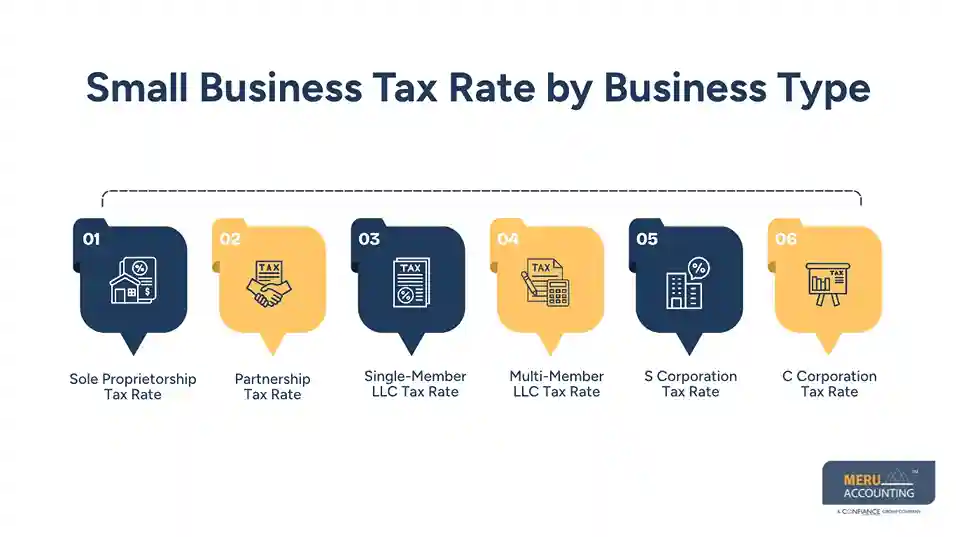
Small Business Tax Rate by Business Type
The small business tax rate by business type can vary a lot. Here is how the main business structures are taxed at the federal level.
1. Sole Proprietorship Tax Rate
A sole proprietorship is a business owned by one person. The IRS treats the owner and business as one taxpayer for federal income tax purposes.
You report business income and costs on Schedule C, which is filed with your Form 1040. Your net profit is added to your other taxable income and taxed at your applicable individual rate.
You may also owe self-employment tax on your net earnings. For 2026, the standard self-employment tax rate is 15.3%, made up of Social Security and Medicare taxes. The Social Security wage base for 2026 is $184,500.
2. Partnership Tax Rate
A partnership has two or more owners who share profits and losses. The business files Form 1065, but it generally does not pay federal income tax on its profits.
Each partner gets a Schedule K-1 that shows their share of the income, deductions, and other tax items. They report these amounts on their own tax returns.
General partners may also owe self-employment tax on their share of business earnings. The rules can differ for limited partners and certain types of income.
3. Single-Member LLC Tax Rate
A single-member LLC is usually treated as a disregarded entity for federal income tax purposes. This means its income is reported on the owner’s tax return, much like a sole proprietorship.
The owner generally reports business income on Schedule C and may owe income tax and self-employment tax on net profit.
However, an LLC can elect to be taxed as a corporation if it meets the IRS rules. So, forming an LLC does not by itself set a fixed tax rate.
4. Multi-Member LLC Tax Rate
A multi-member LLC is usually treated as a partnership for federal tax purposes unless it elects corporate tax treatment.
The LLC files Form 1065, and each member reports their share of the income on a Schedule K-1. The tax is generally paid by the members, not by the LLC as a separate income tax-paying entity.
The amount each member owes depends on their share of the profit, tax status, and other income. Self-employment tax may also apply.
5. S Corporation Tax Rate
An S corporation is generally a pass-through tax structure. It files Form 1120-S, but its income usually passes to its shareholders and is reported on their personal tax returns.
A key difference is how owner pay is handled. Shareholders who work for the business must generally receive reasonable wages. The company pays payroll taxes on those wages, while other profits may pass through to shareholders.
This can affect the total tax bill, but an S corporation does not guarantee tax savings. Owners must follow payroll, filing, and eligibility rules.
6. C Corporation Tax Rate
A C corporation pays federal income tax as a separate entity. For 2026, the federal corporate income tax rate is 21% of taxable income.
If the company pays dividends, shareholders may owe personal tax on those payments as well. This can result in two levels of tax on the same business earnings.
C corporations may suit businesses that plan to keep profits in the company, raise outside funds, or have other long-term goals. The right choice depends on more than the tax rate alone.
Federal Taxes That Affect Small Business Tax Rates
Income tax is only one part of the tax bill. Depending on your business and its activities, you may need to pay other federal taxes.
1. Federal income tax
Owners of pass-through businesses report their share of business profit on personal tax returns. The tax rate depends on their taxable income and filing status.
2. Self-employment tax
Self-employed owners may owe Social Security and Medicare taxes on their net earnings. The standard rate is 15.3%, though income limits and extra Medicare tax rules can change the final amount.
3. Corporate income tax
C corporations pay 21% federal income tax on taxable profits. This tax is paid by the corporation rather than its shareholders.
4. Payroll taxes
Businesses with employees must handle Social Security and Medicare tax withholding, employer contributions, and federal unemployment tax (FUTA). These costs are separate from the owner’s income tax.
5. Excise taxes
Some businesses must pay excise tax on certain goods, services, or activities. This may apply to fuel, air travel, tobacco, and other items covered by federal rules.
What Factors Affect Your Small Business Tax Rate?
Even businesses with the same annual revenue may have very different tax bills. Here are some key factors that can affect what you owe.
- Business structure: Your legal and tax structure affects how profits are reported and taxed. An LLC, for example, may be taxed as a sole proprietorship, partnership, or corporation.
- Annual net profit: Taxes are generally based on taxable income, not total sales. Higher net profit can lead to a higher tax bill.
- Tax deductions: Eligible business costs, such as rent, wages, supplies, insurance, and certain equipment costs, can lower taxable income.
- Owner’s other income: Pass-through business income is added to the owner’s personal tax return. Other income may affect the owner’s tax bracket.
- State and local taxes: Your location can affect your total tax cost. Some states have business income taxes, while others charge franchise, gross receipts, or other business taxes.
- Employee wages: Hiring staff adds payroll tax duties and may raise your total tax costs.
Tax Preparation Services for Small Businesses by Meru Accounting
Tax filing takes more than filling out forms. Business owners need accurate income records, expense details, payroll data, and year-end financial statements to prepare complete tax returns. Meru Accounting provides tax preparation and accounting support to help small businesses manage this work.
Our services include:
- Business Tax Return Preparation: Preparing tax returns and supporting schedules using organized financial records.
- Tax Bookkeeping: Recording business income, expenses, and transactions to keep accounts ready for tax filing.
- 1099 and Contractor Payment Records: Tracking contractor payments and maintaining records needed for year-end reporting.
- Payroll Tax Accounting: Maintaining wage, withholding, and payroll tax records for accurate reporting.
- Year-End Account Reconciliation: Reviewing bank, credit card, and other account balances before tax preparation.
- Financial Statement Preparation: Preparing income statements and balance sheets to support tax filings and financial review.
With 9+ years of success, 600+ happy clients, and 1,100+ completed projects, Meru Accounting brings trained professionals and multi-industry accounting experience to small business tax preparation. Our review process also helps maintain consistency and accuracy in the records used for filing.
Our Expert Insight
One detail that can throw off a small business tax estimate is the timing of income and expenses. A profitable year does not always mean all income has been collected or every expense has been paid. For businesses that use accrual accounting, income and expenses may be reported in a different period than when cash changes hands.
This is why we believe tax estimates should be based on properly closed books, not just bank balances or sales figures. The accounting method, year-end adjustments, and correct treatment of large purchases can all affect the final taxable income.
Key Takeaways
- There is no single small business tax rate for all US businesses.
- Sole proprietors and most LLCs pay tax through the owner’s personal tax return.
- Partnerships pass income to their partners for tax reporting.
- S corporations pass most income to shareholders, but working owners must follow wage rules.
- C corporations pay 21% federal income tax on taxable profits.
- Self-employment, payroll, state, and local taxes can add to the total tax bill.
- Good books and tax planning can help reduce errors and avoid missed deductions.
FAQs
The tax depends on the business structure and the owner’s total taxable income. A sole proprietor may owe federal income and self-employment taxes, while a C corporation pays 21% federal corporate income tax on taxable profits. State taxes may also apply.
An S corporation may offer tax savings for some profitable businesses, but it comes with payroll and filing costs. An LLC offers more tax flexibility. The better choice depends on business profit, owner pay, and operating costs.
There is no single LLC tax rate. A single-member LLC is usually taxed as a sole proprietorship, while a multi-member LLC is generally taxed as a partnership. An LLC can also elect S corporation or C corporation tax treatment.
Most federal business income taxes are based on taxable profit, not gross revenue. Business income is reduced by allowable business expenses and other tax adjustments before tax is calculated.
Self-employed individuals generally need to make quarterly estimated tax payments if they expect to owe at least $1,000 when filing their return, after withholding and refundable credits. Payments are generally due in April, June, September, and January of the following year.
optional anymore
on running the business