
Managing finances in a small business is not just about recording numbers. As a business grows, financial complexity increases quickly. This is where bookkeeping firms become important. However, not every firm understands what small businesses go through during growth stages. Some firms only focus on basic record keeping, while others actively support business decisions, cash flow clarity, and scaling strategy. Choosing the right partner can directly impact how smoothly a business grows.
Many businesses also rely on a bookkeeper for small business to handle daily financial tracking, ensure accuracy, and support better financial decisions during expansion. In this blog, we will explore how to find the right bookkeeping firms that actually understand small business growth challenges and how the right accounting services can improve long-term financial stability.
What You Will Learn From This Blog
In this blog, you will gain a clear understanding of:
- What bookkeeping firms actually do beyond basic data entry
- Why small business growth creates financial challenges
- Common mistakes businesses make while choosing bookkeeping support
- How a bookkeeper for small business supports daily operations
- Key qualities to look for in reliable bookkeeping firms
- How Meru Accounting supports growing businesses with structured financial systems
What Makes Bookkeeping Firms Different from Basic Accounting Services
Many business owners assume all financial services are the same, but there is a clear difference.
Basic accounting services usually focus on tax filing, compliance, and historical reporting. In contrast, professional bookkeeping firms focus on daily financial activity, ensuring that every transaction is recorded correctly and can be used for decision-making.
Good firms don’t just maintain records—they help business owners understand financial health in real time.
This is also where accounting services adds value by connecting bookkeeping data with broader financial planning and strategy.
In simple terms:
- Basic services = compliance and reporting
- Bookkeeping firms = daily tracking + financial clarity + business insight
Common Challenges Small Businesses Face in Financial Management
Small businesses often face financial challenges that grow as the business expands:
Irregular Cash Flow
Income and expenses rarely stay consistent, making planning difficult. This often leads to gaps in meeting monthly bills or planned spends. Many firms find it hard to guess when money will come in or go out, which creates doubt in daily work.
Limited Financial Visibility
Business owners often do not have a clear view of real-time financial status. This makes it hard to know profit levels or current cash position at any time. Without fresh data, choices are often made on guesswork instead of facts.
Scaling Pressure
As revenue grows, expenses, hiring, and operations become more complex. This adds pressure on current financial systems that may not be built for growth. Without proper structure, scaling can quickly lead to confusion in financial tracking.
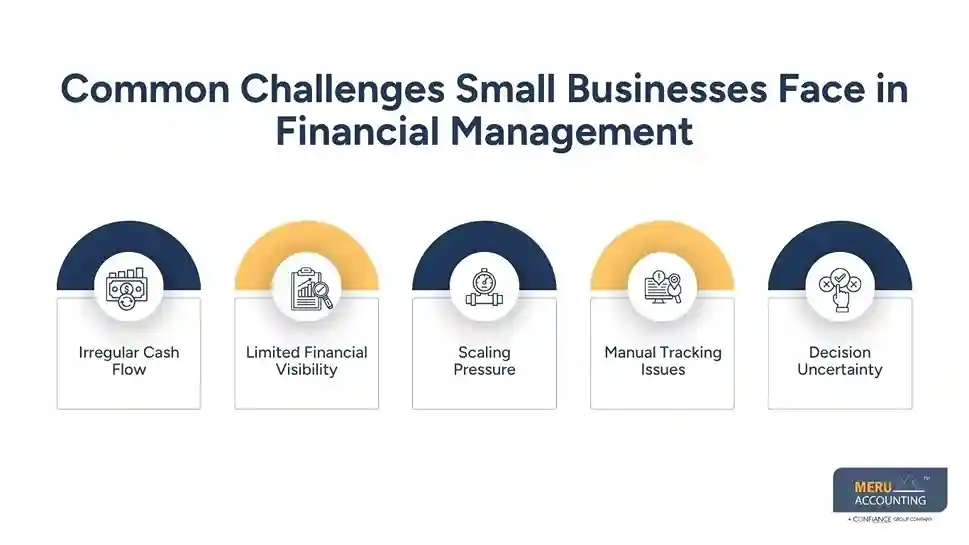
Manual Tracking Issues
Sheets and manual systems often lead to errors and missed entries. Small mistakes can build up over time and impact overall accuracy. It also takes more time to fix errors, which slows down financial reporting.
Decision Uncertainty
Without clear financial reports, decision-making becomes slow and unclear. Business owners may hesitate before making key growth decisions. This delay can result in missed chances or poor timing in financial choices.
Reliable bookkeeping firms help reduce these challenges by creating structured systems.
Key Qualities to Look for in Bookkeeping Firms for Growing Businesses
When evaluating bookkeeping firms, it is important to focus on long-term value, not just basic service cost.
Understanding of Business Growth
They should understand how financial data affects scaling decisions. This includes knowing how cash flow, expenses, and profit patterns change as a business expands. A strong firm connects financial data with real business outcomes instead of treating it as isolated numbers.
Accurate and Timely Reporting
Reports should be updated regularly and easy to understand. Delayed reporting can lead to poor decisions and missed opportunities. Consistent reporting helps business owners stay informed and act quickly when needed.
Scalability of Services
The firm should be able to handle increasing business complexity. As transactions grow, systems should remain smooth and organized. Scalable support ensures the business does not need to switch providers during expansion.
Industry Knowledge
Experience in your industry helps improve accuracy and relevance. Different industries have different financial patterns and requirements. A knowledgeable firm can better anticipate challenges and provide more useful insights.
Strategic Financial Insight
Strong firms help interpret numbers, not just record them. They explain what financial trends mean for future planning. This helps business owners make smarter and more confident decisions.
Use of Modern Systems
Digital tools improve accuracy, speed, and reliability. Automation reduces manual errors and saves valuable time. It also ensures financial data is always accessible and up to date.
How a Bookkeeper for Small Business Supports Scaling Operations
A bookkeeper for small business plays a key role in supporting daily financial operations.
They help businesses by:
- Tracking daily income and expenses
- Maintaining clean financial records
- Monitoring cash flow patterns
- Supporting payroll and vendor payments
- Preparing business-ready financial summaries
As businesses grow, financial activity becomes more complex. A skilled bookkeeper for small business ensures accuracy and reduces financial confusion during expansion.
Many professional bookkeeping firms assign dedicated bookkeepers to ensure consistency and control.
Red Flags When Evaluating Bookkeeping Firms
Not all bookkeeping firms are fit for growing businesses. Watch for these warning signs:
Limited Communication
Slow or unclear replies can lead to long-term problems. This often causes delays in fixing urgent financial issues. Over time, poor talk can also harm trust and work flow between the firm and the business.
No Clear Reporting System
Without set reports, financial choices become hard. Business owners may find it tough to know their real financial state. This lack of clear view can lead to weak plans and missed growth chances.
Only Basic Data Entry Services
If the firm only logs records, it may not support growth. This means they are not giving insight or review for choices. Businesses need more than entry work to handle scale well.
Lack of Business Understanding
Good firms know business goals, not just numbers. Without this view, reports may not match real business needs. This can reduce the value the firm gives beyond basic work.
Outdated Processes
Manual or old systems raise errors and slow down work. They also make it hard to scale as the business grows. New systems are needed for speed, accuracy, and strong financial control.
How to Evaluate and Shortlist the Right Bookkeeping Firms
Choosing the right bookkeeping firms is not only about checking prices or service lists. It is about seeing how well a firm knows your business needs and whether it can support your growth in a clear and set way. A good start is to review how they handle real client cases, not just what they say on paper. Look at how they talk, how fast they reply, and whether they can explain financial reports in simple words that help with choice making.
Another key step is to check their systems, tools, and work style. Good firms often follow a clear method for data entry, balance checks, report making, and review. You should also check whether they offer support like a set bookkeeper for small business, especially if your work is growing. Firms that provide accounting services with set of tools are often better at handling growth issues, cutting errors, and giving steady financial clarity over time.
Meru Accounting – One of the Best Bookkeeping Firms for Small Business Growth
Choosing the right partner is important for long-term success. Meru Accounting is one of the trusted bookkeeping firms that focuses on helping small businesses grow with clarity and structure.
Unlike traditional providers, we focus on financial understanding, not just data recording.
We offer:
- Structured bookkeeping systems for small businesses
- Real-time financial reporting and insights
- Cash flow tracking and management
- Scalable solutions for growing companies
- Dedicated support
Our approach combines accuracy with business understanding, helping owners make better financial decisions.
We also integrate modern accounting practices to ensure smooth, efficient, and scalable financial operations.
Our Expert Perspective
From our experience working with growing businesses, most financial problems do not begin with bookkeeping errors but with limited visibility in daily financial data. When businesses continue using basic tools for too long, they often lose real-time control over cash flow, expenses, and performance tracking. This is why choosing the right bookkeeping firms for accounting services becomes important, as structured systems help maintain accuracy, transparency, and better financial control during growth.
At Meru Accounting, we have seen that businesses make more stable and informed decisions when they move to modern systems supported by professional financial services. A well-structured setup connects financial data with real business actions such as budgeting, pricing, and cost control. With the right firms and proper use of practices, businesses can reduce financial risk, improve compliance, and strengthen long-term decision-making in a reliable and scalable way.
Key Takeaways
- Not all bookkeeping firms provide growth-focused services
- Small businesses face increasing financial complexity during scaling
- A good bookkeeper for small business improves daily financial control
- Key qualities include accuracy, scalability, and business insight
- Red flags include poor communication and outdated systems
- The right firm supports long-term business success
FAQs
Bookkeeping firms manage financial records, track transactions, and help businesses maintain accurate accounts.
A bookkeeper for small business ensures daily financial accuracy and helps maintain stable cash flow.
Businesses should hire bookkeeping firms when financial tracking becomes complex or time-consuming.
Yes, good firms provide insights that support better financial planning and growth decisions.
Before choosing accounting services, look for experience, reporting quality, scalability, communication, and business understanding in a bookkeeping firm.