
Architecture firms today face more than design and client work. They also deal with budgets, billing cycles, vendor costs, payroll, and project-based reporting. As firms grow, financial tasks become harder to manage with basic systems. Hence, specialized bookkeeping for architects is needed to move away from in-house finance handling. They are choosing expert support that understands project-based work. This change helps firms stay accurate, save time, and focus more on design quality and client delivery.
At the same time, digital tools and global finance support models are changing how firms manage money. More firms are adopting outsourced bookkeeping solutions to improve financial control without increasing internal workload.
What You Will Learn From This Blog
In this blog, you will learn:
- Why bookkeeping needs in architecture firms are different
- Common financial problems faced by architecture businesses
- Why in-house accounting is no longer enough
- How outsourced support improves cost control and accuracy
- Why firms are shifting toward professional bookkeeping systems
- How bookkeeping for architects supports growth and stability
Understanding Bookkeeping for Architects in Today’s Design Industry
Bookkeeping in architecture is not just about recording income and expenses. It involves tracking time-based billing, project budgets, consultant fees, material costs, and client payments. These elements are closely tied to project progress and delivery stages. Accurate tracking helps firms understand the real cost of each design project.
Unlike standard businesses, architecture firms often manage multiple projects at once. Each project has its own budget, timeline, and cost structure. This makes financial tracking more complex. Even small tracking errors can affect overall profitability across multiple jobs.
Bookkeeping for architects focuses on:
- Project-based expense tracking: Every expense is assigned to a specific project instead of a general account. This helps firms see exactly where money is being spent. It also improves cost control and reduces financial confusion across projects.
- Client invoicing tied to milestones: Invoices are created based on project stages or milestones completed. This ensures payments align with work progress. It also helps maintain steady cash flow throughout long-term projects.
- Labor cost allocation per project: Employee and contractor hours are tracked and assigned to individual projects. This allows firms to understand true labor costs per job. It also supports better pricing and resource planning.
- Vendor and contractor payments: Payments to suppliers, engineers, and consultants are recorded per project. This ensures all external costs are properly documented. It also helps avoid missed or duplicate payments.
- Cash flow tracking across projects: Incoming and outgoing cash are monitored for each active project. This gives firms a clear view of liquidity at any point in time. It also helps prevent cash shortages during slow payment cycles.
When done correctly, it gives a clear financial view of each project. This helps firms make better pricing and resource decisions. It also improves long term planning and reduces financial uncertainty.
Common Financial Challenges Faced by Architecture Firms
Architecture firms often face financial issues that are not always visible at first. These problems build up over time and affect profitability. Many of these issues come from project-based work and uneven cash flow patterns. Over time, small gaps in tracking can turn into larger financial stress.
Some common challenges include:
Complex project billing cycles
Clients often pay in stages. This creates delays and makes cash flow hard to predict. Payments may depend on project milestones that shift over time. This makes it harder for firms to plan monthly expenses with confidence.
Poor expense tracking
Costs from multiple vendors and consultants can be hard to track without a clear system. Receipts and invoices may come in at different times and from different sources. This leads to missing or delayed entries in financial records, which affects accuracy.
Time tracking issues
Without accurate time logs, project costing becomes unclear. Staff may work across several projects in a single week, which makes allocation difficult. This often results in under billing or unclear profit margins per project.
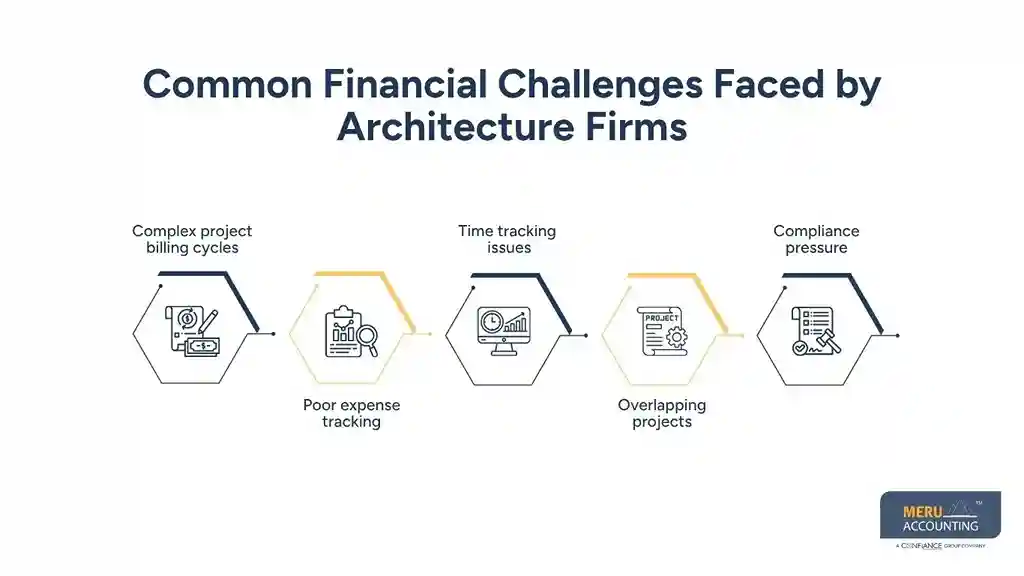
Overlapping projects
Managing several projects at once leads to confusion in financial reporting. Each project may have different timelines, budgets, and billing terms. Without strong systems, it becomes easy to mix up costs and revenue data across projects.
Compliance pressure
Tax rules and reporting standards require accurate and timely records. Missing deadlines or incorrect filings can lead to penalties and audit risks. Firms also need to stay updated with changing financial regulations, which adds more pressure.
These challenges show why bookkeeping for architects is no longer optional but necessary for stable operations. Without structured financial systems, firms risk losing control over profitability and long-term planning.
Why Traditional In-House Accounting is No Longer Enough
Many architecture firms still rely on internal accounting teams or manual spreadsheets. While this may work for small firms, it becomes risky as the business grows.
In-house accounting faces several limits:
- High cost of hiring skilled staff
- Limited industry-specific knowledge
- Manual errors in financial data
- Delayed reporting and updates
- Lack of advanced financial tools
Modern architecture work requires real time financial visibility. In house teams often struggle to keep up with fast changing project data.
This is why firms are moving toward outsourced bookkeeping solutions that offer structured systems and specialized knowledge.
Cost Benefits of Outsourced Bookkeeping Solutions for Architecture Firms
One of the main reasons firms shift to external support is cost control. Hiring a full-time finance team is expensive. It also includes training, software, and management costs. These ongoing expenses can strain small and mid-sized architecture firms. Over time, fixed payroll costs reduce financial flexibility and limit growth options.
With outsourced bookkeeping solutions, firms only pay for what they need. This reduces fixed costs and improves flexibility. Firms can scale services up or down based on project load. This helps maintain better control over monthly budgets and spending.
Key cost benefits include:
Lower staffing expenses: Firms do not need to hire full-time accountants or bookkeeping staff. This reduces salary, benefits, and onboarding costs. It also removes the need for continuous training and supervision.
No need for full-time accounting infrastructure: There is no requirement to maintain a complete in-house finance setup. This saves space, resources, and administrative effort. Firms can instead focus their internal teams on core design work.
Reduced software and tool costs: Outsourcing providers already use advanced accounting tools. This removes the need for firms to purchase or maintain expensive software licenses. It also ensures access to updated systems without extra investment.
Flexible pricing based on project volume: Costs are aligned with the number of projects or transactions handled. Firms only pay for actual work done instead of fixed monthly overheads. This makes financial planning more predictable and efficient.
Better financial efficiency overall: Streamlined bookkeeping improves accuracy and reduces waste in financial processes. Firms gain clearer insight into project profitability and cost structure. This leads to stronger financial decisions over time.
In addition, outsourcing reduces costly errors. Even small mistakes in project costing can affect profitability. Accurate bookkeeping for architects helps avoid these issues. Better financial control also supports long term stability and smoother project execution.
Meru Accounting's Outsourced Bookkeeping Solutions
At Meru Accounting, we understand the financial structure of architecture firms. Our focus is on delivering accurate, clear, and timely bookkeeping support designed for project based industries.
Our outsourced bookkeeping solutions include:
- Project wise financial tracking
- Invoice and payment management
- Expense categorization and reporting
- Payroll and contractor payment support
- Monthly financial reporting
- Tax ready bookkeeping records
We use cloud-based systems to ensure real time access to financial data. This helps architecture firms stay updated on project performance at all times.
Our goal is to simplify bookkeeping for architects so firms can focus more on design work and client satisfaction instead of financial stress.
Our Expert Insight
From our experience, architecture firms perform best when financial systems are structured and consistent. Many firms struggle not because of lack of projects, but because of unclear financial visibility.
When bookkeeping is handled properly:
- Project budgets stay under control
- Cash flow becomes more stable
- Profit margins are easier to track
- Decision-making becomes faster and clearer
We have seen that firms using outsourced bookkeeping solutions reduce financial confusion and improve long term planning. It also helps them scale without financial pressure.
Key Takeaways
- Architecture firms deal with complex, project-based finances
- Traditional accounting systems often fail to keep up
- Bookkeeping for architects improves financial clarity and control
- Outsourcing reduces cost and improves accuracy
- Outsourced bookkeeping solutions offer flexibility and scalability
- Professional support helps firms focus on design and growth
- Clean financial data leads to better business decisions
FAQs
Architecture firms manage multiple projects with different costs. Bookkeeping helps track income, expenses, and project budgets clearly.
It focuses on project-based accounting, milestone billing, and cost tracking for each design project.
Yes, they reduce fixed staffing costs and offer flexible pricing based on business needs.
They use structured systems and expert review to reduce errors in financial records and reporting.
Yes, accurate financial data improves decision-making, project planning, and long-term business growth.