
Managing finances is one of the most important responsibilities for any nonprofit organization. Clear records help build trust, maintain donor confidence, and ensure smooth operations. This is where bookkeeping for nonprofits becomes essential.
Good financial records allow nonprofits to track every donation, expense, and grant in a structured way.
However, many organizations struggle with limited staff, tight budgets, and complex reporting requirements. This makes managing financial records for nonprofit organizations even more important, but also more challenging.
When done properly, bookkeeping for nonprofits helps organizations stay transparent and compliant without adding extra financial pressure.
In this blog, you will learn simple ways to manage financial records, reduce workload, and improve accuracy while keeping costs under control.
What You Will Learn From This Blog
- Why bookkeeping for nonprofits is important for financial clarity and donor trust
- Common challenges faced by nonprofit organizations in managing accounts
- Practical ways to simplify financial recordkeeping without extra cost
- How outsourced financial management for nonprofits can reduce workload and expenses
- Steps to smoothly move toward external bookkeeping support for nonprofits without disruption
Introduction to Bookkeeping For Nonprofits
Meaning Of Bookkeeping For Nonprofits
Bookkeeping for nonprofits refers to recording all financial transactions such as donations, grants, expenses, and fundraising income. It ensures every dollar is tracked properly. This helps organizations stay accountable and transparent.
Role Of Financial Records In Nonprofits
Accurate records are the base of strong decision-making. Maintaining financial records in nonprofit organizations allows leaders to understand where money is coming from and how it is being spent. This helps in planning future programs effectively.
Importance Of Regular Updates
Updating records regularly prevents confusion at the end of the financial year. With bookkeeping for nonprofits, nonprofits can avoid errors and last-minute stress during audits or reporting.
Tools Used In Bookkeeping For Nonprofits
Many organizations use simple accounting software or spreadsheets. Still, financial record-keeping in nonprofit organizations must be done carefully to ensure all transactions are recorded correctly and consistently.
Impact On Transparency And Trust
Donors want clarity about how funds are used. Proper financial record-keeping builds trust and shows that funds are managed responsibly.
Understanding The Importance Of Bookkeeping For Nonprofits
Supports Financial Accountability
Nonprofits must show how funds are used. Proper financial record-keeping ensures every transaction is recorded clearly, making accountability easier.
Helps In Budget Planning
Proper records help organizations plan budgets better. With bookkeeping for nonprofits, leaders can allocate funds to the right programs.
Improves Donor Confidence
Donors prefer organizations that maintain clean records. Strong financial record-keeping helps build long-term trust with supporters.
Simplifies Audit Preparation
Audits can be stressful without proper records. Bookkeeping for nonprofits makes it easier to provide the required financial documents quickly.
Tracks Grant Utilization
Many nonprofits receive restricted grants. Proper financial record-keeping ensures funds are used only for intended purposes.
Common Bookkeeping Challenges Faced By Nonprofits
Limited Financial Staff
Many nonprofits do not have full-time accountants. This makes financial record-keeping difficult and time-consuming for small teams handling multiple tasks.
Manual Recordkeeping Errors
Paper-based or manual systems can lead to mistakes. These errors affect bookkeeping for nonprofits accuracy and create reporting issues later.
Complex Reporting Requirements
Different donors require different reports. Managing financial records for nonprofit organizations becomes complicated under such conditions and increases workload.
Lack Of Proper Systems
Without proper tools, financial record-keeping in nonprofit organizations becomes inconsistent and hard to manage over time. It also makes tracking expenses and donations more difficult.
Time Constraints
Staff often handle multiple roles. This reduces focus on bookkeeping for nonprofits, leading to delays in updates and reporting.
Best Practices To Simplify Bookkeeping For Nonprofits
Use Simple Accounting Tools
Using basic software helps reduce manual work and saves time in daily operations. This improves efficiency in nonprofit financial record-keeping and reduces errors in recording transactions.
Record Transactions Regularly
Daily or weekly updates avoid backlog and confusion in financial data. It keeps financial records in nonprofits accurate and organized throughout the year for smooth reporting.
Separate Funds Clearly
Different funds should be tracked separately for better control and clarity. This makes nonprofit financial record-keeping more transparent and easier to review during audits.
Train Staff On Basic Accounting
Even non-finance staff should understand basic accounting steps and processes. This supports better financial record management in nonprofits and improves overall record accuracy.
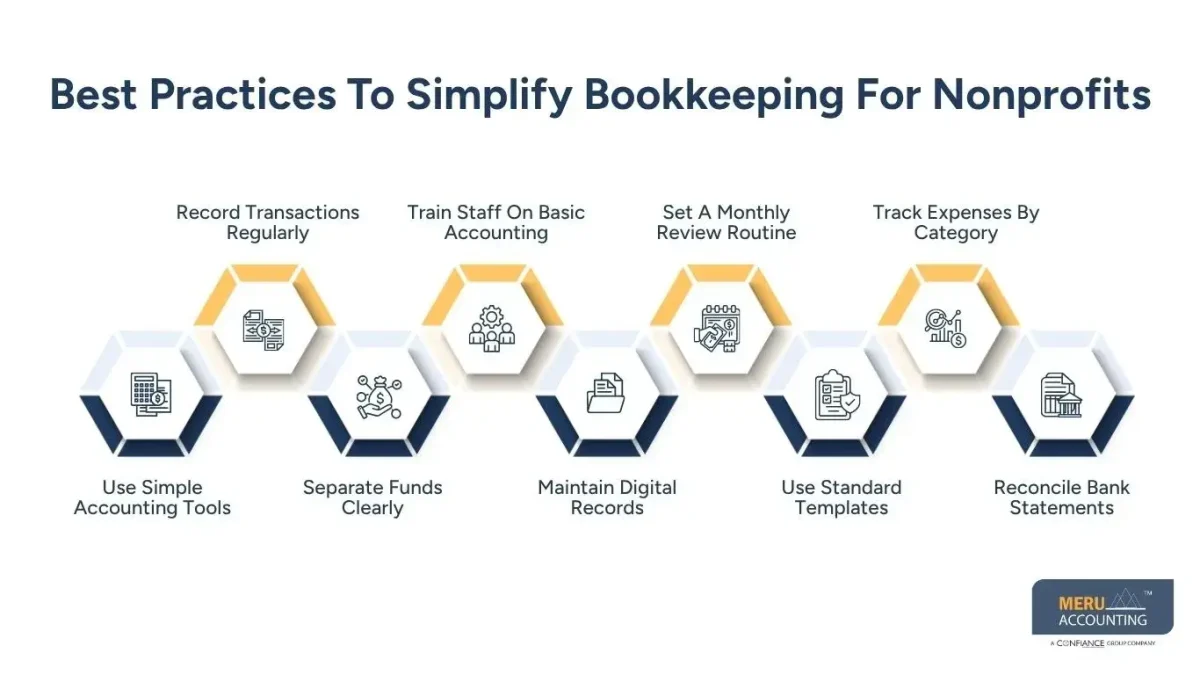
Maintain Digital Records
Digital files are easier to store, search, and retrieve when needed quickly. They improve the reliability of nonprofit financial records and reduce paperwork issues significantly.
Set A Monthly Review Routine
Reviewing accounts every month helps catch errors early and keeps records clean. It supports better financial oversight in nonprofits by improving financial control and planning.
Use Standard Templates
Using fixed templates for invoices and reports reduces confusion and saves time. This makes bookkeeping for nonprofits more consistent and easier to manage.
Track Expenses By Category
Grouping expenses into clear categories helps to understand spending patterns better. It improves accuracy in nonprofit financial records and supports better budgeting decisions.
Reconcile Bank Statements
Regular bank reconciliation ensures records match actual bank transactions. This strengthens nonprofit financial record accuracy and reduces the chances of financial mismatch.
Best Practices For Managing And Recording Donations In Bookkeeping For Nonprofits
Create A Clear Donation Tracking System
Maintain a structured system that captures donor details, date, and purpose of each contribution. Organized records help avoid confusion and keep financial information consistent.
Record Donations Immediately
Enter donation details as soon as funds are received to prevent missing or incorrect entries. Timely updates improve accuracy and reduce end-of-period corrections.
Separate Restricted And Unrestricted Funds
Classify funds based on donor instructions and usage conditions from the beginning. Clear separation ensures proper usage and easier reporting.
Issue Proper Donation Receipts
Provide receipts that include donation amount, date, and organization information for every contribution. Receipts strengthen transparency and help maintain donor confidence.
Reconcile Donations With Bank Statements
Match recorded donations with bank deposits on a regular schedule. Regular checks help identify discrepancies and maintain accurate financial records.
Maintain Digital Donation Records
Store all donation information in secure digital formats for easy access and tracking. Digital systems reduce paperwork and support faster reporting when needed.
How Outsourced Bookkeeping For Nonprofits Reduces Costs
Lower Staffing Expenses
Hiring full-time staff can be costly and adds long-term salary commitments. With outsourced financial services for nonprofits, organizations save on salary, training, and onboarding costs.
Access To Skilled Professionals
Experts handle financial records efficiently with better accuracy and experience. External bookkeeping support for nonprofits ensures better accuracy at a lower overall cost.
Reduced Technology Costs
Outsourcing reduces the need to buy and maintain expensive accounting tools. This makes outsourced bookkeeping for nonprofits more affordable and budget-friendly.
Better Time Management
Internal teams can focus more on programs and donor activities. External bookkeeping teams handle financial tasks smoothly and consistently.
Fewer Financial Errors
Professionals reduce mistakes in recording and reporting financial data. This improves accuracy in nonprofit financial records and reduces correction costs overall.
Steps To Transition To Outsourced Bookkeeping For Nonprofits
Evaluate Current Financial Process
Understand existing gaps and current accounting methods before switching. This helps prepare for outsourced financial management for nonprofits in a more structured and effective way.
Choose The Right Service Provider
Select experienced professionals who understand nonprofit accounting needs clearly. Good external bookkeeping support for nonprofits ensures a smooth and stress-free transition process.
Transfer Financial Data Safely
Ensure secure sharing of financial records and sensitive information during transition. This is important for successful outsourced financial operations and data protection.
Set Clear Communication Channels
Regular updates and clear communication help avoid confusion in daily work. This supports external bookkeeping operations and improves coordination.
Monitor Initial Performance
Track reports and service quality after outsourcing begins. This ensures outsourced financial support for nonprofits meets expectations and delivers accurate results.
How Meru Accounting Supports Nonprofits
- Meru Accounting provides reliable financial support tailored for nonprofit organizations with a focus on accuracy and consistency. The goal is to simplify bookkeeping for nonprofits while keeping costs under control.
- Meru Accounting designs customized financial systems based on the specific needs of each nonprofit. This improves accuracy and efficiency in daily operations for nonprofit bookkeeping.
- A skilled and experienced accounting team manages day-to-day records with care and attention to detail. This strengthens external bookkeeping services for nonprofit clients.
- The focus is on reducing operational expenses while maintaining high-quality service standards. External bookkeeping support from Meru Accounting ensures affordability and value.
- Proper compliance, reporting, and financial regulations are maintained at all times for nonprofits. This improves reliability of nonprofit financial records and helps avoid errors or delays.
- Meru Accounting also ensures a smooth and simple onboarding process for organizations switching from in-house systems. This makes outsourced financial management for nonprofits easy and stress-free.
Key Takeaways
- Bookkeeping for nonprofits is essential for transparency and financial control. It helps track donations, expenses, and grants clearly, which builds donor trust and supports better decision-making.
- Poor systems can lead to errors and reporting delays. Without proper processes, financial records may become inaccurate and create issues during audits or reporting periods.
- Simple tools and regular updates improve efficiency. Keeping records updated on a daily or weekly basis reduces confusion and makes financial management more organized.
- outsourced bookkeeping for nonprofits helps reduce costs and workload. It removes the need for full-time staff and costly systems while ensuring accurate financial handling.
- Choosing the right support partner improves financial management. A reliable service provider ensures proper records, timely reporting, and better financial control for the organization.
FAQs
Bookkeeping for nonprofits helps track donations and expenses clearly. It ensures financial transparency and donor trust.
Yes, but it can be time-consuming. Many choose bookkeeping for nonprofits support or outsourcing for better accuracy.
outsourced bookkeeping for nonprofits reduces staffing and software costs. It also lowers the risk of financial errors.
They should track donations, expenses, grants, and payroll. Proper financial record-keeping ensures all records are complete.
Yes, when done by trusted providers. outsourced bookkeeping for nonprofits uses secure systems for data protection.