

Bookkeeping for startups is one of the first and most important financial tasks for any new business. In the early stage, every transaction matters, and poor records can create long-term financial stress. This process gives clear insight into cash flow, spending patterns, and business health from day one.
Many founders ignore financial record-keeping in the early phase and focus only on sales or product growth. This often leads to missing records, tax issues, and confusion in financial planning. Strong financial tracking builds clarity and helps avoid these risks.
In simple terms, this process is not just record-keeping. It is a system that helps track money movement in a structured way so that decisions are based on real numbers, not guesses.
What You Will Learn From This Blog
- Why bookkeeping for startups is important from day one
- How startup bookkeeping creates financial clarity
- Common mistakes founders make in early records
- How investors depend on accurate financial tracking
- When outsourcing bookkeeping makes sense for new businesses
- How to select the right support for managing early-stage finances
What Is Bookkeeping For Startups And Why It Matters
Bookkeeping for startups refers to the process of recording all financial transactions such as sales, expenses, payments, and income in a structured system. It provides a clear picture of how money moves within the business on a daily basis.
In simple terms, it focuses on maintaining accurate records, while accounting deals with interpreting these records and preparing financial reports. Without proper daily records, accounting outputs can lose accuracy and reliability.
Early-stage businesses depend heavily on structured financial tracking to avoid cash shortages and confusion in day-to-day operations. Even small recording errors can grow into larger financial gaps over time if not corrected early.
Strong financial tracking also plays an important role in decision-making, allowing founders to set pricing, manage hiring, and control spending based on real figures rather than assumptions. This approach is often referred to as startup bookkeeping in practice.
In addition, maintaining proper financial records ensures compliance with tax requirements and legal reporting standards. It reduces the risk of penalties, missing documents, or errors during audits.
Overall, consistent and accurate record-keeping creates financial discipline and stability in the early stages of a business, making it easier to manage growth with confidence.
How Startup Bookkeeping Builds A Strong Financial Foundation
Clear Cash Flow Tracking
Bookkeeping for startups tracks every inflow and outflow of cash. This helps founders understand if the business can sustain monthly costs.
Budget Control And Planning
With startup bookkeeping, budgeting relies on real financial data instead of assumptions. Founders can plan expenses in a practical and realistic manner. Efficient fund allocation becomes easier across operations, marketing, and development.
Financial Discipline From Day One
Regular financial tracking builds a habit of consistent monitoring from the start, reducing careless spending through structured oversight. Stronger accountability develops across all financial decisions within the business.
Accurate Profit Understanding
Clear financial recording separates revenue from actual profit after expenses. Many new businesses misunderstand this difference, which leads to poor financial decisions. Reliable financial insight strengthens decision-making for reinvestment and cost control.
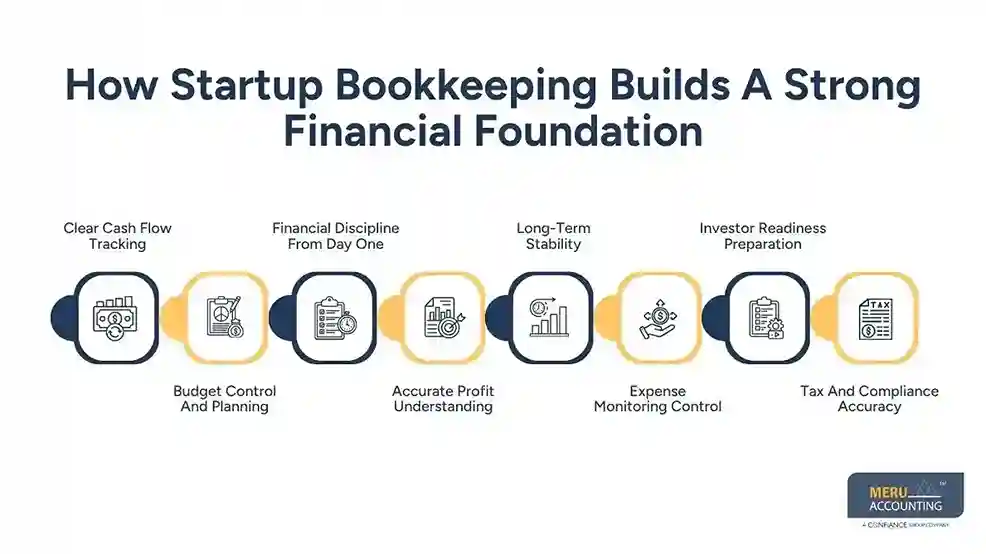
Long-Term Stability
Strong financial record systems create a stable structure that supports future growth. Planning for hiring, expansion, and investments becomes more structured. Financial uncertainty reduces significantly, making scaling more predictable and controlled.
Expense Monitoring Control
Detailed tracking of expenses helps identify unnecessary or repeated costs early. Better cost visibility allows founders to optimize spending without affecting operations. Over time, tighter control improves overall financial efficiency.
Investor Readiness Preparation
Clean financial records make business data more reliable for investors. Organized statements build confidence during funding discussions and evaluations. Transparent reporting increases the chances of successful investment approvals.
Tax And Compliance Accuracy
Accurate record-keeping ensures smoother tax filing and regulatory compliance. Missing or incorrect data often leads to penalties and delays. Proper documentation reduces audit risks and improves legal readiness.
Challenges in Startup Bookkeeping and How to Overcome Them
Missing Transaction Records
Many startups miss recording small expenses during daily operations. Bookkeeping for startups ensures consistent daily entry and proper tracking systems. Accurate recording habits prevent financial gaps and reporting errors later.
Mixing Personal And Business Expenses
New businesses often struggle with combining personal and business spending accounts. Maintaining separate accounts ensures precise expense classification, accurate reporting, and easier tax compliance.
Lack Of Financial Knowledge
Founders may not fully understand accounting and finance systems, which can lead to errors and incomplete records. Professional services provide expert guidance, practical support, and structured processes to improve accuracy and reduce common financial mistakes.
Irregular Record Updates
Delayed entries reduce accuracy in financial records and reporting systems. Regular schedules ensure timely updates and maintain stronger control over accounts, improving decision-making and reducing end-of-month workload pressure.
Poor Software Usage
Many startups use inefficient tools for managing financial data. Proper software improves accuracy, simplifies tracking, reduces errors, and enhances financial visibility.
How Bookkeeping Supports Investor Readiness And Fundraising
Clean Financial Statements
Investors trust startups with proper financial record management because it shows clean and structured records. Accurate statements allow easy review of business performance and financial health.
Proof Of Business Stability
Organized financial records provide clear evidence of revenue, expenses, and growth trends for investors. Consistent reporting reflects stability and disciplined financial management.
Faster Due Diligence
Investors spend less time verifying data when records are properly maintained. Reliable documentation speeds up review processes and reduces back-and-forth queries during funding discussions.
Better Valuation Clarity
Proper startup bookkeeping helps businesses present correct valuations to potential investors. Clear numbers support realistic discussions about company worth and future potential.
Improved Trust Level
Effective bookkeeping for startups increases investor confidence in financial management and reporting accuracy. Trust grows when all financial decisions and results are clearly documented.
When Should Startups Outsource Bookkeeping Services
Early Stage Complexity
When transactions increase, managing financial records internally becomes challenging. Proper systems or external help may be required.
Lack Of Time
Founders often focus on growth, so delegating financial tasks saves valuable time. Outsourcing allows more attention to core business activities.
Cost Efficiency
Hiring full-time staff may be expensive for early-stage companies. External services offer flexible pricing and scalable support.
Need For Accuracy
Professional support reduces errors in financial records and improves reliability. Accurate documentation ensures smoother reporting and compliance.
Scaling Business Needs
As startups grow, financial management needs become more structured and complex. External support helps maintain consistency during expansion and scaling.
How To Choose The Right Bookkeeping Partner For Your Startup
Industry Experience
Choose a partner skilled in bookkeeping for startups and early-stage companies. Experience with young businesses ensures better handling of common financial challenges and reporting needs.
Software Knowledge
A strong startup bookkeeping partner should use modern tools for accuracy and speed. Proper systems reduce errors and make financial tracking more efficient.
Clear Communication
Good financial service providers explain reports in simple language. Clear communication helps founders understand their financial position without confusion.
Security of Data
Financial data safety is a key priority in managing startup finances. Secure systems protect sensitive information from unauthorized access or misuse.
Flexible Service Plans
Startups need flexible financial service packages that grow with business size. Scalable options ensure support remains suitable during different growth stages.
Why Choose Meru Accounting For Startup Bookkeeping
Meru Accounting offers structured and reliable financial services designed for early-stage businesses that need strong control over their records. Our team provides a clear system that tracks every transaction in real time, ensuring accuracy and transparency through professional bookkeeping for startups.
We understand that managing daily records is not just data entry but a process that shapes future financial decisions. Our experts handle cash flow tracking, financial reporting, and compliance with close attention to detail.
Meru Accounting works with global clients, especially in the US and other regions, offering scalable solutions that adjust as your business grows.
Modern accounting tools reduce errors and improve reporting speed, while our approach focuses on clarity, accuracy, and long-term financial structure so founders can rely on startup bookkeeping expertise instead of manual record-keeping.
Key Takeaways
- Proper bookkeeping for startups is essential from the first day of business
- Strong financial tracking reduces confusion and errors in daily operations
- Investors prefer businesses with clean and structured financial records
- Poor record management can lead to tax and compliance issues
- Outsourcing startup bookkeeping saves time and improves accuracy
- Choosing the right financial partner is important for long-term stability
Our Expert Perspective
At Meru Accounting, experience with early-stage businesses shows a clear pattern: startups that implement strong bookkeeping for startups practices from the beginning face fewer financial issues later.
Many operational challenges arise not from low revenue but from inconsistent or weak record-keeping. Delaying financial tracking until tax season often creates stress and incomplete data, whereas a structured daily system improves accuracy, ensures compliance, and provides clear financial visibility.
Early clarity allows founders to make informed decisions and reduces risk during business growth and expansion.
FAQs
Bookkeeping for startups is important from day one because it tracks every financial movement and prevents future confusion in records.
Bookkeeping for startups records daily transactions, while accounting focuses on reports and financial analysis.
Startup bookkeeping can be done manually, but software gives better accuracy and saves time in tracking records.
A startup should outsource bookkeeping for startups when transactions increase or internal time becomes limited.
Startups commonly use tools like Zoho Books, QuickBooks Online, and Xero for accurate and automated financial record-keeping.