




Bookkeeping for the construction industry is very different from bookkeeping in other businesses. Construction companies manage multiple projects at the same time, track job-based costs, pay workers under different wage rules, and handle subcontractors with strict compliance needs.
When this work is handled without a clear structure, financial problems slowly build up—often without being noticed until serious damage is done.
Many construction businesses start with basic record-keeping methods. At first, this may seem manageable. But as projects grow, invoices increase, payroll becomes complex, and reporting deadlines tighten, unstructured bookkeeping creates confusion instead of clarity.
This lack of organization affects cash flow, project profitability, compliance, and decision-making. In this blog, we explain what really happens when bookkeeping for the construction industry is handled without structure and why organized systems are essential for long-term stability.
What You Will Learn From This Blog
- What unstructured bookkeeping looks like in construction businesses
- Why structure is essential in bookkeeping for the construction industry
- Common financial risks caused by poor bookkeeping
- How disorganized records affect cash flow and job profitability
- Compliance issues created by unorganized bookkeeping
- Warning signs that your business needs structured bookkeeping support
- How outsourced support brings consistency and control
What “Unstructured” Bookkeeping Looks Like in Construction Businesses
Unstructured bookkeeping does not always mean that records are missing. In many cases, records exist but are scattered, incomplete, or inconsistent.
Outsourced construction bookkeeping helps centralize records and maintain consistent accounting practices.
In construction businesses, unstructured bookkeeping often includes:
- Expenses recorded without linking them to specific projects
- Labor costs are not tracked by job or phase
- Subcontractor invoices entered late or without proper classification
- Change orders recorded outside the accounting system
- Bank reconciliations are delayed for months
- Financial reports are prepared only at tax time
When bookkeeping for the construction industry lacks structure, data cannot be trusted. Business owners are left guessing instead of relying on real numbers.
This creates a situation where decisions are made based on estimates, not actual financial performance.
Importance of Well-Organized Structure in Bookkeeping for the Construction Industry
A structured approach to bookkeeping for the construction industry ensures that every financial activity is recorded, classified, and reviewed consistently.
Well-organized bookkeeping allows construction businesses to:
- Track project costs accurately
- Monitor labor and material expenses
- Understand project-level profitability
- Prepare reliable financial statements
- Meet tax and labor compliance requirements
Construction projects are long-term and cost-heavy. Without structure, small recording errors can turn into large financial losses. Structured bookkeeping creates clarity across every stage of a project, from bidding to completion.
It also supports planning, budgeting, and forecasting, which are critical in construction operations.
Common Financial Risks Caused by Poor Bookkeeping for the Construction Industry
When bookkeeping for the construction industry is poorly managed, financial risks increase across the business.
Incorrect Job Costing
Unstructured bookkeeping makes it difficult to track costs by project. Labor, materials, and overhead may be recorded incorrectly or not assigned at all. This results in inaccurate job costing and unreliable profit reports.
Cash Shortages
Without proper tracking of receivables and payables, construction businesses may believe they have available cash when they do not. This leads to delayed payments to vendors, workers, and subcontractors.
Overbilling or Underbilling
Progress billing depends on accurate cost tracking, which outsourced construction bookkeeping maintains through systematic job costing.
Poor bookkeeping leads to incorrect invoices, disputes with clients, and delayed payments.
Tax Errors
Missing or incorrect records increase the risk of tax filing mistakes, penalties, and audits.
These risks grow when bookkeeping for the construction industry is treated as an afterthought instead of a core business function.
Poor Cash Flow Forecasting
Unstructured bookkeeping makes it difficult to forecast cash needs accurately, which can lead to short-term borrowing or project delays.
Uncontrolled Overhead Costs
Without proper tracking, overhead expenses may increase unnoticed, reducing overall profitability and affecting project budgets.
Weak Financial Decision Making
When financial data is inconsistent, business owners cannot make informed decisions. Outsourced construction bookkeeping delivers accurate financial data to support better decisions.
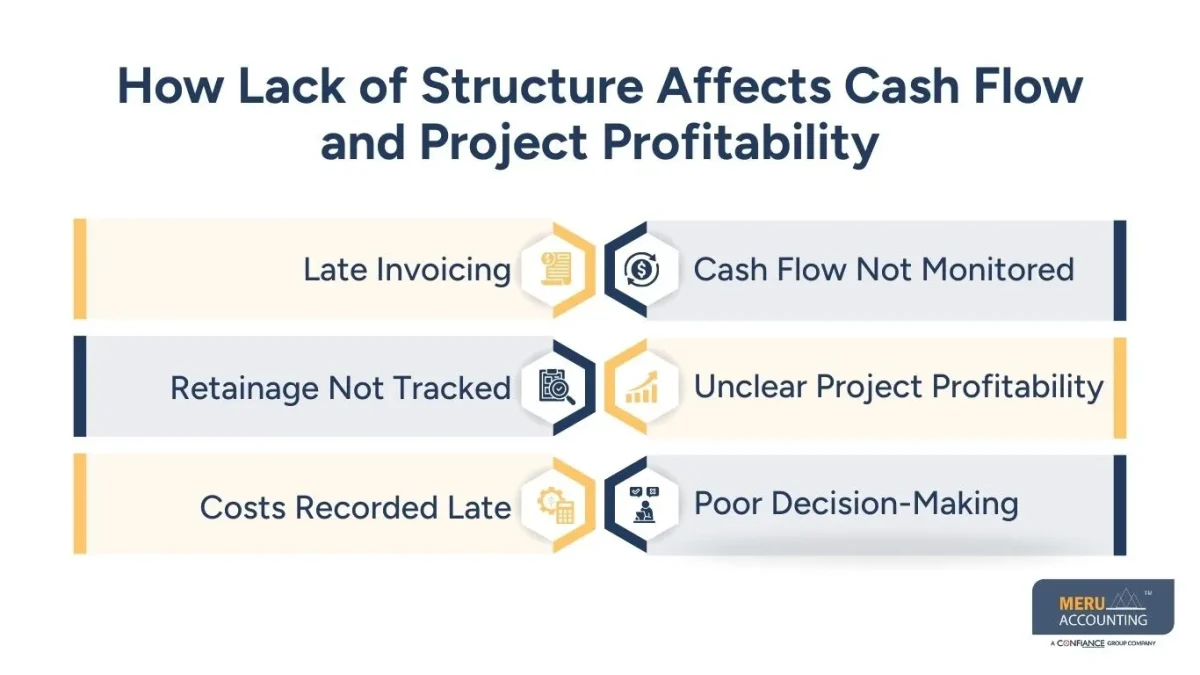
How Lack of Structure Affects Cash Flow and Project Profitability
Cash flow is one of the biggest challenges in construction. Outsourced construction bookkeeping helps maintain accurate cash flow records and improves financial planning.
Late Invoicing
When bookkeeping for the construction industry is unstructured, invoices are often sent late.
This delays cash inflow and increases pressure on working capital.
Retainage Not Tracked
Retainage is often missed or recorded incorrectly without proper bookkeeping.
This results in delayed payments and unexpected cash shortages.
Costs Recorded Late
Costs are recorded after payments are due, making budgets unreliable.
This hides true project expenses and reduces profit visibility.
Cash Flow Not Monitored
Project cash flow is not reviewed regularly without structured bookkeeping.
This leads to surprise shortages and poor planning for new work.
Unclear Project Profitability
When costs and income are not tracked by project, profitability becomes unclear.
Losses may only be discovered after project completion.
Poor Decision-Making
Without accurate financial data, businesses cannot plan or bid effectively.
This increases the risk of taking on unprofitable projects.
Compliance Challenges When Bookkeeping for the Construction Industry Is Not Organized
Construction businesses face strict compliance requirements related to payroll, subcontractors, and taxes.
Unorganized bookkeeping for the construction industry often leads to:
- Incorrect worker classification
- Missing subcontractor tax documents
- Late payroll filings
- Inaccurate sales or use tax reporting
- Incomplete audit trails
These issues can result in penalties, legal disputes, and loss of business reputation.
Organized bookkeeping ensures that compliance tasks are handled consistently and on time, reducing financial and legal risk.
Signs Your Construction Business Needs Structured Bookkeeping Support
Many construction business owners do not realize their bookkeeping is unstructured until problems appear.
Common warning signs include:
- Not knowing which projects are profitable
- Struggling to prepare financial reports
- Frequent corrections during tax filing
- Delayed invoicing and collections
- Difficulty managing payroll and subcontractors
- Confusion during audits or reviews
If these issues exist, it is a clear sign that bookkeeping for the construction industry needs a structured approach.
How Outsourced Construction Bookkeeping Brings Consistency
Outsourced construction bookkeeping provides construction businesses with structured systems, trained professionals, and consistent processes.
Standardized Job Costing
Outsourced bookkeeping uses consistent methods to assign costs to each project. This improves accuracy and helps track profitability correctly.
Regular Financial Reporting
Outsourced services follow a fixed reporting schedule for every month or quarter. This ensures business owners always have up-to-date financial insights.
Accurate Payroll and Subcontractor Tracking
Payroll and subcontractor payments are recorded with correct classifications. This reduces errors and supports compliance with labor rules.
Timely Bank Reconciliations
Bank reconciliations are completed on time every month. This helps identify errors, missing payments, and cash issues early.
Clear Audit Documentation
Outsourced bookkeeping maintains organized records for audits and compliance. This reduces risk during tax filing and financial reviews.
Consistent Processes and Continuity
Outsourced bookkeeping follows documented procedures instead of relying on one person. This ensures continuity even when staff changes or workloads increase.
Better Financial Visibility
Construction businesses gain clear, reliable financial data without internal burden. This supports better decision-making and improves project control.
How Meru Accounting Supports Structured Bookkeeping for the Construction Industry
Meru Accounting provides specialized bookkeeping for the construction industry with a focus on structure, accuracy, and consistency.
Our services are designed to support construction businesses by:
- Implementing project-based bookkeeping systems
- Maintaining accurate job costing records
- Managing payroll and subcontractor payments
- Preparing clear financial reports for decision-making
- Supporting compliance with tax and labor regulations
- Tracking retainage and progress billing accurately
- Providing regular review and reconciliation of project accounts
Meru Accounting understands the operational challenges of construction businesses. Our team follows defined processes to ensure that bookkeeping for the construction industry remains organized throughout the year.
By offering outsourced construction bookkeeping, Meru Accounting helps construction companies move away from reactive bookkeeping and toward reliable financial management.
For construction businesses seeking organized and dependable financial records, Meru Accounting delivers structured bookkeeping services designed for project-based operations. Contact us to learn how our team can support your accounting needs.
Key Takeaways
- Bookkeeping for the construction industry requires structure due to project-based operations
- Unstructured bookkeeping leads to cash flow issues, compliance risks, and unclear profitability
- Organized bookkeeping improves job costing, reporting, and decision-making
- Compliance becomes manageable with consistent record-keeping
- Outsourced construction bookkeeping introduces reliable processes and trained support
FAQs
Unorganized bookkeeping leads to wrong project costs, unclear cash flow, and unreliable financial reports. This causes losses, late payments, and compliance problems.
Structured bookkeeping tracks job costs, payroll, and expenses accurately. It helps construction businesses know which projects are profitable and stay compliant.
Without structure, costs are not assigned correctly to each project. This hides losses and makes profitability unclear.
Yes, outsourced bookkeeping brings consistent processes and clear job cost tracking. It helps clean up records and keeps financials organized going forward.
Switch when cash flow is hard to track or when financial reports are delayed. Also consider it if compliance issues or accounting errors keep happening.


