A flat 21% tax rate sounds simple until a C corporation has to file its tax return. One business may claim large write-offs for new equipment, while another may have higher payroll costs or fewer tax breaks. Both may earn the same amount but end up with very different tax bills. That’s where understanding C corporation tax brackets becomes important.
For 2026, most C corporations pay a flat 21% federal tax on taxable income. But what counts as taxable income, which costs can a company write off, and how do state taxes affect the final bill? These are the details business owners need to get right when planning their taxes.
What You Will Learn From This Blog
- How C corporation tax brackets work in 2026.
- The federal tax rate that applies to C corporations.
- How to work out taxable income and estimate corporate tax.
- Which tax breaks may lower a corporation’s tax bill.
- How double taxation affects owners.
- Key Form 1120 filing rules and tax dates for 2026.
What Are C Corporation Tax Brackets?
C corporation tax brackets are the tax rates used to work out the federal income tax a C corporation owes. Unlike the tax system for people, which has several income bands and rates, the federal tax system for most C corporations uses one flat rate.
Under Section 11 of the Internal Revenue Code, a C corporation is taxed at 21% of its taxable income. This rate applies to the full amount of taxable income, not just the part above a set income level.
For example, a C corporation with $100,000 in taxable income owes $21,000 in federal income tax before any tax credits or other items that may change its final tax bill.
C corporations file their own tax returns and pay tax as separate legal tax entities. This is one of the main ways they differ from sole proprietorships, partnerships, and S corporations, where business income often passes through to the owners’ tax returns.
It is also worth noting that the 21% rate is a federal rate. A corporation may owe extra tax to the state where it does business. Some states also have minimum taxes or other fees, even when a company has little or no taxable income.
optional anymore
on running the business
C Corporation Tax Brackets in 2026: Federal Tax Rates Explained
The federal corporate income tax rate remains 21% in 2026 for most C corporations. There are no separate federal tax bands for small, mid-size, or large C corporations.
Taxable corporate income | Federal tax rate | Federal income tax |
$50,000 | 21% | $10,500 |
$100,000 | 21% | $21,000 |
$250,000 | 21% | $52,500 |
$500,000 | 21% | $105,000 |
$1,000,000 | 21% | $210,000 |
These are simple estimates based on taxable income and do not include state taxes, tax credits, or other tax items.
The flat rate makes it easier to estimate federal corporate tax. However, it does not mean every dollar a business earns is taxed. A corporation first works out its taxable income after allowed business costs, deductions, and other tax adjustments.
For this reason, business owners should not use total sales or gross revenue as the base for their tax estimate. They need to look at taxable income.
How C Corporation Taxes Are Calculated
To understand how C corporation taxes are calculated, a business must first find its taxable income. This is not always the same as the profit shown in its books.
The IRS allows corporations to deduct eligible business costs, but some expenses may have different tax rules. The main steps are:
1. Calculate gross income
Start with the income earned from sales, services, and other business activities. Adjust this amount for returns, allowances, and other items that apply.
2. Subtract allowed business expenses
Deduct eligible costs, such as:
- Employee wages and benefits
- Rent and utility bills
- Business insurance
- Office and supply costs
- Marketing and advertising
- Professional and legal fees
- Eligible business travel costs
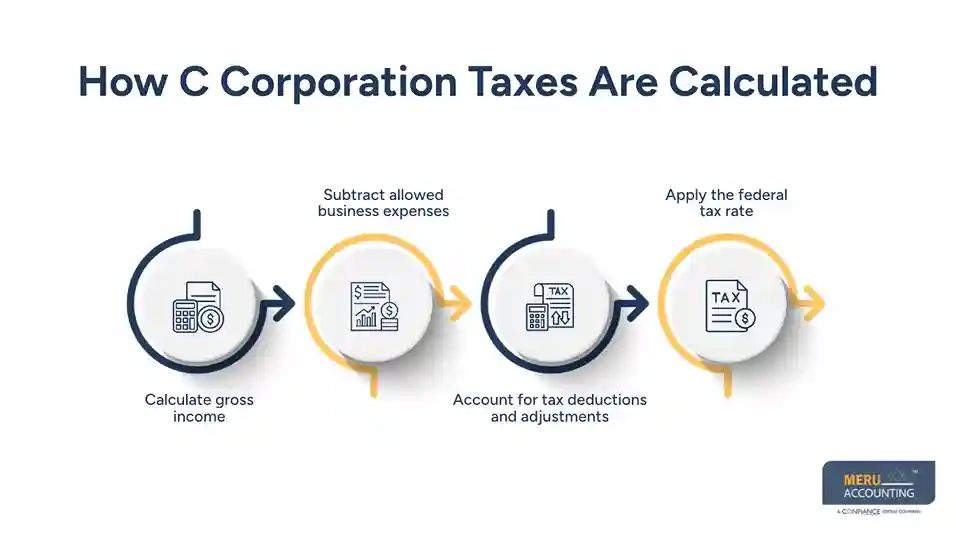
3. Account for tax deductions and adjustments
Review depreciation, interest costs, and other tax rules. Some costs may be subject to limits or special rules.
4. Apply the federal tax rate
Once taxable income is set, apply the 21% federal corporate tax rate. Then account for any tax credits and other items that affect the final amount due.
This is the basic process behind how C corporation taxes are calculated. The actual return may need more adjustments based on the type of business and its tax records.
C Corporation Tax Calculation Example for 2026
Consider a C corporation with the following figures for its 2026 tax year:
Business details | Amount |
Gross income | $900,000 |
Allowable business expenses | $500,000 |
Depreciation deduction | $100,000 |
Taxable income | $300,000 |
Federal tax rate | 21% |
Estimated federal tax | $63,000 |
In this case, the company has $900,000 in gross income and $600,000 in allowed costs and deductions.
Its taxable income is $300,000.
The federal tax calculation is:
$300,000 21% = $63,000
The corporation’s estimated federal income tax is $63,000 before tax credits, estimated tax payments, and other adjustments.
This example shows how C corporation taxes are calculated using taxable income rather than total sales. It is a basic example, not a full tax return. Actual results may vary based on tax rules, credits, and other items.
Tax Deductions and Credits That Can Reduce C Corporation Taxes
A corporation can lower its taxable income through eligible deductions. It may also claim tax credits to reduce the tax it owes.
Here are some key tax breaks to review in 2026.
1. Employee wages and benefits
Wages, salaries, and certain employee benefit costs are usually deductible when they meet IRS rules. Keep payroll records, benefit details, and proof of payment.
2. Depreciation and Section 179
Businesses that buy eligible equipment, tools, and other assets may claim depreciation. For 2026, the Section 179 limit is $2.56 million, with a phaseout that starts when the cost of eligible property placed in service exceeds $4.09 million. Special rules apply to some assets.
The law also made 100% bonus depreciation permanent for eligible property acquired after January 19, 2025.
Internal Revenue Service+1
3. Rent and utility costs
Rent, power, water, and other costs needed to run the business may qualify as deductions. The company should keep bills, lease terms, and payment records.
4. Research and development costs
Some businesses may claim tax breaks for eligible research work. The rules for domestic research costs changed under the 2025 tax law, so firms should check the rules that apply to their tax year.
5. Business tax credits
Some firms may qualify for credits tied to research, hiring, or other eligible business work. Unlike a deduction, a tax credit can cut the tax bill dollar for dollar.
Not all costs qualify for a full write-off. A business should check IRS rules before it claims a deduction or credit.
How Double Taxation Affects C Corporation Owners
One key point about C corporations is double taxation. The company pays tax on its profits first. If it then pays out after-tax profits as dividends, the owners may owe tax on those dividends too.
For example, a C corporation earns $200,000 in taxable income.
- Federal corporate tax at 21%: $42,000
- Profit left after federal tax: $158,000
- The company may pay some of this amount to owners as dividends.
- Shareholders may then owe tax on the dividends they receive.
The tax on dividends depends on each owner’s tax status, income, and the type of dividend paid.
Not all profits are paid out. A C corporation may keep some earnings to fund growth, hire staff, buy assets, or meet future costs. In that case, owners do not pay dividend tax on profits that were not paid to them.
This is why business owners should look at both corporate tax and owner-level tax when they plan how to use company profits.
C Corporation Tax Filing Requirements and Deadlines for 2026
Most domestic C corporations must file Form 1120, U.S. Corporation Income Tax Return, each year. The form reports income, costs, deductions, credits, and the tax due.
For a corporation that uses the calendar year, the 2026 tax return is due on April 15, 2027.
For firms that use a fiscal year, the due date is the 15th day of the fourth month after the end of the tax year. Some special rules apply.
Internal Revenue Service+1
Other key filing rules include:
- Estimated tax payments: A corporation must make estimated tax payments if it expects to owe $500 or more after credits.
- Payment dates: These payments are due in the 4th, 6th, 9th, and 12th months of its tax year.
- Filing extension: A corporation can use Form 7004 to ask for more time to file. An extension does not give more time to pay tax.
- Tax records: Keep income records, bank statements, payroll data, bills, and proof of tax payments.
Late filing or late payment can lead to IRS penalties and interest. A firm should plan its tax work well before the due date.
Get Expert Help With C Corporation Tax Preparation
A C corporation’s tax return is only as accurate as the records behind it. Missing expenses, incorrect asset values, or poorly tracked business costs can affect taxable income and lead to errors on Form 1120. Meru Accounting helps businesses get these details in order before tax filing.
Our team provides accounting and tax support for corporations, including:
- Corporate tax preparation: Organizing tax data and preparing records for Form 1120 filing.
- Tax-ready bookkeeping: Recording income, expenses, payroll, and other business transactions.
- Expense and deduction review: Checking business costs and supporting records for tax reporting.
- Depreciation and fixed asset records: Tracking equipment, assets, and related costs.
- Financial statement preparation: Preparing clear income statements, balance sheets, and supporting reports.
- Year-end accounting and cleanup: Reviewing account balances, correcting errors, and closing the books before tax season.
Our review and quality-check process helps keep financial records consistent and ready for tax work. Whether you need support with corporate tax preparation, year-end bookkeeping, or ongoing accounting, we help keep your financial data organized so you and your tax professional can work with reliable numbers.
Our Expert Insight
One tax issue C corporations should watch is the timing of major equipment purchases. Buying equipment near year-end does not automatically mean the full cost can be deducted in that tax year. The deduction depends on when the asset is placed in service and whether it meets the rules for Section 179 or bonus depreciation.
At Meru Accounting, we believe these decisions should be reviewed before year-end, not left until tax filing. A purchase that looks like a tax-saving move may not offer the expected benefit if the timing or eligibility rules are overlooked. Proper tax planning means looking at the business need first and the tax benefit second.
Key Takeaways
- Most C corporations pay a flat 21% federal income tax rate in 2026.
- C corporation tax brackets do not work like the tax brackets for individuals.
- Taxable income, not gross sales, is used to work out federal corporate tax.
- Deductions and credits may lower the final tax bill.
- C corporation owners may face double taxation when profits are paid as dividends.
- Most calendar-year C corporations must file their 2026 Form 1120 by April 15, 2027.
- Good books and early tax planning can help firms avoid errors and late filings.
FAQs
Most C corporations pay a flat 21% federal income tax rate in 2026. There are no separate federal tax brackets based on the size of the company’s taxable income.
C corporation taxes are based on taxable income after allowed costs, deductions, and tax adjustments. The company then applies the 21% federal tax rate and accounts for eligible credits and other tax items.
Yes. Most small, mid-size, and large C corporations pay the same 21% federal rate. The amount of tax they owe depends on their taxable income and eligible tax breaks.
Yes. A C corporation may deduct eligible wages, rent, insurance, supplies, and other business costs. It may also claim depreciation and tax credits if it meets the IRS rules.
For a calendar-year C corporation, the 2025 Form 1120 was due April 15, 2026. The return for the 2026 tax year is due April 15, 2027. Fiscal-year firms have different due dates based on their year-end.
optional anymore
on running the business