A franchise may have 15 locations, but that doesn’t mean all 15 are doing well. One store may be meeting its sales goals, while another struggles with high operating costs. A third may be losing money on inventory without the owner even knowing it. Cloud bookkeeping software for franchise businesses gives owners a better way to track these differences and see what’s happening across the entire network.
Beyond recording sales and expenses, the real value lies in having reliable numbers to work with. Franchise owners can compare location-level results, review spending patterns, and see how each outlet contributes to overall profit. This makes bookkeeping more than a monthly task; it becomes a useful part of running and growing a franchise.
What You Will Learn From This Blog
- How cloud bookkeeping works for franchise businesses with multiple locations.
- Common accounting issues that arise as a franchise network grows.
- How cloud tools help track sales, costs, cash flow, and unit-level results.
- Which features matter when choosing bookkeeping software for a franchise.
- How franchise accounting software integrations connect POS, payroll, stock, and payment tools.
- How outsourced accounting support can improve the quality of financial records.
What Is Cloud Bookkeeping Software for Franchise Businesses?
Cloud bookkeeping software is an online tool that lets a business record, review, and manage its financial data through the internet. Instead of keeping books on one office computer, users can access records from approved devices and locations.
For a franchise, this means the head office and local units can work with financial data in a shared system. Each location can record its own sales, bills, payroll costs, and other expenses, while the head office can review reports across the network.
For example, a franchise with five outlets can use one system to track income and costs for each unit. The owner can review a single outlet’s results or compare all five in one report, based on how the software is set up.
Cloud bookkeeping software for franchise businesses can also help set common rules for how teams record sales, assign costs, and close their books each month. This makes it easier to keep records in the same format as the network expands.
Common Bookkeeping Challenges in Multi-Location Franchise Operations
Managing books for one outlet is often quite simple. The work gets more complex when several units use different staff, vendors, bank accounts, and sales systems. Some common issues include:
1. Tracking Income and Costs Across Locations
Each unit may have its own sales volume, rent, wages, utility bills, and vendor costs. If teams use separate files or record data in different ways, it can be hard to compare results. A shared system with location-based records helps keep each unit’s activity clear.
2. Keeping Financial Records Consistent
One manager may record a repair bill as a general expense, while another may place it under maintenance. Such gaps can affect reports and make unit comparisons less useful. Franchises need a shared chart of accounts and clear rules for how staff record each type of transaction.
3. Reconciling Sales and Bank Deposits
POS systems may show daily sales, but the amount paid into the bank can differ due to card fees, refunds, tips, or payment delays. Each unit must match its sales records with bank activity. Without regular checks, errors can remain in the books for weeks.
4. Managing Royalty Fees and Shared Costs
Franchise fees may be based on gross sales, so errors in sales data can lead to wrong royalty amounts. Shared marketing, software, or supply costs can also be hard to split across units. These items need clear rules and proper records.
5. Preparing Reports on Time
When the head office waits for each unit to send its books, month-end reports can take longer to prepare. Late bills, missing records, and open bank items can delay the close. This makes it harder for owners to act on current financial data.
How Cloud Bookkeeping Software for Franchise Businesses Simplifies Multi-Location Accounting
Cloud tools help bring records, tasks, and reports into one system. Here is how they can make daily bookkeeping easier for franchise teams.
1. Centralized Financial Data
A cloud system gives approved users access to financial records in one place. Local teams can enter sales and bills, while head office staff can review activity across units.
This reduces the need to collect files from each outlet and merge them by hand. It also gives managers a clearer view of which locations have finished their books and which still need review.
2. Location-Wise Income and Expense Tracking
The software can use classes, locations, departments, or separate entities to group transactions. This helps owners see how much each outlet earns and spends.
For example, a franchise owner can review rent, wages, supplies, and sales for each unit. If one outlet has higher supply costs than others, the owner can check vendor prices, waste, or stock use to find the cause.
3. Faster Bank Reconciliation
Many cloud tools can link to bank accounts and import new transactions. Bookkeepers can then match payments and deposits with bills, sales, and other entries.
For franchise units, this helps teams review bank activity on a regular basis instead of waiting until month-end. Still, imported data must be checked. A bank feed does not confirm that every entry has been coded to the right account or location.
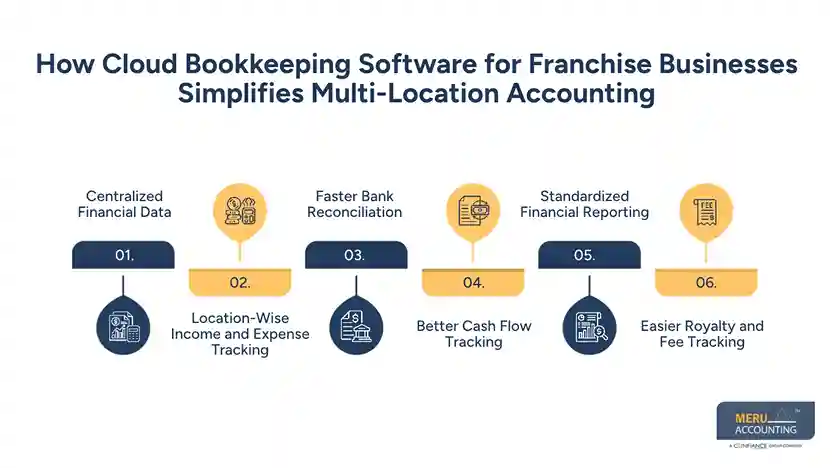
4. Better Cash Flow Tracking
Franchise owners need to know when cash is coming in and when bills are due. Cloud reports can show bank balances, open invoices, unpaid bills, and recent cash activity.
This helps managers plan vendor payments, rent, payroll, and other costs. It can also help them spot a unit that is facing cash flow pressure before the issue grows.
5. Standardized Financial Reporting
When all units follow the same chart of accounts and close process, their reports are easier to compare. Owners can review profit and loss reports, balance sheets, and cash flow data for each location.
A shared reporting setup also helps the head office prepare consolidated reports. The process must account for intercompany balances and other items that need to be removed during consolidation.
6. Easier Royalty and Fee Tracking
Franchise agreements often set royalty fees as a share of sales. Cloud bookkeeping tools can help gather sales data by unit and support fee checks.
For example, if a franchise agreement sets a royalty at 6% of eligible sales, a unit with $80,000 in eligible sales would owe $4,800. The amount should still be checked against the terms of the agreement, including any exclusions or changes.
Essential Features to Look for in Franchise Cloud Bookkeeping Software
Not every bookkeeping tool can handle the needs of a growing franchise. Before choosing one, review these key features:
Feature | Why It Matters |
Multi-location tracking | Keeps income and costs separate for each outlet. |
Location-wise reports | Helps owners compare sales, costs, and profit across units. |
User access controls | Lets head office and local staff view or edit only the records they need. |
Bank feeds | Imports bank activity to support faster reconciliation. |
Automated transaction rules | Helps apply common coding rules to repeat transactions. |
Custom reports | Gives managers the data they need to review each unit. |
Audit trails | Shows changes made to financial records and supports review. |
Data security | Helps protect financial data through access controls and other safeguards. |
Multi-entity support | Helps businesses that operate through separate legal entities manage their books. |
Also, check whether the software can handle the number of users, bank accounts, and locations you expect to add. A tool that works for two outlets may not suit a network of twenty.
optional anymore
on running the business
Franchise Accounting Software Integrations
Bookkeeping software works best when it can share data with the other tools a franchise uses. Franchise accounting software integrations can reduce manual entry, help match records, and give teams a more complete view of business activity.
Here are some common integrations to review:
1. POS System Integrations
POS systems record sales, refunds, discounts, taxes, and payment types. Linking them with bookkeeping software helps move sales data into the books.
This can save time for teams that process many daily transactions. It also helps bookkeepers match sales totals with card settlements and bank deposits.
2. Payroll Integrations
Payroll tools track wages, taxes, benefits, and other staff costs. When linked to bookkeeping software, payroll entries can flow into the right accounts and locations.
This helps owners review labor costs by unit and compare them with sales. Payroll entries should still be checked against payroll reports and bank payments.
3. Inventory Management Integrations
Stock tools track items bought, sold, used, or lost. Connecting these systems with accounting software can help record stock costs and track changes in inventory value.
For food, retail, and other stock-based franchises, this can help managers review waste, stock levels, and cost of goods sold.
4. Payment Gateway Integrations
Payment tools handle card and online payments. Their data can help bookkeepers match sales, fees, refunds, and net deposits.
This is useful when a franchise accepts payments through more than one channel. Teams should check settlement dates and fees to avoid treating net deposits as gross sales.
5. Vendor and Bill Payment Tools
Bill tools help teams collect invoices, route them for approval, and track due dates. When linked to the books, approved bills can flow into accounts payable.
This gives head office a better view of unpaid bills across all units and helps prevent late payments or duplicate entries.
Before setting up franchise accounting software integrations, check how often data syncs, which fields transfer, and how errors are reported. A link between two tools does not always mean every entry is correct. Regular checks are still needed.
Outsourced Franchise Accounting Services by Meru Accounting
A franchise with multiple outlets needs more than a bookkeeper to record daily transactions. Each location must have properly coded expenses, matched sales deposits, updated vendor balances, and accurate financial reports. Meru Accounting provides outsourced franchise accounting services to help manage these responsibilities while keeping financial records consistent across locations.
Our accounting team can support your franchise operations with:
- Multi-Location Bookkeeping: Record sales, expenses, vendor bills, and other transactions under the right franchise location for clear unit-level reporting.
- POS and Bank Reconciliation: Match POS sales, card settlements, bank deposits, refunds, and processing fees to identify missing or incorrect entries.
- Royalty and Franchise Fee Tracking: Review sales records, calculate royalty amounts based on franchise agreements, and maintain proper fee records.
- Accounts Payable and Receivable: Manage vendor bills, payment schedules, customer invoices, and outstanding balances across franchise units.
- Payroll and Expense Accounting: Record payroll costs and operating expenses by location to help track labor costs and unit-level spending.
- Financial Reporting and Consolidation: Prepare location-wise profit and loss statements, balance sheets, and consolidated reports to help owners compare financial performance.
We also help review account balances, resolve reconciliation differences, maintain consistent bookkeeping practices, and support month-end close. Whether you need ongoing bookkeeping for every outlet or additional accounting support as your franchise network expands, Meru Accounting can provide a dedicated team to keep your financial records organized and ready for review.
Our Expert Insight
One detail franchise owners should watch is the timing difference between POS sales, payment settlements, and bank deposits. A store may record $25,000 in weekly sales, but the bank may receive less due to card fees, refunds, chargebacks, and pending settlements. Treating the bank deposit as total sales can lead to understated revenue and incorrect royalty calculations.
We recommend recording gross sales separately from payment fees and settlement adjustments. This gives franchise owners a more accurate view of revenue and helps avoid errors when calculating royalties or reviewing location performance.
Key Takeaways
- Cloud bookkeeping software for franchise businesses helps bring financial data from several locations into one system.
- Location-based tracking makes it easier to review sales, costs, and profit by unit.
- A shared chart of accounts helps keep records consistent across the franchise network.
- Franchise accounting software integrations can link POS, payroll, stock, payment, and bill tools with the books.
- Bank feeds and automated rules can save time, but entries still need review.
- Outsourced accounting support can help keep reconciliations, reports, and month-end tasks on track.
FAQs
The best choice depends on your franchise size and accounting setup. QuickBooks Online, Xero, and NetSuite are options worth evaluating, but check their multi-location reporting, entity management, user permissions, and integration capabilities before choosing.
Yes. A suitable system can track transactions for several outlets using location, class, department, or entity-based records. However, franchises operating through separate legal entities may need a multi-entity accounting setup rather than simple location tracking.
Most franchises benefit from connecting their accounting system with POS, payroll, inventory, payment processing, and accounts payable tools. The right integrations depend on the business model, transaction volume, and how each location handles daily operations.
Franchise owners can use location-specific profit and loss statements to compare revenue, labor, occupancy costs, inventory expenses, and operating margins. Comparing these figures with sales trends and budget targets can help identify which outlets need attention.
Yes. Outsourced accounting can be a practical option when managing more locations creates additional bookkeeping work but hiring a full in-house accounting team isn’t necessary. It provides access to bookkeeping, reconciliations, accounts payable, payroll support, and financial reporting as business needs grow.
optional anymore
on running the business