



Construction business accounting works very differently from accounting in retail, manufacturing, or services. Every construction job is unique, time-bound, and cost-heavy. Yet many construction companies still rely on ledger-based methods that focus only on totals instead of tracking individual projects. This mismatch creates blind spots that hurt margins, delay decisions, and increase financial risk.
In this blog, we explain why construction business accounting must be project-centric, how project-based methods improve control, and how the right systems and tools support long-term growth.
What You Will Learn From This Blog
- Construction work operates on individual projects rather than monthly cycles, so accounting systems must be aligned with how projects are planned, executed, and billed.
- Ledger-based accounting often hides cost overruns and budget issues because it focuses on totals instead of tracking performance at the project level.
- Project-based accounting improves visibility by showing real-time project costs, progress, and profitability while the work is still ongoing.
- Software designed for construction helps track job costs, labor, materials, and budgets in a more organized and accurate way.
- Strong construction business accounting supports steady business growth by improving cost control, cash flow planning, and financial clarity.
Understanding Construction Business Accounting In A Project-Centric Industry
Construction business accounting operates in a project-driven environment where every job has its own scope, timeline, and cost structure. Unlike routine business activities, construction work is planned and delivered on a project-by-project basis. This makes it necessary to track financial performance separately for each job rather than relying on overall company figures.
Each project involves multiple cost components such as labor, materials, subcontractors, and equipment usage. These costs must be recorded and monitored at the project level to maintain accuracy.
In addition, construction projects often run for several months or even years, crossing multiple financial periods, which adds complexity to cost tracking and revenue recognition.
Billing in construction is also variable and often depends on project progress. Methods such as progress billing, retainage, and change orders directly affect when and how revenue is recorded.
Without proper project tracking, businesses face higher financial and compliance risk, making project-centric construction business accounting essential for control and clarity.
Why Traditional Ledger-Centric Accounting Falls Short In Construction Businesses
Focus On Totals Instead Of Projects
Ledgers focus on overall totals, not individual project performance, which can be a major limitation in construction business accounting, as it hides specific job-level financial issues from managers.
Delayed Cost Insights
Cost issues surface only after monthly or quarterly closings. By then, correcting overruns becomes more difficult and costly.
Limited Job Cost Visibility
Without proper construction accounting software for small business, material waste and labor overruns often remain hidden, preventing project managers from making timely, informed decisions.
Poor Cash Flow Control
Billing delays reduce control over available working capital. Late payments can disrupt ongoing project operations significantly.
Difficult Profit Analysis
In construction business accounting, ledger-centric reporting often makes it difficult to measure project profitability and compare individual jobs accurately.
Key Differences Between Project-Centric And Ledger-Centric Accounting Approaches
|
Feature / Aspect |
Project-Centric Accounting |
Ledger-Centric Accounting |
|
Primary Focus |
Tracks individual projects, focusing on project costs and profitability. |
Focuses on overall financial accounts and general ledger accuracy. |
|
Purpose |
Evaluates project performance and resource utilization. |
Ensures accurate recording for financial reporting and compliance. |
|
Cost Tracking |
Costs are tracked by project with separate budgets and expenses. |
Costs are tracked by account codes or cost centers without linking to projects. |
|
Revenue Recognition |
Revenue recognized per project milestones or completion. |
Revenue recognized according to standard accounting principles. |
|
Reporting |
Detailed project reports (P&L, cost-to-complete, variances). |
Standard financial statements (balance sheet, income statement, cash flow). |
|
Decision-Making Support |
Helps project managers and business owners optimize project performance. |
Supports accountants and management for overall financial oversight. |
|
Best Suited For |
Project-based businesses like construction, consulting, IT services. |
Organizations emphasizing compliance, statutory reporting, and centralized accounting. |
How Project-Based Accounting Improves Cost Tracking And Profitability
Accurate Job Costing
In construction business accounting, every project cost is tracked carefully to ensure expenses are recorded and monitored accurately.
Early Detection Of Overruns
Cost overruns are identified early before affecting overall profitability. Managers can quickly take action to prevent larger financial losses.
Better Resource Planning
Labor and materials are assigned efficiently to each project. Proper allocation avoids delays and unnecessary project interruptions.
Clear Profit Margins
Each project’s profit margin is calculated accurately and clearly. This helps management see which projects are most profitable.
Improved Client Pricing
Project data enables accurate pricing for future client bids. Historical costs and performance guide fair and competitive estimates.
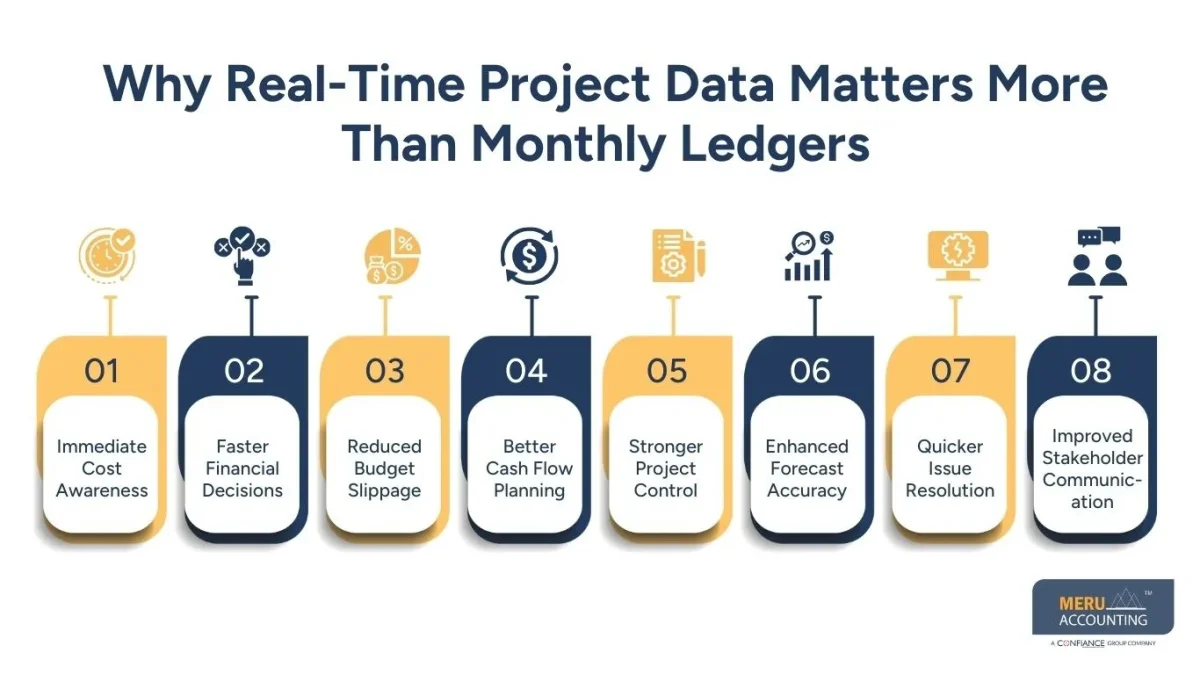
Why Real-Time Project Data Matters More Than Monthly Ledgers
Immediate Cost Awareness
Managers receive immediate updates before losses can grow significantly. Real-time tracking allows quicker actions to control project expenses.
Faster Financial Decisions
Timely project data supports faster and smarter financial decisions. Managers can adjust spending and allocations immediately when needed.
Reduced Budget Slippage
Overspending is detected early and corrected before it escalates. Tracking costs continuously keeps projects within planned budget limits.
Better Cash Flow Planning
Construction accounting software for small business helps align billing with actual project progress, ensuring sufficient cash flow for ongoing operations.
Stronger Project Control
In construction business accounting, real-time project data keeps teams accountable for costs and performance, improving oversight and operational efficiency
Enhanced Forecast Accuracy
Real-time data improves accuracy in predicting future project outcomes. Managers can plan resources and budgets more reliably.
Quicker Issue Resolution
Problems are identified immediately, allowing rapid corrective actions. Delays and errors can be resolved before escalating further.
Improved Stakeholder Communication
Accurate data ensures clear and timely reporting to stakeholders. Clients and partners stay informed on project progress continuously.
Using Construction Accounting Software For Small Business To Track Projects Accurately
Centralized Project Records
All project data is stored securely for easy access. Managers can view every project’s details in one place.
Automated Cost Allocation
Expenses are assigned accurately to each individual project. This ensures all costs are tracked without manual mistakes.
Real-Time Dashboards
Users can monitor project health instantly using live dashboards. Immediate visibility helps managers make informed decisions quickly.
Progress Billing Support
Construction accounting software for small business ensures billing aligns with actual work completed, reducing errors and delays in invoicing.
Reduced Manual Errors
Automation minimizes errors that occur with manual data entry. This improves accuracy and saves time for accounting teams.
Using construction accounting software for small business makes project tracking simple. It ensures accurate cost management and stronger financial control.
How Construction Accounting Software For Small Business Supports Job Costing And Budget Control
Detailed Cost Categories
Labor, materials, and overhead are tracked separately for accuracy. This allows managers to see exactly where project money is spent.
Budget Vs Actual Tracking
In construction business accounting, real-time tracking of budget versus actual costs allows early detection of variances, preventing overspending.
Change Order Tracking
In construction business accounting, change orders are automatically updated in the system, allowing managers to track scope changes without losing financial control.
Labor Hour Monitoring
Employee hours are recorded and controlled carefully for projects. This helps manage labor costs and prevents unnecessary overtime.
Reporting By Project
Project-level reports provide clear insights for better decision-making. Managers can evaluate performance and adjust operations quickly.
Using construction accounting software for small business becomes essential. It ensures accurate job costing and strong budget control.
Common Mistakes When Shifting From Ledger-Centric To Project-Centric Accounting
Not Training Teams
Staff must fully understand how project-based accounting works. Lack of training leads to mistakes and inaccurate project data.
Poor Data Migration
Old records must be mapped correctly into new systems. Incorrect migration can cause confusion and financial discrepancies.
Ignoring Job Cost Setup
Proper project cost setup is critical in construction business accounting; without it, expense and profit tracking are unreliable.
Delayed System Updates
Outdated data reduces the usefulness of project-level insights. Regular system updates ensure reports reflect current project conditions.
No Review Process
Reports must be reviewed regularly to ensure accuracy and relevance. Reviewing reports prevents errors and highlights potential cost overruns.
Best Practices For Implementing Project-Centric Construction Business Accounting
Start With Clear Project Codes
Standard project codes ensure consistent tracking across all jobs. This avoids confusion when managing multiple projects simultaneously.
Track Costs Daily
Entering costs daily improves accuracy and financial control. Small errors are caught before they accumulate into bigger issues.
Review Reports Weekly
Frequent reviews prevent surprises and improve project decision-making. Regular monitoring helps maintain budget adherence and performance clarity.
Align Accounting With Operations
Finance and project teams must collaborate closely on data. Alignment ensures accounting reflects real project activities accurately.
Use Reliable Tools
Strong accounting tools support accurate project tracking and reporting. Reliable systems simplify complex financial management tasks for managers.
Adopting these best practices strengthens construction business accounting outcomes.
Choosing The Right Construction Accounting Software For Small Business
Project-Based Reporting
Software must support detailed job-level reporting for accuracy. This enables managers to see costs and revenue per project.
Job Costing Features
Accurate job-level cost tracking is essential for profitability. Proper features ensure all labor, material, and overhead are captured.
Billing Flexibility
Software should handle progress, milestone, and change order billing. Flexible billing keeps invoices aligned with actual project progress.
Scalability
Systems must grow as the construction business expands. Scalable solutions avoid switching software frequently as projects increase.
Support And Integration
Reliable support and integration with other tools are critical. This ensures smooth operations and reduces technical and reporting errors.
Selecting the right construction accounting software for small business simplifies project-focused accounting.
How Project-Centric Accounting Strengthens Long-Term Construction Business Growth
Better Profit Planning
Accurate project data improves forecasting for better profit planning. Managers can estimate future project costs more reliably.
Stronger Cash Flow
Timely billing and accurate tracking keep cash flow steady. Good cash flow ensures smooth project execution and operations.
Reduced Financial Risk
Project-level tracking helps catch issues before they escalate. Early detection reduces financial losses and compliance problems.
Improved Client Trust
Accurate project billing builds confidence with clients consistently. Clients appreciate transparency in costs and completed work.
Sustainable Expansion
Stable finances allow for controlled and sustainable business growth. Project-centric accounting provides the foundation for long-term success.
Project-centric construction business accounting ensures accurate tracking, clear reporting, and solid future growth.
How Meru Accounting Supports Project-Centric Construction Accounting
Effective construction project management requires precise accounting at the project level. Meru Accounting provides accounting and bookkeeping services focused on project-centric construction business accounting for accurate tracking and better decision-making.
Project-Based Setup Support
Meru Accounting helps structure accounting according to individual projects. This ensures all project costs and revenues are tracked accurately.
Job Costing Accuracy
Costs are tracked carefully and reviewed at the job level. Accurate job costing prevents overruns and improves overall project profitability.
Software Implementation Help
We assist with construction accounting software for small business setup. Proper setup ensures projects are managed efficiently from day one.
Ongoing Reporting Support
Regular project reports are provided to improve financial control. Managers receive timely insights to make informed operational decisions.
Advisory For Growth
We guide construction firms toward stable and sustainable expansion. Our advice supports better planning, budgeting, and project profitability.
Meru Accounting focuses on practical construction business accounting aligned with project needs. This approach ensures accurate tracking, reporting, and long-term business success.
Get accurate project-level insights and control your construction finances today. Contact Meru Accounting for expert accounting and bookkeeping services tailored to your projects.
Key Takeaways
- Construction accounting must follow projects, not ledgers
- Project-centric systems improve cost control and profit
- Real-time data matters more than monthly summaries
- Software plays major role in job tracking
FAQs
Project-centric construction accounting tracks income, expenses, and profits for each construction project separately instead of only using overall company totals.
Ledger-centric accounting focuses on general totals and delays cost visibility, making it hard to see which projects are profitable.
It assigns labor, materials, and overhead to specific projects, helping businesses control costs and avoid overruns.
It allows small construction firms to track budgets, costs, and billing for each project in real time, reducing errors and improving profitability.
Businesses get better cost control, accurate project profitability, timely financial insights, and stronger long-term growth.


