



Manufacturing businesses operate under constant pressure from cost fluctuations, supply interruptions, and changing customer expectations. A cost accountant helps manufacturers handle these challenges by providing clear cost insights and structured financial control.
With accurate tracking of production expenses and overheads, a cost accountant supports informed decisions that protect profit margins during unstable market conditions.
This blog explains how a cost accountant supports manufacturing businesses through disciplined planning, cost monitoring, and practical analysis. It also highlights the importance of cost accounting in manufacturing industry and shows how it improves pricing accuracy, budget control, and long-term competitiveness.
What You Will Learn From This Blog
- Understand how a cost accountant supports both daily manufacturing operations and long-term business planning
- Learn how cost tracking, cost analysis, and cost control help manufacturers manage expenses
- See how changes in market prices affect raw materials, labor, and overhead costs
- Understand why clear cost visibility is important during unstable market conditions
- Learn why cost accounting in manufacturing industry is necessary for accurate decision-making
- See how reliable cost data improves financial control and planning
- Understand how structured cost reviews help reduce rising production expenses
- Learn how cost accountants focus on practical cost improvements rather than assumptions
- See how proper cost allocation helps protect and improve profit margins
- Understand how small cost adjustments can create meaningful financial results
Understanding Market Volatility In The Manufacturing Sector
Raw Material Price Fluctuations
Manufacturers frequently face unpredictable and sudden raw material price changes. A cost accountant closely monitors material price trends and cost movements.
Supply Chain Disruptions
Supply chain delays and shortages significantly increase indirect operational costs. Cost analysis helps businesses clearly measure the true financial impact.
Labor Cost Variations
Rising wages and overtime expenses increase overall production costs steadily. Tracking labor efficiency becomes essential for controlling workforce-related expenses.
Energy And Utility Cost Changes
Energy and utility price increases directly affect total manufacturing expenses. Accurate cost allocation reveals the true cost of production activities.
Customer Pricing Pressure
Customers often resist price increases during uncertain market conditions. Manufacturers need clear cost data to respond with informed pricing decisions.
Why A Cost Accountant Is Critical In Uncertain Manufacturing Markets
Clear Cost Visibility
A cost accountant ensures every expense is recorded correctly. This approach prevents hidden losses and improves financial transparency.
Better Decision Support
Management relies on accurate cost reports for operational planning. Decisions are based on verified data instead of assumptions.
Improved Cost Control
Regular cost reviews highlight unnecessary spending across departments. Early corrections help maintain control over rising expenses.
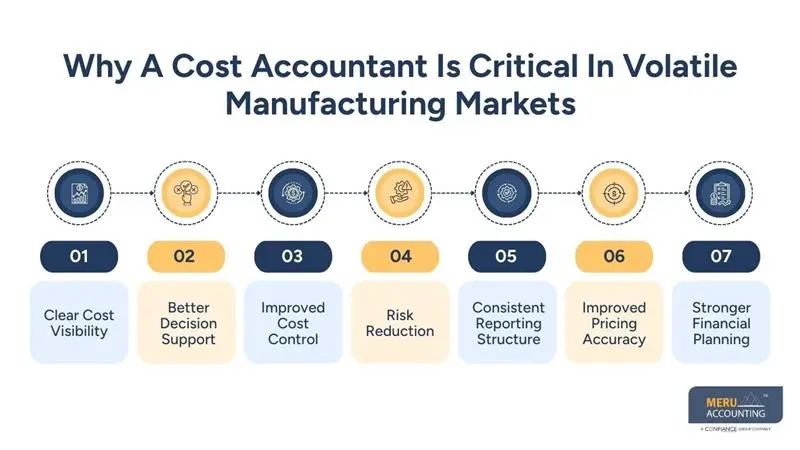
Risk Reduction
Strong cost monitoring reduces unexpected financial risks and losses. Manufacturers gain better operational and financial stability.
Consistent Reporting Structure
Standard cost formats help track changes over time accurately. This forms a core part of cost accounting in the manufacturing industry.
Improved Pricing Accuracy
Detailed cost data supports accurate and realistic product pricing. This prevents underpricing and protects profit margins.
Stronger Financial Planning
Cost insights help align budgets with changing market conditions. Planning becomes more stable during uncertain economic periods.
Core Principles Of Cost Accounting In Manufacturing Industry
Direct And Indirect Cost Classification
Costs are correctly grouped to improve understanding across manufacturing operations. This approach helps prevent pricing mistakes and inaccurate cost reporting.
Standard Cost Setting
Benchmarks are established for material usage and labor efficiency standards. Cost variances are reviewed regularly to maintain production cost discipline.
Variance Analysis
Differences between planned and actual production costs are carefully analyzed. This process helps identify operational issues and cost control gaps.
Overhead Allocation Methods
Indirect manufacturing costs are fairly assigned across products and departments. Accurate overhead allocation supports better pricing and profitability analysis.
Cost Control Procedures
Regular cost reviews ensure spending remains within approved operational limits. This process supports consistent cost accounting in manufacturing industry practices.
How A Cost Accountant Helps Control Rising Production Costs
Material Cost Monitoring
Material usage and production waste are carefully tracked across manufacturing processes. This approach helps reduce unnecessary material purchases and excess inventory.
Labor Efficiency Tracking
Labor time and output levels are compared regularly for accuracy. Identified inefficiencies are corrected early to prevent rising labor costs.
Process Cost Reviews
Production processes are reviewed regularly to identify cost gaps. Small operational adjustments help reduce overall manufacturing expenses.
Supplier Cost Analysis
Vendor pricing trends are monitored to identify cost increase patterns. This analysis supports better purchasing and supplier negotiation decisions.
Cost Trend Reporting
A cost accountant clearly reports cost changes to management. This ensures management stays informed about ongoing production cost trends.
Strategic Cost Reduction Techniques Used By Cost Accountants
Waste Reduction Analysis
Scrap material and rework costs are clearly identified and analyzed. Targeted improvements help reduce operational losses and production inefficiencies.
Cost Center Performance Review
Each department’s spending is reviewed against approved operational budgets. Underperforming areas are addressed to improve overall cost efficiency.
Make-Or-Buy Cost Comparison
Internal production costs are compared with external outsourcing alternatives. Final decisions are driven by accurate cost comparisons and analysis.
Process Improvement Costing
Operational improvement initiatives are measured using detailed financial analysis. Documented savings are tracked and reviewed over time for accuracy.
Expense Control Policies
Clear cost control rules help reduce unnecessary business spending. This approach strengthens cost accounting in manufacturing industry outcomes.
Utilizing Cost Accounting In Manufacturing Industry For Better Pricing Decisions
Accurate Product Costing
Each product’s true production cost is calculated with accuracy. This approach supports fair pricing and protects expected profit margins.
Margin Analysis
Profit margins are reviewed carefully for each manufactured product. Low-margin products are identified for pricing or cost review.
Break-Even Cost Analysis
Minimum product pricing levels are calculated using accurate cost data. This process helps manufacturers avoid loss-making sales decisions.
Customer Cost Review
Costs linked to specific customers are carefully reviewed and analyzed. Pricing adjustments are made carefully based on customer-related cost differences.
Market Price Comparison
Internal production costs are compared with prevailing market prices. This comparison helps manufacturers maintain competitive yet profitable pricing.
Inventory Cost Management Strategies Applied By A Cost Accountant
Stock Valuation Accuracy
Inventory is valued using proper costing methods and clear valuation rules. This approach helps avoid financial misstatements in inventory reporting.
Slow-Moving Inventory Review
Slow-moving or unused inventory items are identified early through reviews. Holding and storage costs are reduced through timely inventory decisions.
Material Usage Analysis
Material consumption trends are monitored across production cycles regularly. This control helps prevent over-ordering and unnecessary inventory buildup.
Storage Cost Allocation
Warehousing and storage costs are assigned properly to inventory items. Accurate allocation ensures final product costs remain correct.
Inventory Reporting Structure
Clear inventory reports support the cost accounting in manufacturing industry. Structured reporting improves inventory visibility and cost control accuracy.
Improving Profit Margins Through Accurate Cost Allocation
Correct Overhead Distribution
Indirect production costs are spread fairly across manufactured products. This method ensures products show true and reliable profitability levels.
Department-Wise Cost Tracking
Each department’s financial performance is measured using detailed cost tracking. Profit leaks are identified early for corrective management action.
Product Mix Cost Analysis
High-margin and low-margin products are compared using cost data. Production focus is adjusted toward products delivering stronger margins.
Cost Adjustment Reviews
Costs are updated regularly as market and production conditions change. This ensures pricing remains realistic and aligned with actual expenses.
Margin Improvement Planning
A cost accountant supports structured planning to improve overall margins. This process focuses on sustainable and measurable profit improvements.
Cost Accountant–Driven Budgeting And Forecasting In Uncertain Markets
Realistic Budget Creation
Budgets are prepared using historical cost data and trend analysis. Cost assumptions remain practical and aligned with business conditions.
Flexible Cost Forecasting
Forecasts are adjusted regularly to reflect material and price changes. Manufacturers stay prepared for unexpected cost increases or reductions.
Scenario Cost Planning
Best-case and worst-case cost scenarios are prepared in advance. This planning helps reduce financial risk exposure during uncertainty.
Cash Flow Cost Planning
Cost timing is aligned carefully with expected business cash needs. This approach helps maintain stable liquidity during volatile periods.
Performance Tracking
Actual production costs are compared with budgets on regular intervals. This supports cost accounting in manufacturing industry planning and control.
How Meru Accounting Supports Manufacturing Businesses
Meru Accounting provides specialized accounting services for manufacturing businesses. Our services focus on accurate cost management, reporting, and financial control.
Industry-Focused Cost Expertise
Meru Accounting provides experienced cost accountant support for manufacturers. Our team understands production-based cost challenges within manufacturing operations.
Structured Cost Accounting Systems
We design clear cost accounting in manufacturing industry frameworks. This improves accuracy and control across financial reporting processes.
Cost Control And Reporting
Our reports help identify cost gaps early during reviews. Management gains better clarity on operational spending trends.
Pricing And Margin Support
We assist with cost-based pricing decisions for manufactured products. Profitability improves steadily through informed pricing adjustments over time.
Manufacturing Cost Compliance Support
Our services ensure manufacturing cost records meet internal policy requirements. This helps reduce reporting errors and audit-related cost issues.
Decision Support Through Cost Insights
We provide clear cost insights to support informed management decisions. This improves planning accuracy during changing market and production conditions.
Key Takeaways
- Clear cost tracking supports better business and financial decisions.
- A cost accountant helps manage uncertainty and improve operational stability.
- Correct cost allocation protects profit margins across manufacturing activities.
- Strong pricing decisions depend on accurate and reliable cost information.
- Professional accounting guidance strengthens long-term manufacturing performance.
FAQs
A cost accountant tracks production costs, identifies cost increases early, and helps manufacturers adjust pricing and budgets to avoid losses during market changes.
Cost accounting in manufacturing industry helps businesses understand where money is being spent, control waste, and manage rising material and labor costs effectively.
Yes, a cost accounting professional provides accurate product cost data, which helps manufacturers set prices that cover costs and protect profit margins.
Cost accounting in manufacturing industry helps track inventory value, reduce excess stock, and control storage and handling costs.
Yes, a cost accounting professional helps small manufacturers manage costs, plan budgets, and stay competitive even with limited resources.


