
If you’re looking to hire a financial analyst, understanding the costs involved in 2026 is crucial for your business planning. Financial analysts help businesses make better financial decisions, manage budgets, forecast revenue, and evaluate investments. But before bringing one on board, you need to know how much it will impact your budget.
This blog provides a comprehensive guide to help you understand the costs and considerations associated with hiring a financial analyst.
What You Will Learn From This Blog
- How to determine the need to hire a financial analyst for your business
- Key factors that influence financial analyst hiring costs
- Average salaries and hourly rates for financial analysts in 2026
- Tips to manage and reduce hiring costs effectively
- Cost differences between hiring a professional versus using financial software
- How experience and location impact hiring expenses
- Insights into when to hire a financial analyst for optimal results
Understanding The Need To Hire A Financial Analyst
Financial Planning and Analysis
A financial analyst helps businesses plan and manage their finances effectively. If you want to hire a financial analyst, your budgets can be reviewed more accurately, income forecasted reliably, and areas to save money identified.
Investment Evaluation
Potential investments are evaluated to determine which options can deliver better returns for your business. Financial analyst hiring ensures that these investment decisions are guided by professional insights.
Risk Management
Hiring a financial analyst ensures that your business identifies financial risks. This is why businesses increasingly look to hire a financial analyst for proactive risk management.
Budget Optimization
Financial analysts help allocate funds efficiently. By choosing to hire a financial analyst, businesses ensure money is directed to high-impact areas.
Performance Monitoring
Financial data is analyzed regularly to provide reports that improve decision-making. Operational efficiency is enhanced through these insights.
Factors That Influence The Cost To Hire A Financial Analyst
Experience Level
Entry-level analysts usually cost less than those with extensive experience in the field. Understanding different levels is crucial when planning financial analyst hiring or deciding to hire a financial analyst.
Education and Certification
Analysts who hold certifications like CFA, CPA, or other specialized degrees may cost more. These advanced skills and formal qualifications often justify the higher pay and add significant value to your business.
Industry
The type of industry your business operates in can greatly affect hiring costs. Financial analysts working in finance-heavy or high-demand industries may demand higher pay compared to those in smaller or less competitive sectors.
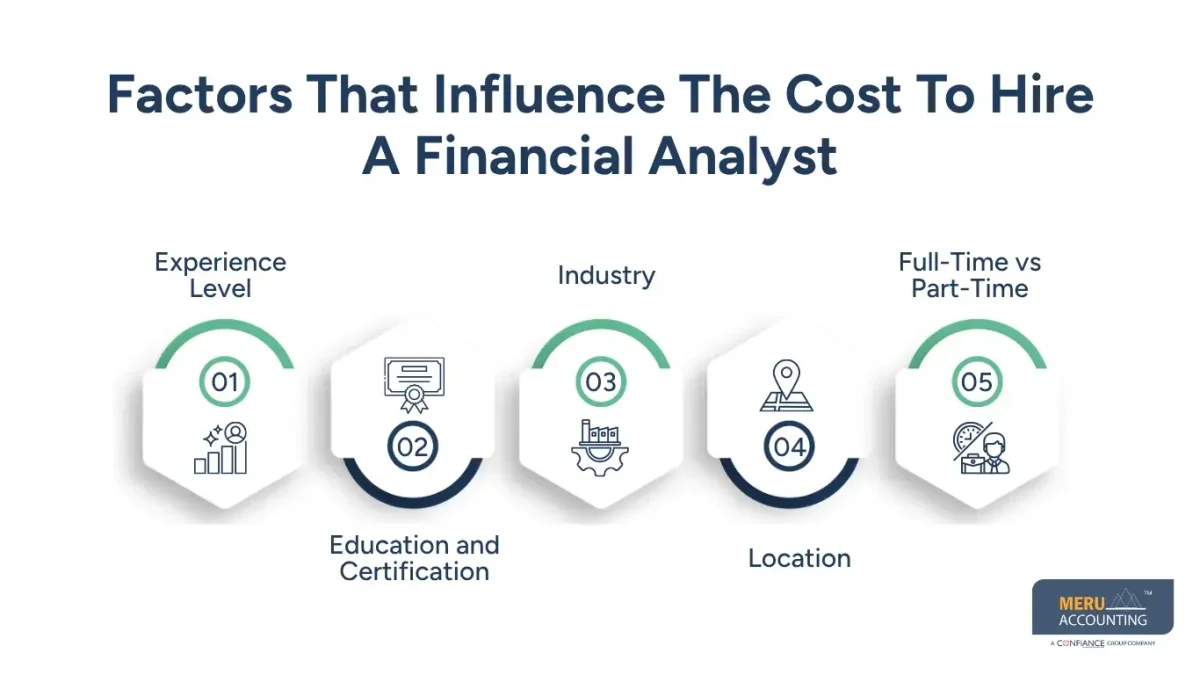
Location
Hiring costs can vary widely across different cities and regions. Analysts based in major metropolitan areas typically have higher salaries due to the increased cost of living and competitive job market.
Full-Time vs Part-Time
Deciding whether to hire a full-time, part-time, or freelance analyst directly affects the overall expenditure. Businesses often weigh their options carefully before financial analyst hiring.
Average Salary and Hourly Rates For Hiring A Financial Analyst
Entry-Level Financial Analysts
Salaries start around $55,000 to $70,000 per year. Hourly rates range between $25 and $35. These analysts are ideal for businesses needing basic financial reporting and budgeting support.
Mid-Level Financial Analysts
With 3-7 years of experience, analysts earn $70,000 to $95,000 annually. Hourly rates average $35 to $50. They can handle more complex financial modeling and forecasting independently.
Senior Financial Analysts
Senior analysts with over 7 years of experience earn $95,000 to $130,000 per year. Hourly rates can reach $50 to $70. They provide strategic insights and guide major investment or budget decisions.
Freelance Analysts
Freelancers may charge $40 to $80 per hour depending on expertise. Businesses can hire a financial analyst on a freelance basis for short-term projects, reducing long-term payroll costs. They are perfect for short-term projects or specialized financial tasks without long-term commitments.
Regional Differences
Urban areas tend to have higher salary ranges compared to smaller towns or rural locations. Cost differences often reflect the demand for financial talent in specific regions.
Industry-Specific Salaries
Some industries pay higher salaries due to the complexity of financial work. Finance, investment, and tech sectors typically offer premium compensation for experienced analysts.
Remote Financial Analysts
Hiring analysts remotely can reduce costs significantly. Remote analysts from lower-cost regions offer professional expertise at more affordable rates.
Contract vs Permanent Employees
Contract analysts may cost more per hour but save on benefits and long-term obligations. Permanent employees offer continuity but require full salary and benefits packages.
Tips For Reducing The Cost Of Financial Analyst Hiring
Consider Part-Time or Contract Work
If you plan to hire a financial analyst, starting with part-time or contract work can save money while still providing expertise when needed. This approach gives flexibility to scale the team up or down based on project requirements.
Use Remote Analysts
Remote financial analysts may have lower costs than local professionals, depending on regional salary differences. Businesses can access skilled analysts from lower-cost regions without compromising quality.
Hire Junior Analysts For Routine Tasks
Junior analysts can manage basic reporting, leaving senior analysts to handle complex analysis. This ensures that higher-cost professionals focus on tasks that require advanced expertise.
Offer Incentives Instead Of High Salaries
Performance-based bonuses or profit-sharing can motivate analysts without inflating base salaries. It encourages better results while keeping the fixed payroll expenses manageable.
Outsource Certain Financial Tasks
Some financial analysis tasks can be outsourced to firms like Meru Accounting to reduce costs while maintaining accuracy. Outsourcing also saves on recruitment, training, and employee benefits.
When To Consider Hiring A Financial Analyst In 2026
Business Expansion
If your business is growing or planning to expand, financial analyst hiring becomes essential to ensure proper financial planning. Analysts can forecast cash flow and identify potential financial challenges before they arise.
Investment Decisions
You should hire a financial analyst before making strategic investment decisions to ensure informed outcomes. This helps you make informed decisions and avoid costly mistakes.
Budgeting Needs
When budgeting becomes complex, an analyst can help structure and manage finances efficiently. They can also track spending trends and suggest ways to optimize costs.
Regulatory Compliance
Businesses dealing with complex financial regulations may need an analyst to maintain compliance and avoid penalties. Analysts help ensure that reporting and documentation meet all legal requirements.
Strategic Planning
Analysts help in long-term strategic decisions, ensuring your business remains financially healthy. They provide insights that support growth initiatives and sustainable business practices.
Cost Comparison: Hiring A Financial Analyst Vs. Using Financial Software
Comparison Factor | Hiring a Financial Analyst | Using Financial Software |
Initial Cost Considerations | Higher upfront cost due to salary or contract fees. | Lower upfront cost as software typically requires a one-time or subscription fee. |
Efficiency | Analysts can interpret results, provide insights, and offer recommendations. Companies that hire a financial analyst gain strategic guidance that software alone cannot deliver. | Software can automate calculations but cannot provide context or insights. |
Accuracy | Analysts can detect inconsistencies and anomalies, reducing the risk of financial errors. | Software may overlook unusual patterns, increasing the risk of errors. |
Custom Reporting | Tailored reports can be created based on your specific business needs. | Most software provides standard reports with limited customization options. |
Long-Term Value | Provides better decision-making and long-term ROI by guiding strategy and investment. | Appears cheaper initially but lacks strategic insights for long-term planning. |
Regional Cost Differences In Hiring A Financial Analyst
United States
Major cities like New York, Los Angeles, and Chicago have higher average salaries due to the cost of living. Competitive markets in these cities also drive demand for highly skilled financial analysts.
Canada
When considering financial analyst hiring, note that salaries in Canada vary by province, offering cost-effective options without compromising expertise. Provinces with major financial hubs like Toronto and Vancouver tend to have higher pay rates.
Europe
Western Europe tends to have higher costs, while Eastern European countries offer more affordable hiring options. The difference reflects regional economic conditions and demand for finance professionals.
Asia
Countries like India and the Philippines offer cost-effective options for hiring remote financial analysts. Skilled analysts in these regions provide quality work at lower rates compared to Western countries.
Global Outsourcing
Businesses increasingly hire analysts remotely to benefit from lower costs without compromising expertise. Outsourcing also provides flexibility to scale the team based on business needs.
How Experience Level Impacts Financial Analyst Hiring Cost
Entry-Level Analysts
Best for smaller businesses with basic financial tasks. Entry-level analysts are budget-friendly but require supervision. Routine reporting and simple budget tracking can be handled efficiently by this level.
Mid-Level Analysts
Offer more autonomy and expertise, suitable for growing businesses with complex needs. Mid-level analysts can manage forecasting and moderate-level financial analysis independently, adding significant value to decision-making.
Senior Analysts
Ideal for large organizations or businesses making strategic decisions. Senior analysts bring advanced insights at a higher cost. Guidance for junior staff and oversight of financial planning ensure high-quality output.
Specialist Analysts
Businesses that hire a financial analyst with specialist expertise in investment or risk analysis gain high-value insights for critical projects. To ensure critical projects succeed, businesses can hire a financial analyst with specialist expertise for precise evaluation and decision-making.
Team-Based Approach
A mix of junior, mid-level, and senior analysts can optimize costs while delivering comprehensive financial analysis. A strategic financial analyst hiring mix of junior, mid-level, and senior analysts balances cost with professional expertise across all financial operations.
Meru Accounting’s Financial Analyst Services
Expertise Across Industries
Meru Accounting provides experienced financial analysts for businesses across multiple industries. Accurate and relevant financial insights help guide informed business decisions.
Flexible Engagement Models
Full-time, part-time, and project-based services are available to control costs while accessing high-level expertise. This flexibility allows businesses to match resources with specific financial needs.
Customized Reporting
Analysts deliver reports tailored to each business, enabling a clear understanding of financial performance. Customized reports support better planning and decision-making.
Cost-Effective Solutions
Hiring Meru Accounting’s analysts is often more affordable than maintaining a full-time in-house team. High-quality financial services are provided without compromising budget constraints.
Support For Strategic Growth
By choosing to hire a financial analyst, businesses gain structured guidance for budgeting, investment evaluation, and risk management, supporting strategic growth in 2026. Businesses gain structured guidance for long-term financial stability and growth.
Key Takeaways
- Hiring a financial analyst provides better financial insights and informed decision-making.
- Costs depend on experience, location, certifications, and engagement type.
- Average salaries in 2026 range from $55,000 to $130,000 per year, with hourly rates from $25 to $70.
- Part-time, remote, and outsourced options can reduce hiring expenses.
- Using financial software may save costs upfront but lacks the strategic insights a professional analyst offers.
- Meru Accounting offers cost-effective, customized financial analyst services for businesses of all sizes.
FAQs
Hiring costs depend on experience and location. Entry-level analysts earn $55,000–$70,000/year, while senior analysts cost $95,000–$130,000/year.
Experience, certifications, industry, location, and employment type affect cost. Specialized skills or senior-level analysts usually command higher pay.
Freelancers are cost-effective for short-term projects. Full-time analysts are better for ongoing work but have higher salary and benefits.
Salaries vary by city and country. Analysts in major cities or Western countries earn more, while regional or remote analysts may cost less.
Outsourcing gives access to experienced analysts without full-time costs. Firms like Meru Accounting offer flexible, cost-effective solutions.