A cpa for realtors plays an important role in managing commission income, business expenses, estimated tax payments, and annual tax filings. Unlike salaried workers, real estate agents may earn a large commission in one month and receive little income in the next. Without proper records and tax planning, even a profitable year can end with an unexpected tax bill.
Common mistakes include missing eligible deductions, reporting commission income incorrectly, and failing to set aside money for taxes. Realtor CPA Services address these issues through accurate bookkeeping, tax preparation, and financial review. With the right tax plan, agents can understand their obligations, maintain clear records, and make informed business decisions throughout the year.
What You Will Learn From This Blog
- Why a cpa for realtors is valuable for commission-based income and tax planning.
- Which business expenses real estate agents may deduct under IRS rules.
- How to avoid errors involving mileage, home offices, referral fees, and estimated taxes.
- What Realtor CPA Services include and when to seek professional tax advice.
- How accurate financial records can reduce reporting errors and unexpected tax costs.
IRS Tax Rules Realtors Need to Understand
A cpa for realtors should base tax advice on current IRS rules and the agent’s actual circumstances. Understanding the following requirements can prevent common filing mistakes.
Independent Contractor vs. Employee Tax Classification
Many licensed real estate agents qualify as statutory nonemployees when they meet IRS conditions, including specific compensation and written-contract requirements. The correct classification depends on the actual working arrangement and applicable law.
Quarterly Estimated Tax Payment Requirements
Self-employed agents may need to make estimated payments when withholding is insufficient. Realtor CPA Services can calculate projected payments using expected tax, prior-year figures, withholding, and applicable safe-harbor rules.
Business Expense Documentation and Deduction Eligibility
A bank statement may prove that a payment occurred, but it may not establish its business purpose. Keep receipts, invoices, mileage records, and notes that explain the reason for each expense.
Tax Filing Requirements for Real Estate Agents and Brokers
Self-employed agents generally report business income and expenses on Schedule C and calculate self-employment tax on Schedule SE when applicable. A cpa for realtors can determine which forms apply based on business structure, income, and tax status.
optional anymore
on running the business
Why Tax Planning Matters for Realtors
Real estate agents face tax issues that differ from those of many salaried workers. Income may depend on completed transactions, brokerage agreements, and referral arrangements, while business expenses continue between closings. A cpa for realtors reviews these factors to estimate taxable profit and assess payment requirements.
Tax planning also allows agents to prepare for federal income tax and self-employment tax where applicable. Realtor CPA Services can include income forecasts, expense reviews, and estimated payment calculations. Regular reviews give agents time to correct missing records before tax deadlines.
Common Tax Mistakes Realtors Make and How to Avoid Them
A cpa for realtors can identify reporting gaps before they become costly filing errors. The following mistakes deserve attention throughout the tax year.
Missing Eligible Business Expense Deductions
Agents may overlook listing photography, advertising fees, business insurance, accounting charges, and qualifying software costs. These expenses can reduce taxable business profit when they meet IRS requirements.
Maintain a monthly expense ledger and save invoices with proof of payment. A qualified tax professional can review the records to distinguish eligible business costs from personal purchases and other non-deductible expenses.
Failing to Track Business Mileage and Vehicle Expenses
Property visits, open houses, inspections, and client meetings may involve substantial business travel. Without a mileage log, an agent may struggle to prove the distance and purpose of each trip.
Record dates, destinations, business purposes, and miles driven. A cpa for realtors can compare the standard mileage method with actual vehicle costs and check the applicable rules. Ordinary commuting and personal trips generally do not qualify as business mileage.
Mixing Personal and Business Finances
Combining household purchases, commission deposits, fuel costs, and advertising payments in one account makes expense reviews harder. It can also lead to personal spending being reported incorrectly as a business deduction.
Use separate business banking records where practical and label transactions clearly. Realtor CPA Services can reconcile accounts, identify personal costs, and prepare financial reports that show actual business income and expenses.
Underpaying Quarterly Estimated Taxes
Many self-employed agents receive commissions without enough federal tax withheld. Spending the full amount can leave insufficient cash when estimated tax payments become due.
A cpa for realtors can forecast annual income, allowable expenses, and expected tax payments. The IRS generally requires estimated payments when an individual expects to owe at least $1,000 after withholding and refundable credits and does not meet the applicable payment safe harbor. Exceptions apply.
Misreporting Commission Income and Referral Fees
Real estate income may include brokerage commissions, referral fees, bonuses, and other payments. Reporting only the amounts shown on individual tax forms can leave taxable income unreported.
Compare brokerage statements, bank deposits, and Forms 1099 before filing. Realtor CPA Services can reconcile these records and investigate differences so that the return reflects the agent’s complete taxable business income.
Claiming Home Office Deductions Incorrectly
Working from home does not automatically qualify an agent for a home office deduction. The area generally must meet IRS rules for regular and exclusive business use, subject to specific exceptions.
Keep measurements, household expense records, and details of business use. A cpa for realtors can assess eligibility and compare the simplified and actual expense methods when permitted.
Overlooking Self-Employment Tax Obligations
Self-employed real estate agents may owe federal income tax and self-employment tax on their business earnings. Self-employment tax covers Social Security and Medicare contributions under applicable rules.
Review your work arrangement and tax classification rather than assuming the brokerage handles all tax duties. Realtor CPA Services can assess whether Schedule C and Schedule SE apply and calculate the relevant amounts.
Ignoring Tax Deadlines and Recordkeeping Requirements
Late payments and incomplete records can lead to penalties, filing delays, or difficulties responding to IRS questions. Missing receipts may also weaken the evidence for an expense claim.
Maintain a calendar for tax payments, annual filing dates, and IRS response deadlines. A cpa for realtors can review the financial records during the year and identify missing documents before filing.
Tax Deductions Every Realtor Should Know
Business deductions reduce taxable profit only when expenses qualify under applicable tax rules. A qualified tax professional can review the purpose and supporting documentation for each expense before including it in a tax return.
Marketing, Advertising, and Listing Promotion Expenses
Online advertising, listing photography, business cards, website fees, and promotional materials may qualify as business expenses. Keep invoices and records that link each cost to your real estate business.
MLS Fees, Licensing Costs, and Professional Memberships
Eligible multiple listing service fees, license renewals, and professional membership dues may be deductible. A cpa for realtors can review these charges and check that they relate to the agent’s business.
Business Travel, Client Meetings, and Continuing Education
Qualifying business travel, parking, tolls, and professional education may be deductible under IRS rules. Personal travel and ordinary commuting generally do not qualify, even when an agent discusses business during the trip.
Office Supplies, Technology, and Software Expenses
Accounting software, printer supplies, listing tools, and business-use phone costs may qualify for deductions. Realtor CPA Services can review mixed-use expenses and determine the eligible business share.
Retirement Contributions and Eligible Health Insurance Deductions
Eligible self-employed agents may qualify for certain retirement contribution and health insurance deductions. A cpa for realtors can review income, coverage, plan terms, and applicable limits before a claim is made.
IRS Tax Rules Realtors Need to Understand
A cpa for realtors should base tax advice on current IRS rules and the agent’s actual circumstances. Understanding the following requirements can prevent common filing mistakes.
Independent Contractor vs. Employee Tax Classification
Many licensed real estate agents qualify as statutory nonemployees when they meet IRS conditions, including specific compensation and written-contract requirements. The correct classification depends on the actual working arrangement and applicable law.
Quarterly Estimated Tax Payment Requirements
Self-employed agents may need to make estimated payments when withholding is insufficient. Realtor CPA Services can calculate projected payments using expected tax, prior-year figures, withholding, and applicable safe-harbor rules.
Business Expense Documentation and Deduction Eligibility
A bank statement may prove that a payment occurred, but it may not establish its business purpose. Keep receipts, invoices, mileage records, and notes that explain the reason for each expense.
Tax Filing Requirements for Real Estate Agents and Brokers
Self-employed agents generally report business income and expenses on Schedule C and calculate self-employment tax on Schedule SE when applicable. A cpa for realtors can determine which forms apply based on business structure, income, and tax status.
How a CPA for Realtors Can Prevent Costly Tax Errors
A CPA for realtors can identify reporting gaps, review tax obligations, and correct errors before they lead to additional tax or penalties. Regular financial reviews also give real estate agents a clearer view of their income, deductions, and upcoming payments.
Reviewing Income, Expenses, and Commission Records
A CPA reviews brokerage statements, commission reports, bank deposits, and Forms 1099 to verify that all income is reported accurately. The review also identifies missing expenses, duplicate entries, and discrepancies between financial records.
Identifying Eligible Deductions and Tax Credits
A tax professional reviews advertising costs, licensing fees, business mileage, software charges, and other expenses to determine which qualify for deductions. Realtor CPA Services may also include a review of eligible tax credits, based on the agent’s circumstances and current IRS rules.
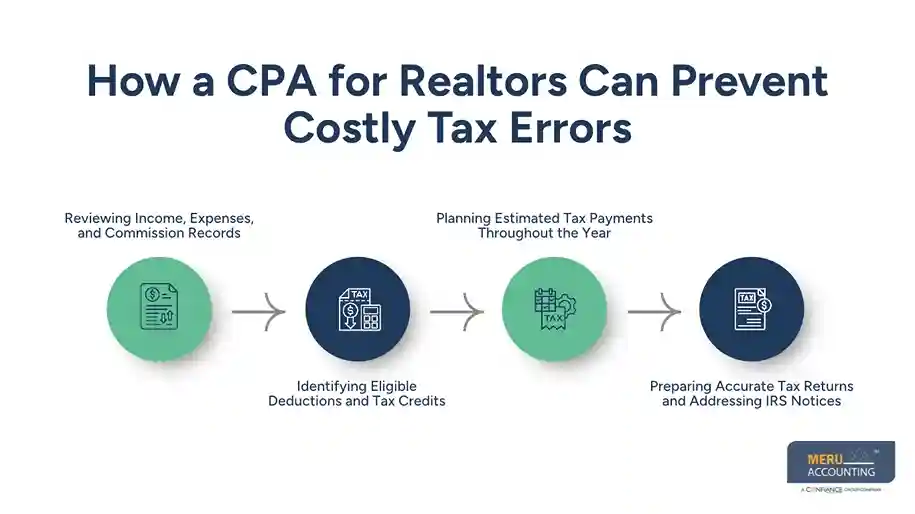
Planning Estimated Tax Payments Throughout the Year
Commission income can change sharply between quarters, making tax estimates difficult to manage. A CPA for realtors can forecast annual income, estimate tax liability, and review payment amounts as earnings change to reduce the risk of underpayment.
Preparing Accurate Tax Returns and Addressing IRS Notices
Accurate tax returns depend on complete income records, valid deductions, and the correct forms. Realtor CPA Services can include return preparation and assistance with IRS notices, while representation rights depend on the professional’s credentials and the matter involved.
Realtor CPA Services: What to Expect From a Real Estate Tax Accountant
Realtor CPA Services can cover annual tax filing, tax planning, bookkeeping, and financial reporting. When choosing a cpa for realtors, check the professional’s credentials, real estate experience, fees, and agreed scope of work.
Tax Preparation and Filing
A tax accountant reviews commission statements, expense records, tax forms, and prior returns before preparing the required filings. The agent should provide complete records and review the return before submission.
Tax Planning and Liability Forecasting
Tax planning estimates expected tax liability based on projected commissions, eligible expenses, and other income. A tax professional can update forecasts after major closings or changes in earnings.
Bookkeeping and Financial Statement Preparation
Regular bookkeeping records income, business costs, and account balances. A cpa for realtors can prepare reports that show net profit, unpaid bills, and funds available for upcoming tax payments.
Business Structure and Entity Taxation
An agent may operate as a sole proprietor or use a business entity, depending on legal and business needs. Realtor CPA Services can compare tax treatment, filing duties, and administrative costs before a change is made.
IRS Audit Representation and Tax Notice Assistance
An IRS notice may request records or ask questions about reported income and deductions. A cpa for realtors can review the notice, organize supporting documents, and prepare a response. Confirm the professional’s authority to represent you before the IRS.
Practical Example: How Better Tax Planning Can Reduce a Realtor's Tax Errors
Consider an agent who earns $120,000 in gross commissions and initially records $10,000 in business expenses. A later review finds another $8,000 in documented costs that may qualify for deduction.
Financial item | Initial records | After review |
Gross commissions | $120,000 | $120,000 |
Eligible business expenses | $10,000 | $18,000 |
Net business profit | $110,000 | $102,000 |
If the additional expenses qualify in full, taxable business profit decreases by $8,000. This does not mean the agent saves $8,000 in tax; the actual result depends on income tax rates, self-employment tax, other income, and applicable rules.
Realtor CPA Services can verify the records, assess deduction eligibility, and review estimated tax payments. The example shows why a cpa for realtors should review financial records throughout the year instead of waiting until filing season.
Why Choose Meru Accounting for Law Firm Accounting Services
Real estate professionals need clear financial records to review commissions, operating costs, and business profit. Meru Accounting provides accounting, bookkeeping, and financial reporting services based on each client’s requirements.
Our services include transaction recording, expense classification, account reconciliation, and financial statement preparation within the agreed scope. These records provide a clear basis for reviewing business performance and preparing tax information.
When comparing a cpa for realtors, confirm whether the provider offers tax preparation, tax planning, or IRS representation in addition to bookkeeping. Meru Accounting defines its services according to the engagement, so clients can understand which accounting and tax-related tasks are included.
Our Expert Perspective
The most useful tax review explains differences between brokerage statements, bank deposits, and reported expenses. A cpa for realtors should be able to trace each major figure to its source and explain why an expense qualifies for deduction.
Agents should review their financial statements monthly, record business costs when they occur, and set aside money for expected tax payments. Realtor CPA Services are most useful when the agent and tax professional address missing records and changing income before deadlines approach.
Key Takeaways
- Reconcile commission income and referral fees with brokerage statements, deposits, and tax forms.
- Keep mileage logs, invoices, and proof of payment for eligible business expenses.
- Separate personal and business transactions to reduce bookkeeping errors.
- Review estimated tax payments when commission income changes.
- Confirm home office, vehicle, retirement, and health insurance deductions under current IRS rules.
- Select a cpa for realtors based on credentials, experience, service scope, and fees.
- Use Realtor CPA Services that match your tax filing, bookkeeping, and planning needs.
FAQs
Common tax mistakes include missing eligible deductions, misreporting commission income, failing to track mileage, and underpaying estimated taxes.
Realtors may deduct eligible expenses such as advertising, MLS fees, licensing costs, business mileage, office supplies, and software.
Self-employed realtors generally make quarterly estimated tax payments when their expected tax liability meets IRS payment requirements.
A CPA for realtors can review commission income, verify deductions, calculate estimated taxes, and check tax returns for reporting errors.
Real estate CPAs may provide tax preparation, tax planning, bookkeeping, financial reporting, business structure advice, and IRS notice assistance.
optional anymore
on running the business