
In real estate development, financial discipline decides whether a project succeeds or faces delays and cost pressure. A development accountant plays a key role in managing budgets, tracking expenses, and ensuring every stage of the project stays financially aligned. Without a development accountant, real estate projects often lose visibility over spending and face budgeting gaps that affect overall progress.
In today’s property market, firms also rely on accounting & bookkeeping services for property realtors in the USA to maintain structured records and support financial accuracy. When both systems work together, project planning becomes more stable, and financial decisions become easier to manage.
What You Will Learn From This Blog
- Role of a development accountant in real estate projects
- Importance of financial control in property development
- How profitability improves with structured accounting
- Common financial issues in real estate projects
- Use of accounting & bookkeeping services for property realtors in the USA
- The difference between a development accountant and a traditional accountant
- How to choose the right financial expert
What Is A Development Accountant In Real Estate?
A development accountant in real estate plays a key role in managing finances at every stage of a property project, starting from land acquisition to project completion.
Their primary responsibility is to track all project-related expenses in detail, ensuring that no cost is overlooked.
They also help monitor budgets closely, making sure that spending stays within planned limits and any deviations are identified early to avoid financial pressure later in the project.
In addition to cost and budget control, a project accountant prepares regular financial reports that give developers a clear picture of the project’s financial progress.
These insights support better decision-making and improve overall financial control. They also coordinate with project managers, investors, and other stakeholders to ensure that all financial decisions remain aligned with the project’s goals and long-term development strategy.
Why Financial Control Is Critical In Property Development Projects
High investment risk
Real estate projects involve large capital, and a project accountant helps reduce financial uncertainty.
Proper allocation of funds ensures better control over high-value investments and minimizes losses.
Budget discipline
A project accountant ensures spending does not exceed planned limits. Strong cost-control measures and variance tracking help maintain financial stability.
Cash flow management
Proper cash flow tracking by a project accountant helps avoid payment delays. Timely payments to contractors, suppliers, and stakeholders keep project operations smooth.
Risk identification
A development accountant helps detect financial risks early in the project cycle. Early detection supports quick corrective actions and protects project profitability.
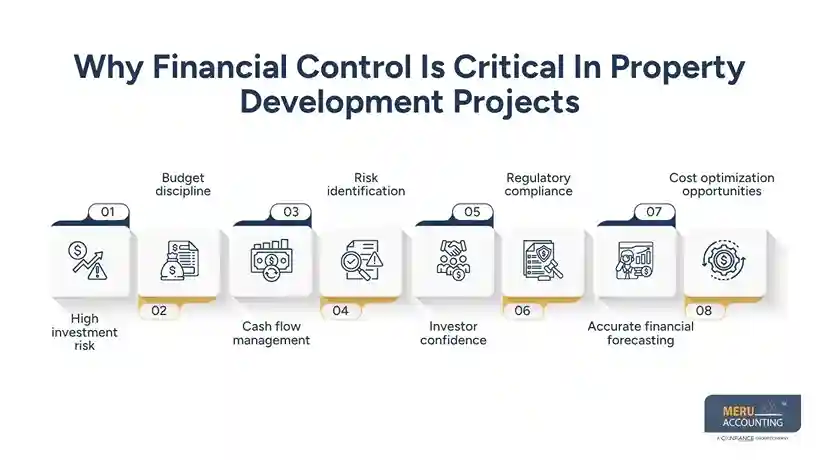
Investor confidence
Clear financial reporting from a project accountant builds trust among investors. Transparent financial data improves communication and strengthens long-term relationships.
Regulatory compliance
A project accountant ensures all financial activities follow legal and tax regulations. Accurate compliance reduces penalties and supports smooth project execution.
Accurate financial forecasting
A development accountant prepares realistic financial forecasts for better planning Well-structured projections guide investment decisions and future cost planning.
Cost optimization opportunities
A project accountant identifies areas where costs can be reduced without affecting quality. Improved efficiency leads to better margins and stronger financial performance.
Key Responsibilities Of A Development Accountant In Real Estate Projects
- A development accountant records all project costs, including materials, labor, and services, ensuring accurate expense tracking throughout the project lifecycle.
- A project accountant helps create structured and realistic project budgets, supporting better financial planning and cost control.
- Reports prepared by a project accountant provide clear insight into project performance, helping stakeholders understand financial progress.
- A project accountant ensures tax rules and legal requirements are properly followed, reducing compliance risks and penalties.
- A project accountant works closely with internal teams to maintain smooth financial operations and proper coordination across departments.
How A Development Accountant Improves Project Profitability
Cost optimization
A development accountant identifies unnecessary spending and helps reduce costs. Efficient cost control improves margins without affecting project quality.
Better financial planning
A project accountant supports structured planning that improves long-term outcomes, often enhanced by accounting & bookkeeping services for property realtors in the USA. Clear financial direction reduces uncertainties and supports steady growth.
Profit forecasting
A project accountant uses real data to estimate project profitability. Accurate projections help set realistic expectations and financial targets.
Decision support
Developers rely on insights from a project accountant for better financial decisions. Data-driven analysis improves the quality and speed of key decisions.
Resource efficiency
A project accountant ensures proper use of financial and physical resources. Optimized resource allocation prevents waste and improves overall productivity.
Cash flow control
A development accountant monitors inflows and outflows to maintain liquidity, ensuring stability through accounting & bookkeeping services for property realtors in the USA. Stable cash flow ensures uninterrupted project execution and timely payments.
Variance analysis
A project accountant compares actual costs with planned budgets regularly. Early identification of variances helps control overspending and protect profitability.
Common Financial Challenges In Real Estate Development Without Proper Accounting
Uncontrolled spending
Without a project accountant, costs often increase without proper tracking. Lack of monitoring leads to unnecessary expenses and reduced profitability.
Poor budget management
Lack of structured financial control leads to budget overruns. Inaccurate planning makes it difficult to maintain financial discipline across project stages.
Cash flow gaps
Projects may face payment delays without proper financial monitoring. Irregular cash flow disrupts operations and slows down project progress.
Weak reporting systems
Financial data becomes unclear when a development accountant is not involved. Incomplete reporting reduces transparency and affects decision-making quality.
Reduced investor trust
Poor financial visibility can negatively impact investor confidence. Limited clarity in accounts often discourages long-term investment support.
Role Of Accounting & Bookkeeping Services For Property Realtors in the USA
Organized financial data
Accounting & bookkeeping services for property realtors in the USA help maintain clean and structured records. Accurate data organization improves financial clarity and reduces errors in reporting.
Tax support system
These services support accurate tax preparation and compliance. Proper tax handling reduces penalties and ensures smooth regulatory compliance.
Expense recording
All financial transactions are recorded properly for better clarity. Systematic expense tracking improves cost control and financial accuracy.
Financial transparency
A development accountant uses these services to ensure clear reporting. Transparent financial records strengthen accountability and improve decision-making.
Business growth support
These services help real estate firms maintain financial stability and support growth decisions. Strong financial systems enable better planning and long-term scalability.
Development Accountant Vs Traditional Real Estate Accountant: Key Differences
Aspect | Development Accountant (Project Accountant) | Traditional Real Estate Accountant |
Project focus | Focuses specifically on real estate development projects | Handles general real estate accounting activities |
Cost monitoring | Tracks expenses in a detailed, project-wise manner | Records expenses in a broader, less granular format |
Reporting depth | Provides detailed, project-specific financial reports | Produces standard financial statements and summaries |
Financial control | Plays a strong role in managing and controlling project budgets | Focuses more on overall accounting compliance and reporting |
Real estate understanding | Possesses deep knowledge of property development cycles | Has a general understanding of real estate financial operations |
How To Choose The Right Development Accountant For Your Project
Industry experience
Select a development accountant with real estate project experience. Relevant industry exposure ensures better understanding of project-specific financial challenges.
Technical knowledge
A good project accountant must understand budgeting and reporting tools. Strong technical skills improve accuracy in financial tracking and analysis.
Communication skills
A project accountant should explain financial data in a simple way. Clear communication helps stakeholders make faster and better decisions.
Past work record
Experience shows how effective a project accountant can be in real situations. A proven track record reflects reliability and professional competence.
Compliance knowledge
A project accountant must understand tax and legal requirements clearly. Strong compliance awareness reduces risks and ensures smooth project execution.
Real Estate Development Accounting Services by Meru Accounting
Meru Accounting provides professional support for real estate firms and developers. Our team includes experienced professionals who work as development accountants for projects of different sizes. We also provide accounting & bookkeeping services for property realtors in the USA, helping businesses maintain accurate records and improve financial control.
Our structured approach helps reduce financial errors, improve reporting accuracy, and support better decision-making. A development accountant from our team ensures every financial detail is tracked properly. With strong accounting support, real estate firms gain better control over costs, budgets, and overall project performance.
Our Expert Perspective
Financial clarity in real estate projects is widely recognized by our accounting experts as a key factor separating successful execution from project delays. An accountant is seen as a critical function that brings structure to complex financial activities and ensures consistent control at every stage of development.
Our experts further observe that combining this role with accounting & bookkeeping services for property realtors in the USA improves financial visibility across spending, reporting, and planning. Such an integrated approach is consistently linked with more stable project execution and reduced financial uncertainty across real estate portfolios.
Key Takeaways
- A development accountant plays a crucial role in ensuring strong financial control in real estate projects.
- Proper budgeting helps reduce cost overruns and minimizes financial risks during project execution.
- Accounting support improves the accuracy and reliability of financial records and reporting.
- Strong financial tracking contributes to better cost management and improved project profitability.
- Selecting the right project accountant significantly enhances overall project success and efficiency.
FAQs
A development accountant manages budgets, expenses, and financial reports for property projects.
A project accountant helps maintain financial control and reduce project risk.
Accounting & bookkeeping services for property realtors in the USA help maintain accurate financial records.
Yes, a project accountant focuses only on real estate development projects.
Look for experience, clear communication, and real estate knowledge in a development accountant.