
The difference between bookkeeping and accounting is important for every business owner because both functions play different roles in financial management.
Bookkeeping focuses on recording daily financial transactions such as sales, expenses, invoices, and payroll, while accounting focuses on analyzing and interpreting financial data for budgeting, tax planning, reporting, and business decisions.
Accurate bookkeeping creates the foundation for accounting and allows businesses to maintain proper financial control. Many businesses now prefer outsourced bookkeeping services because managing financial records internally can require significant time and resources.
Small businesses, startups, eCommerce companies, and service firms often rely on professional bookkeeping firms to maintain organized financial records without building large internal teams.
Proper bookkeeping and accounting practices reduce financial errors, support tax filing and audits, and provide better visibility into business performance and growth planning.
What You Will Learn From This Blog
- Meaning of bookkeeping and accounting
- The core difference between bookkeeping and accounting
- Responsibilities involved in bookkeeping and accounting
- Software and tools used in both functions
- How financial reporting differs in bookkeeping and accounting
- Situations where businesses need outsourced bookkeeping services
- Benefits of outsourced bookkeeping support for growing companies
- How Meru Accounting supports businesses with bookkeeping solutions
- Answers to common bookkeeping and accounting questions
What are Catch Up Bookkeeping Services?
Catch-up bookkeeping services are designed to organize and update delayed or incomplete financial records that have been delayed, overlooked, or mismanaged.
Many e-commerce sellers use bookkeeping catch up services to handle daily transaction entries, payment settlements, refunds, and inventory tracking as their business grows.
These services ensure all financial transactions are accurately recorded and reconciled, providing reliable records for reporting, tax filing, and business planning.
Businesses that manage multiple sales channels often need these services to fix reporting gaps, resolve inventory mismatches, and correct errors. Some use them occasionally, while others schedule them regularly to maintain order.
Beyond compliance, accurate records give sellers a clear view of cash flow, costs, and performance, enabling informed decisions and better planning for future growth.
Introduction To The Outsourced Bookkeeping Services
Outsourcing bookkeeping involves hiring an external bookkeeping firm to manage financial records, transaction entries, reconciliations, payroll records, invoices, and expense tracking. Many businesses choose this approach because maintaining bookkeeping internally can require additional staff, training, software costs, and administrative time.
Small businesses, startups, eCommerce companies, and service firms often prefer external financial support to maintain organized financial records while focusing on daily business operations and better understanding the difference between bookkeeping and accounting for improved financial clarity.
Modern remote bookkeeping solutions commonly use cloud accounting software such as QuickBooks, Xero, and Zoho Books, allowing businesses to access financial reports securely from any location.
Professional bookkeeping firms also follow structured financial recording methods that reduce errors related to invoices, reconciliations, and expense classification.
Many providers offer industry-specific bookkeeping solutions for sectors such as healthcare, manufacturing, retail, real estate, and hospitality, making financial management more organized and efficient for growing companies.
Core Difference Between Bookkeeping And Accounting
Category | Bookkeeping | Accounting |
Core Difference | Focuses on recording and organizing financial transactions. | Focuses on interpreting financial data and generating business insights. |
Purpose | Forms the foundation of financial management by maintaining accurate records of all transactions, which highlights the difference between bookkeeping and accounting in financial workflows. | Uses financial data to analyze performance, profitability, taxes, and business health. |
Daily Responsibilities | Records sales, purchases, payroll entries, supplier payments, receipts, invoices, expenses, and reconciliations. | Prepares financial reports, analyzes trends, calculates taxes, and supports business decision-making. |
Role in Decision-Making | Maintains organized financial records but does not interpret data. | Converts financial records into insights used for planning and strategic decisions. |
Example Function | Records monthly expenses and day-to-day financial transactions. | Identifies cost-saving opportunities and profit improvement strategies. |
Reporting Structure | Provides the raw financial data needed for accounting reports. | Creates financial statements such as profit & loss, balance sheets, and cash flow reports. |
Dependence | Accounting depends on accurate bookkeeping records. | Relies on bookkeeping data to prepare accurate financial analysis. |
Education & Skills | Focuses on transaction management and accounting software usage. | Requires advanced financial education, tax knowledge, and analytical skills. |
Business Impact | Ensures financial data is accurate and well-organized. | Helps businesses make informed financial and strategic decisions. |
Skills, Tools, And Software Used In Bookkeeping And Accounting
Transaction Recording Skills
Bookkeepers must maintain strong attention to detail to ensure every financial transaction is recorded accurately. Even small errors in data entry or reconciliation can significantly affect financial statements.
Accurate recordkeeping requires consistency, discipline, and proper documentation practices across daily financial operations, forming the base layer in the difference between bookkeeping and accounting.
Financial Analysis Skills
Accounting professionals focus on analyzing financial data, preparing reports, and evaluating overall business performance. Financial analysis helps identify trends, risks, and opportunities for improvement.
Strong analytical thinking supports budgeting, forecasting, and strategic decision-making for business growth.
Accounting Software Platforms
Most businesses rely on accounting software to manage bookkeeping and accounting tasks efficiently. Popular tools include QuickBooks, Xero, NetSuite, and FreshBooks.
Automation features in these platforms streamline invoicing, payroll processing, bank reconciliation, and financial reporting.
Spreadsheet And Reporting Tools
Spreadsheets are widely used for financial analysis, reconciliations, and customized reporting tasks. Budgeting, expense tracking, and data comparison are easier with structured spreadsheet systems.
Financial professionals use spreadsheets to prepare detailed reports and support accurate decision-making processes.
Tax Compliance Knowledge
Accounting professionals must understand tax regulations, filing requirements, and financial reporting standards. Incorrect tax filing can lead to penalties and compliance risks for businesses.
Bookkeeping and accounting teams often collaborate with tax experts to ensure accurate and timely tax submissions.
How Financial Reporting Differs In Bookkeeping And Accounting
Daily Transaction Reports
Bookkeeping generates daily records of financial transactions, including sales, purchases, payroll, and payments. These records maintain financial accuracy and support structured accounting processes.
Profit And Loss Statements
Accounting prepares profit and loss statements using organized bookkeeping data over specific time periods, clearly demonstrating the difference between bookkeeping and accounting in financial reporting. Reports highlight revenue, expenses, and overall profitability for business performance evaluation.
Balance Sheet Preparation
Accounting develops balance sheets that present assets, liabilities, and owner equity in a structured format. These statements help assess the overall financial position of a business at a given time.
Cash Flow Analysis
Bookkeeping records all cash inflows and outflows from daily business operations. Accounting evaluates cash flow patterns to determine liquidity and operational financial stability.
Tax Reporting Functions
Accounting uses bookkeeping records to prepare accurate tax reports and ensure proper classification of income and expenses. Well-maintained records reduce errors, delays, and compliance risks during tax filing.
Financial Forecasting Reports
Accounting prepares forecasting reports based on historical financial data and business trends. These insights support budgeting, expansion planning, and future financial decision-making.
When Businesses Should Consider Outsourced Bookkeeping Services
Rapid Business Growth
Business growth usually increases transaction volume, payroll complexity, vendor payments, and invoicing requirements.
Managing bookkeeping internally may become difficult during expansion periods, especially when businesses begin to understand the difference between bookkeeping and accounting responsibilities.
Delayed Financial Records
Financial records often get delayed when business owners prioritize operations and customer handling. Regular bookkeeping ensures timely updates and consistent financial reporting.
Frequent Financial Errors
Bookkeeping errors can impact payroll accuracy, vendor payments, tax filings, and financial decision-making. Professional oversight reduces errors through standardized processes and review systems.
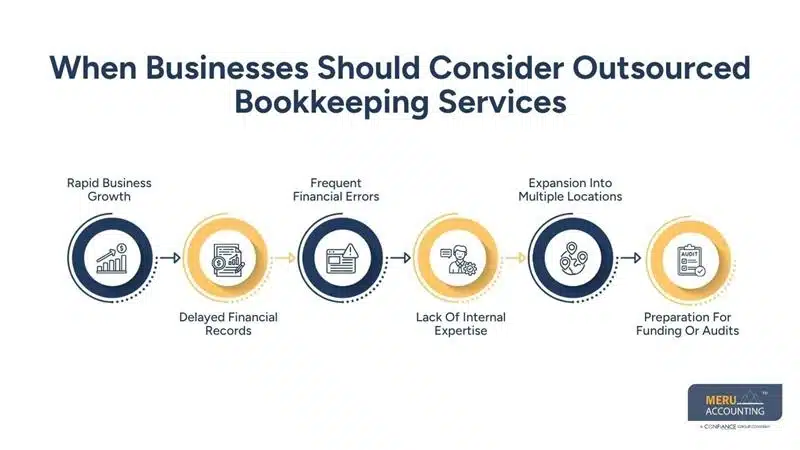
Lack Of Internal Expertise
Many businesses operate without trained bookkeeping professionals, leading to inconsistent financial records. Experienced support provides skilled expertise for accurate and compliant bookkeeping.
Expansion Into Multiple Locations
Multi-location businesses face increased complexity in tracking and managing financial data across branches. Centralized systems help streamline records and improve financial coordination.
Preparation For Funding Or Audits
Investors, banks, and auditors require clean and well-organized financial statements for evaluation. Audit-ready records support smooth funding processes and financial transparency.
Benefits of Using Outsourced Bookkeeping Services For Growing Companies
Better Time Management
Business owners often spend excessive time managing invoices, receipts, reconciliations, and payroll entries.
Outsourcing bookkeeping allows owners to focus on operations and customer relationships. This creates better productivity within growing businesses.
Lower Operational Costs
Maintaining internal bookkeeping departments can increase payroll expenses, training costs, and software investments.
Smaller businesses may struggle with these ongoing costs. Outsourced bookkeeping services offer professional financial management at controlled costs.
Access To Experienced Professionals
Professional bookkeeping firms work with businesses across multiple industries. Their experience allows them to identify common financial recording issues quickly. This creates more consistent bookkeeping procedures.
Organized Financial Reporting
Timely bookkeeping creates accurate financial reports and easier tax preparation. Organized records also simplify business analysis and investor communication. Reliable reports are important for long-term business planning.
Better Data Security
Professional bookkeeping firms commonly use encrypted cloud systems and secure financial access controls.
This reduces the risk of lost records or unauthorized financial access. D
How Meru Accounting Supports Businesses With Bookkeeping Services
Industry-Focused Bookkeeping Solutions
Meru Accounting provides bookkeeping and accounting services for businesses across industries such as healthcare, retail, manufacturing, real estate, hospitality, eCommerce, and professional services.
The company understands that each industry follows different financial processes and reporting structures.
Cloud Accounting Expertise
Meru Accounting works with leading accounting platforms such as QuickBooks, Xero, Zoho Books, and NetSuite. Cloud integration allows clients to access financial records securely and efficiently.
Customized Bookkeeping Support
Every business maintains different transaction volumes and reporting needs. Meru Accounting provides customized bookkeeping support based on business size, industry requirements, and operational structure.
This allows businesses to receive financial support aligned with their goals.
Experienced Financial Professionals
The company maintains teams experienced in bookkeeping, accounting, payroll, reconciliation, tax coordination, and financial reporting.
Our professionals follow structured bookkeeping processes to maintain financial accuracy. Organized financial records also simplify year-end reporting requirements.
Support For Global Businesses
Meru Accounting provides financial support services for businesses operating in different countries and markets.
International businesses often require structured bookkeeping practices for compliance and reporting. Professional financial management reduces operational pressure for growing companies.
Our Expert Perspective
From our practical experience working with growing businesses, many companies tend to delay bookkeeping updates until tax season approaches, often due to limited clarity on the difference between bookkeeping and accounting functions. This often leads to financial confusion, missing invoices, reporting gaps, and unnecessary operational stress.
Businesses that maintain consistent bookkeeping records throughout the year generally experience smoother tax preparation, improved cash flow visibility, and stronger financial planning. Structured financial support often provides the consistency required during expansion stages.
Key Takeaways
- Bookkeeping records daily financial transactions, while accounting analyzes financial information, which clearly explains the difference between bookkeeping and accounting
- Both bookkeeping and accounting are important for financial management
- Bookkeeping forms the foundation for accounting reports
- Accounting focuses on reporting, taxes, budgeting, and financial analysis
- Outsourced bookkeeping services reduce internal workload and reporting delays
- Growing businesses often require external bookkeeping support for accuracy and organization
- Cloud accounting software simplifies financial access and reporting
- Organized bookkeeping records reduce tax preparation stress
- Financial reporting assists business owners with planning and decision-making
- Meru Accounting provides customized bookkeeping and accounting solutions for different industries
FAQs
Bookkeeping focuses on recording daily financial transactions such as sales, expenses, and invoices. Accounting focuses on analyzing financial records, preparing reports, and supporting business decisions.
Small businesses use outsourced bookkeeping services to save time, reduce internal workload, and maintain organized financial records without hiring large in-house teams.
Popular bookkeeping software includes QuickBooks, Xero, Zoho Books, and FreshBooks.
Yes, bookkeeping can be done separately. However, accountants usually review bookkeeping records to prepare financial statements, tax reports, and business analysis.
A business should consider external bookkeeping support when financial records become difficult to manage internally, errors increase, reporting gets delayed, or transaction volume grows rapidly.