Imagine running a small store where sales come in every day, suppliers send bills, employees receive salaries, and customers sometimes pay late. At the end of the month, you want to know whether the business made a profit. But where do you begin? This is where financial accounting for dummies becomes useful.
Instead of looking at every bill, payment, and sale as a separate task, financial accounting puts them into a clear order. The accounting cycle follows nine steps that turn daily business activity into financial reports. Each step has a purpose, and missing one can affect the final figures.
Understanding financial accounting for dummies does not require an accounting degree. With a few practical examples, business owners can understand how transactions move from the first entry to the final report. This blog also explains how outsourced financial accounting services fit into the process.
What You Will Learn From This Blog
- Why understanding the nine steps of financial accounting for dummies makes it easier to follow business transactions.
- Why the accounting cycle follows nine steps.
- How each step changes or checks financial records.
- Which common mistakes can affect business reports.
- How accounting software and outsourced financial accounting services manage routine accounting work.
Financial Accounting for Dummies: Understanding the Basics and Its Importance
Before learning the accounting cycle, it is worth knowing a few basic terms used in financial accounting. Financial accounting for dummies becomes easier when you understand how these terms relate to everyday business activities.
Assets
Assets are things a business owns that have financial value. Cash, office equipment, stock, buildings, and money due from customers are common examples.
Liabilities
Liabilities are amounts a business owes to others. Supplier bills, bank loans, unpaid salaries, and tax dues fall under this category.
Equity
Equity is the owner’s remaining interest in the business after liabilities are deducted from assets. It shows the value left for owners based on the company’s recorded assets and debts.
Revenue and Expenses
Revenue is the money a business earns from sales or services, while expenses are the costs of running it. Rent, wages, electricity, and stock purchases are common expense examples.
Double-Entry Accounting
Every financial transaction affects at least two accounts, with total debits matching total credits. For example, a cash sale increases cash and sales revenue by the same amount.
Financial Statements
Financial statements bring recorded figures together into reports. The income statement, balance sheet, and cash flow statement show business performance, financial position, and cash movements.
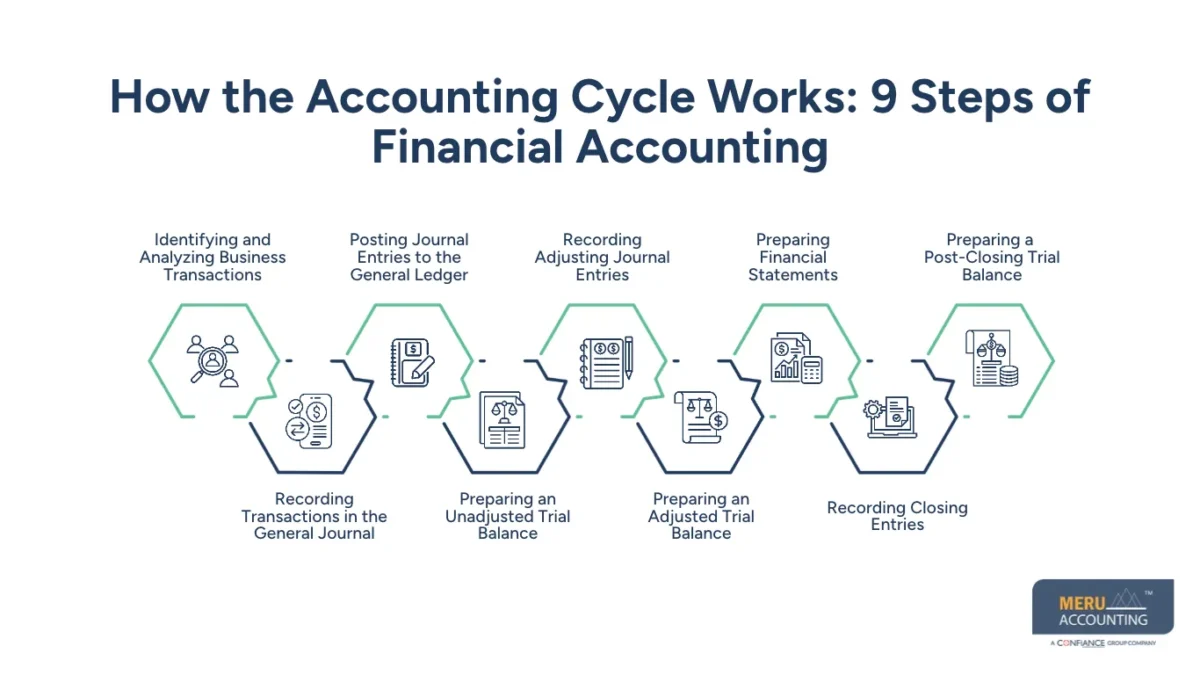
How the Accounting Cycle Works: 9 Steps of Financial Accounting
Now, follow a $5,000 credit sale through the nine steps to understand how financial accounting for dummies works in practice.
Step 1: Identifying and Analyzing Business Transactions
An accountant first checks which business activities affect the company’s finances. These may include sales, purchases, salary payments, rent, loans, and customer collections.
For a $5,000 credit sale, the accountant checks the sales invoice and confirms that the customer owes the business money. The transaction is then ready for recording.
Step 2: Recording Transactions in the General Journal
In financial accounting for dummies, the general journal records financial events in date order. Each entry includes the accounts involved, debit and credit amounts, and a short description.
For the $5,000 credit sale, accounts receivable is debited, and sales revenue is credited. Both sides must have equal amounts under double-entry accounting.
Step 3: Posting Journal Entries to the General Ledger
A journal shows transactions in date order, while a ledger groups them by account. The accountant transfers the $5,000 entry to the accounts receivable and sales revenue accounts.
This makes it easier to check how much customers owe and how much revenue the business has earned during the period.
Step 4: Preparing an Unadjusted Trial Balance
In financial accounting for dummies, the unadjusted trial balance lists the balances of all ledger accounts before adjustments.
Suppose total debits are $30,000 and total credits are also $30,000. The figures match, but accountants must still check for wrong account entries and missing transactions.
Step 5: Recording Adjusting Journal Entries
Some income and expenses need adjustment before reports are prepared. Common examples include unpaid bills, earned but unrecorded revenue, prepaid costs, and depreciation.
For instance, if a business has used equipment during the month, it records the required depreciation expense. This places the cost in the correct reporting period.
Step 6: Preparing an Adjusted Trial Balance
After all adjustments are entered, accountants prepare an adjusted trial balance. It shows the updated balances of accounts after the required changes.
The debit and credit totals must match. Accountants use this report to check the figures before preparing the financial statements.
Step 7: Preparing Financial Statements
The adjusted figures now become the basis for financial statements. These reports show different parts of the company’s financial position and performance.
The income statement reports revenue and expenses, the balance sheet lists assets and liabilities, and the cash flow statement shows cash received and paid during the period.
Step 8: Recording Closing Entries
At the end of the reporting period, accountants close temporary accounts such as revenue and expenses. Their balances are transferred to the relevant equity account.
This resets temporary accounts for the next period. Permanent accounts, such as cash, equipment, and loans, retain their balances.
Step 9: Preparing a Post-Closing Trial Balance
The final check includes only permanent accounts after closing entries. Accountants compare the debit and credit totals once again.
When the totals match, the accounting records are ready for the next reporting period. The financial accounting for dummies process then starts again with new business transactions as the accounting cycle repeats.
Common Accounting Cycle Mistakes and How Businesses Can Avoid Them
Even a business with accounting software can face errors if entries are missed or records are not checked. Financial accounting for dummies also means knowing where these problems usually begin.
Missing Transaction Records
A forgotten bank charge or supplier bill can change account balances. Businesses should keep invoices, receipts, and bank records in one place.
Incorrect Debit and Credit Entries
In financial accounting for dummies, an entry posted to the wrong account can affect financial reports even when totals match. Accountants should review journal entries before posting them.
Skipping Account Reconciliation
A bank statement may show a different balance because of pending payments or bank fees. Regular reconciliation identifies these differences before closing.
Missing Adjusting Entries
Unrecorded depreciation and unpaid expenses can affect reported profit. Accountants should review these items at the end of every reporting period.
Delayed Financial Reporting
Late entries can delay monthly reports and leave owners with outdated figures. Financial accounting for dummies highlights fixed deadlines for recording and checking transactions
How Accounting Software Improves the Financial Accounting Cycle
Accounting software changes how businesses handle daily records. It can reduce manual entry, organize account data, and make financial accounting for dummies easier to follow.
Automated Transaction Entry
Many tools import bank transactions and match them with recorded payments. Accountants can review the suggested entries rather than entering every amount manually.
Faster Bank Reconciliation
Software compares bank data with ledger balances and flags transactions that do not match. Financial accounting for dummies explains how accountants check missing payments or duplicate entries.
Easy Financial Report Preparation
Most accounting systems can create income statements, balance sheets, and cash flow reports from recorded data. The figures still need a proper review before use.
Better Access to Financial Records
Cloud-based systems allow authorized users to view financial data from different locations. Access controls also limit who can view or change records.
Regular Data Checks
Some tools flag duplicate invoices, unusual entries, and overdue payments. These alerts explain a basic financial accounting for dummies concept: reviewing records to identify possible errors.
optional anymore
on running the business
How Outsourced Financial Accounting Services Improve Accounting Accuracy and Reporting
When daily transactions increase, business owners may find it hard to manage every accounting task internally. Outsourced financial accounting services allow businesses to assign agreed accounting work to an external team.
Consistent Transaction Recording
Outsourced financial accounting services cover sales, purchases, expenses, and other entries. Financial accounting for dummies covers how collecting bills and checking records keeps the financial statements organized.
Regular Bank Reconciliation
External accountants compare bank statements with accounting records. They review missing entries, duplicate payments, and balance differences before reports are prepared.
Timely Month-End Closing
Month-end closing involves ledger reviews, adjustment entries, and financial report preparation. Standard accounting procedures help ensure these tasks are completed within agreed deadlines.
Access to Accounting Professionals
Businesses may need staff with knowledge of bookkeeping, financial reporting, and accounting software. Outsourcing provides access to accounting professionals without hiring every role full-time.
Better Control Over Accounting Costs
An in-house team involves salaries, training, and software costs. Outsourced financial accounting services offer a service-based arrangement that businesses can compare with their workload and budget.
Clear Financial Reports
Regular reports show income, expenses, account balances, and cash movements. Financial accounting for dummies explains how owners use these figures to review business performance and plan spending.
How Meru Accounting Manages Financial Accounting and Reporting
A company may record hundreds of transactions in a month, but the value of those records depends on how well they are checked and reported. Meru Accounting provides accounting and bookkeeping services for businesses in the USA, UK, Australia, Canada, Singapore, UAE, and New Zealand.
Its services cover key financial tasks:
- Bookkeeping: Records sales, purchases, expenses, and other business transactions.
- General Ledger Management: Reviews account balances and keeps financial data organized.
- Bank Reconciliation: Compares bank statements with accounting records to find missing entries and balance differences.
- Financial Reporting: Prepares reports covering income, expenses, assets, liabilities, and cash movements.
- Accounting Software: Works with QuickBooks and Xero to manage financial records and reporting.
Meru Accounting provides outsourced financial accounting services based on each client’s agreed requirements. Its accounting processes focus on complete records, regular account checks, and clear reports for business owners and finance teams.
Our Expert Perspective
The real test of financial accounting for dummies is whether a business can trace a figure in its financial report back to the original bill, invoice, or payment. A balanced trial balance alone does not prove that every entry is right.
Businesses should check transactions throughout the month instead of waiting until the closing date. Regular bank reviews, complete records, and timely adjustments make the final reports more reliable.
Key Takeaways
- Financial accounting for dummies explains how businesses record, classify, and report their financial transactions.
- The accounting cycle has nine steps, from transaction analysis to the final trial balance.
- Journal entries and ledger accounts form the base of financial records.
- Adjusting entries place income and expenses in the correct period.
- Financial statements show revenue, expenses, assets, liabilities, and cash movements.
- Accounting software reduces manual work and organizes financial data.
- Outsourced financial accounting services cover bookkeeping, reconciliation, and reporting.
- Regular account reviews reduce errors and reporting delays.
FAQs
The accounting cycle is a nine-step process that records business transactions, checks account balances, and prepares financial statements for a reporting period.
The accounting cycle starts with identifying business transactions, records them in journals and ledgers, and ends with closing accounts and checking final balances.
An unadjusted trial balance shows account balances before adjustments, while an adjusted trial balance includes changes for accrued expenses, prepaid costs, and depreciation.
The accounting cycle ensures that business transactions are recorded, checked, and adjusted before financial statements show the company’s income, expenses, assets, and liabilities.
Most businesses complete the accounting cycle monthly, quarterly, or annually, depending on their financial reporting needs.
optional anymore
on running the business