
Agencies and service firms often work with tight margins, changing client demands, and uneven cash flow patterns. In such conditions, financial analysis services for small businesses become an important tool to understand income patterns, cost behavior, and profit gaps. Many firms now depend on structured financial review systems to make better financial decisions and reduce risk.
When agencies apply structured financial review systems or financial planning and analysis services, they gain clarity on where money is earned and where it is lost. This clarity is not only about reporting numbers but about shaping better business actions that lead to stable profitability.
What You Will Learn From This Blog
- How agencies use financial review methods to track profit patterns
- Why service firms depend on structured cost analysis
- Key financial metrics that influence business decisions
- Common mistakes businesses make without financial clarity
- How structured reporting leads to long-term profit stability
- Practical use cases from service-based companies
What Are Financial Analysis Services for Small Businesses?
Financial analysis services for small businesses begin with a clear and structured process of collecting financial data. This includes income details, expense records, invoices, payroll inputs, and bank transaction feeds.
When all these records are brought together in one system, financial planning and analysis services ensure that information is complete, consistent, and ready for accurate review. Once the data is organized, structured reporting plays an important role in presenting financial health in a simple format.
Reports such as profit and loss statements and cash flow summaries give agencies a clear view of performance and help them understand whether projects are generating real profit.
At the same time, expenses are grouped into fixed, variable, and project-based categories, making it easier to track cost behavior and its impact on margins.
Another important part of financial analysis is identifying revenue patterns, especially since service firms often deal with uneven income cycles. Seasonal changes and client-based fluctuations become easier to track, which supports better planning.
Throughout this entire process, data accuracy remains critical, as even small reporting errors can lead to incorrect pricing decisions, staffing issues, or weak financial planning.
How Agencies and Service Firms Use Financial Analysis Services For Small Businesses to Improve Profitability
Project Profit Evaluation
Agencies review each project’s revenue and cost structure using financial analysis services for small businesses to understand real profit margins. This prevents underpriced services and loss-making contracts.
Client Profitability Review
Not all clients generate the same level of profit consistently. Financial analysis helps identify high-cost clients and low-margin accounts.
Resource Allocation Decisions
Teams, tools, and time are assigned based on financial return. This reduces waste and improves output efficiency.
Pricing Structure Adjustment
Service pricing is revised using cost and margin data. Agencies avoid undercharging and maintain healthier profit levels.
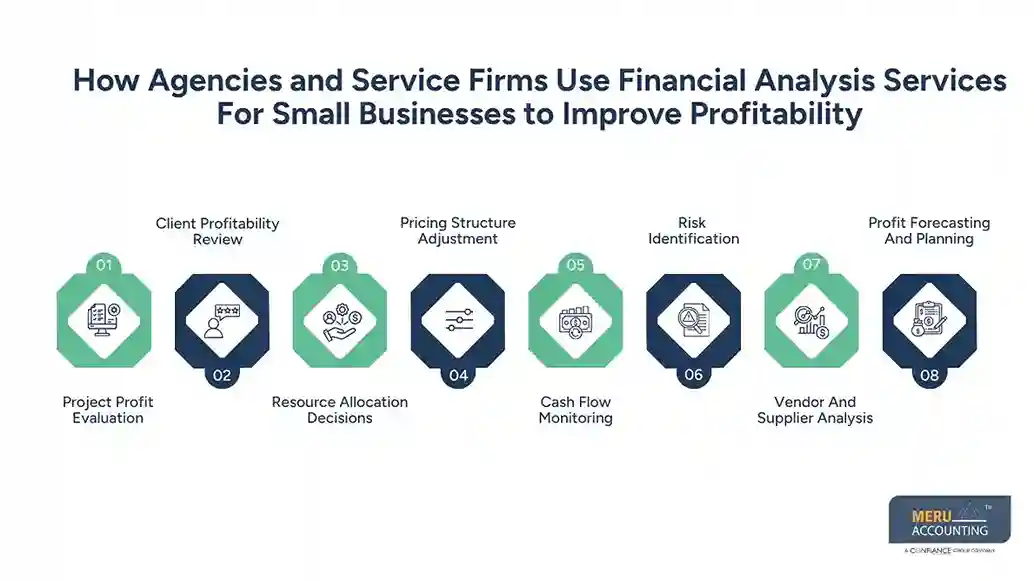
Cash Flow Monitoring
Agencies track cash inflows and outflows using financial planning and analysis services to maintain operational liquidity.
Regular monitoring helps them anticipate seasonal fluctuations or unexpected expenses. By identifying potential shortfalls early, firms can prevent disruptions in day-to-day operations.
Risk Identification
Financial patterns reveal potential risks like rising costs or delayed payments. Early identification allows firms to implement corrective or contingency actions. Addressing risks proactively minimizes negative impact on long-term profitability.
Vendor And Supplier Analysis
Analyzing vendor performance using financial analysis services for small businesses ensures cost efficiency and quality delivery consistently. Negotiating contracts with reliable suppliers reduces overall project expenditure effectively.
Profit Forecasting And Planning
Forecasting profits through financial planning and analysis services helps agencies anticipate financial challenges and opportunities accurately. It guides strategic decisions and improves resource allocation for upcoming projects.
Challenges Agencies Face Without Financial Analysis
Poor Cost Visibility
Without structured financial review, agencies cannot clearly see where money is being spent. This lack of visibility often results in unnecessary or hidden operational expenses.
Weak Profit Tracking
Many firms assume projects are profitable without verifying real margins, which creates long-term financial gaps. This can lead to taking on projects that actually reduce overall profitability.
Delayed Financial Decisions
Without timely reports, decisions are based on outdated numbers, increasing financial risk. Slow decision-making often causes missed opportunities or inefficient resource allocation.
Inefficient Budget Planning
Budgets become guesswork instead of data-based planning, leading to overspending. This prevents agencies from setting realistic financial goals and controlling costs effectively.
These issues are often reduced when businesses adopt financial analysis services for small businesses to improve financial clarity and decision-making.
How Financial Analysis Helps Agencies Control Operational Costs
Expense Monitoring Systems
Regular tracking of operational expenses through financial planning and analysis services for small businesses ensures early detection of unnecessary costs. Better visibility enables smarter allocation of financial resources across departments.
Vendor Cost Evaluation
Agencies use insights from financial planning and analysis services to compare vendor pricing and services, helping reduce procurement costs without losing quality. Strong vendor comparisons create room for better negotiation and cost savings.
Workforce Cost Analysis
Payroll and contractor costs are reviewed against project output using financial analysis services for small businesses, ensuring balanced and performance-linked spending. Balanced workforce planning prevents overspending on underutilized staff or contractors.
Tool And Software Optimization
Unused or underused tools are removed to reduce recurring costs. Optimized software usage ensures spending aligns with actual business requirements.
Office Resource Management
Utilities, rent, and administrative costs are tracked to avoid wasteful spending. Controlled resource usage maintains financial stability across daily operations consistently.
How Financial Reporting Supports Long-Term Profitability in Service Firms
Strategic Planning Support
Reports generated through financial planning and analysis services guide long-term decisions such as expansion, hiring, and service diversification. Data-driven planning helps align resources with organizational growth objectives efficiently.
Performance Benchmarking
Financial reports allow comparison across months or years to track improvement. Benchmarking trends highlight areas that require corrective action for better results.
Investment Decision Support
Firms use insights from financial analysis services for small businesses to decide when and where to invest for growth. Careful evaluation ensures capital is allocated to projects with the highest returns.
Stability In Revenue Planning
Predictable reporting through financial planning and analysis services reduces uncertainty in future income estimates. Accurate forecasting assists agencies in scheduling resources and managing cash flow.
Compliance And Transparency
Accurate reporting ensures firms meet tax and regulatory requirements without penalties. Clear documentation strengthens trust with clients, investors, and governing authorities.
Key Metrics and Reports in Financial Analysis Services for Small Businesses
Profit Margin Reports
Profit margin reports generated through financial analysis services for small businesses show how much profit remains after costs, helping agencies assess performance. Tracking profit margins over time reveals which services contribute most to revenue.
Cash Flow Statements
Cash flow reports track actual money movement, not just recorded income. Monitoring inflows and outflows ensures operational liquidity and prevents unexpected shortages.
Accounts Receivable Aging
Reports identify unpaid invoices and help firms manage collections efficiently. Prioritizing overdue accounts improves cash flow and reduces potential financial risk.
Cost Per Project Analysis
Each project is measured based on total cost versus revenue generated. Comparing project costs allows managers to identify inefficiencies and optimize budgets.
Break-Even Analysis
This metric, supported by financial planning and analysis services, identifies the minimum revenue required to cover expenses fully. Understanding break-even points guides pricing and planning for sustainable profitability.
How Meru Accounting Supports Financial Analysis Services for Small Businesses
Meru Accounting provides structured financial analysis services for small businesses, designed for agencies and service firms handling multiple clients and projects.
With experience across industries like IT, media, real estate, and consulting, the focus remains on clear reporting and accurate cost tracking. Strong financial clarity allows agencies to make informed decisions with reduced uncertainty.
Project-Based Financial Reporting
We design reports that show profit at the project level, helping agencies understand which services generate real value. Project-wise insights highlight underperforming areas that need cost correction quickly.
Real-Time Financial Tracking
Financial data is updated regularly so firms can monitor cash flow and expenses without delay. Timely updates reduce reporting gaps and support faster financial decision-making.
Customized Reporting Formats
Reports are tailored based on business type, making financial data easier to understand and act upon. Simplified formats improve readability for owners and management teams during reviews.
Cost Control Analysis
We identify cost leak points and suggest structured methods to reduce unnecessary spending. Targeted analysis ensures operational costs remain aligned with business priorities.
Tax And Compliance Alignment
All financial analysis under financial analysis services for small businesses is aligned with tax rules and reporting standards to avoid future issues. Proper alignment reduces compliance risks and supports accurate financial documentation.
Our Expert Perspective
Our team’s experience with service-based firms shows a clear pattern: most profit loss arises from weak financial tracking rather than low sales. Agencies often focus heavily on client work while overlooking internal financial management.
Implementing financial analysis services for small businesses allows firms to uncover hidden cost leaks and strengthen margins without increasing staff workload or operational complexity.
Key Takeaways
- Financial planning and analysis services provide the clarity essential for service firm profitability
- Project-level analysis reveals real profit performance
- Cost tracking reduces unnecessary operational spending
- Cash flow visibility prevents financial pressure
- Structured reporting supports long-term planning
- Agencies perform better when financial data is reviewed regularly
FAQs
They are structured systems that review income, expenses, and profit patterns to understand business performance in detail.
Agencies manage multiple projects and clients, so financial analysis helps track which work is profitable and which is not.
Most service firms review reports monthly, while some high-volume agencies review them weekly.
Yes, it identifies unnecessary spending and helps control operational expenses based on data.
Yes, even small agencies benefit because it gives clarity on cash flow, pricing, and project profitability.