
Hotels run in a very fast cycle where guests come and go every hour. Rooms get booked, meals are served, and services are used all day long. Every single activity creates a financial record. Because of this constant flow, hotels cannot rely on basic bookkeeping or random tracking. They need a clear system that records every dollar in and every dollar out. This system is known as hotel accounting. It helps hotel owners and managers understand how the business is doing at any time. In this blog, we will explain what hotel accounting procedures are, how it works inside real hotel operations, and why many hotels now prefer outsourced accounting support.
We will also break down the structure of accounting in hotel operations in simple terms so anyone can understand it, even without a finance background.
What You Will Learn From This Blog
This blog will help you understand:
- What does hotel accounting mean in real life
- How hotel accounting procedures work step by step
- Key parts of hotel finance systems
- Daily accounting flow in hotel operations
- Common issues in in-house accounting setups
- Why is outsourcing growing in the hotel space
- How expert accounting support improves profit control
By the end, you will clearly see how hotel finance runs behind the front desk.
What Are Accounting Services for Law Firms?
To understand hotel accounting procedures, we must look at how hotels handle money every day.
Hotel accounting procedures are structured steps used to record, track, and manage all financial activity inside a hotel. These steps make sure no transaction is missed or wrongly recorded.
Hotels deal with many types of income, such as:
- Room bookings
- Restaurant sales
- Banquet events
- Travel group packages
- Guest add-on services
They also handle many costs such as:
- Staff salaries
- Food and raw materials
- Electricity and water bills
- Repairs and maintenance
- Booking platform fees
So, we can say that hotel accounting procedures are a complete system that tracks hotel financial flows in a clean and structured way.
It helps owners see real profit, not just total sales. It also supports tax filing, audits, and business planning.
Without this system, hotel finance becomes unclear very fast.
Core Components of Accounting in Hotel Operations
The system of accounting in hotel operations has many moving parts. Each part plays an important role in daily control.
Daily Income Tracking
Hotels must record all income every day. This includes room revenue, food bills, and service charges.
Expense Control System
All costs must be tracked clearly. This helps managers understand spending patterns.
Night Audit Process
A night audit checks all daily transactions. It makes sure reports match real sales.
Guest Billing System
Each guest has a bill account called a folio. All charges are added until checkout.
Vendor Payment Tracking
Hotels work with many suppliers. Payments must be tracked to avoid delays or errors.
Financial Reports
Reports are created weekly, monthly, and yearly. These reports show profit, cost, and trends.
Together, these parts form the base of strong accounting in hotel systems.
Standard Hotel Accounting Procedures Every Hotel Should Follow
Hotels use set procedures to keep financial control strong. These steps reduce confusion and help maintain clean records.
Daily Entry System
Every transaction must be recorded on the same day it happens. This keeps data fresh and correct.
Shift Wise Cash Check
At the end of each shift, cash must match system records. This reduces loss risk.
Real-Time Guest Updates
Guest bills should be updated instantly. This avoids billing issues at checkout.
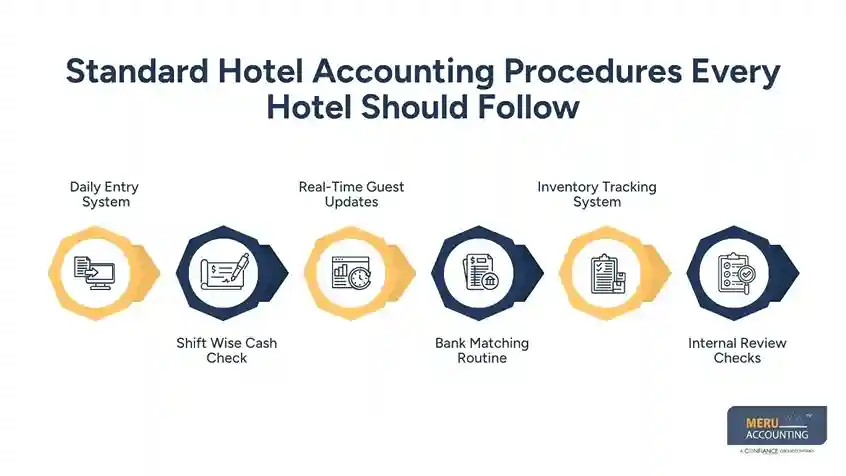
Bank Matching Routine
Bank records must be matched with internal accounts regularly.
Inventory Tracking System
Hotels must track food stock and supplies to control waste and cost.
Internal Review Checks
Regular checks help catch errors early and improve accuracy over time.
These steps make hotel accounting procedures a practical system that supports daily hotel work.
Why Hotel Accounting Needs Strong Structure
Hotel finance is different from normal business accounting. It is faster, more complex, and more detailed. A hotel may handle hundreds or even thousands of transactions in one day. These include small and large payments mixed together.
If the system is weak, errors grow quickly. A small mistake in billing can affect reports, taxes, and profit.
This is why structured accounting in hotel systems is very important. They create order in high-speed operations.
Common Challenges in Managing Hotel Accounting Procedures In-House
Many hotels try to manage accounting within their own team. But this often creates problems as the hotel grows.
High Work Pressure
Hotels run 24/7. Accounting work never stops, which creates pressure on small teams. Staff may find it hard to keep up during busy periods.
Mistakes in Manual Entry
Manual systems often lead to missing or wrong entries. Even small errors can affect financial records and reports.
Limited Skilled Staff
Not all hotels have trained accounting staff with hospitality experience. This can make complex accounting tasks harder to manage.
Slow Financial Reports
Internal teams may take time to prepare reports, which slows decision-making. Delays can limit access to key business data.
Compliance Stress
Tax and finance rules change often. Keeping up becomes hard for small teams. Missing updates can lead to costly issues.
Because of these issues, accounting in hotel systems can become unstable without expert help. Professional support helps improve accuracy, speed, and financial control.
Why Hotels Need Professional Outsourced Accounting Services
Outsourcing hotel accounting is now a common business choice. It helps hotels improve control and reduce stress.
Better Accuracy in Records
Experts reduce mistakes and maintain clean financial books.
Lower Cost Structure
Hotels save money by avoiding large in-house finance teams.
Faster Reports
Outsourced teams deliver reports on time and often in real time.
Strong Compliance Support
Experts stay updated with tax rules and legal changes.
Flexible Growth Support
As hotels grow, accounting support can scale quickly without hiring delays.
With outsourcing, hotel accounting procedures become easier to manage because trained teams handle the full system.
It also improves accounting in hotel operations by making them more stable, faster, and more reliable.
How Outsourcing Improves Hotel Decision Making
Good accounting is not just about records. It also supports better business decisions.
When hotel financial data is clear, owners can:
- Adjust room pricing
- Control food costs
- Plan staff schedules
- Improve marketing spend
- Increase profit margins
Outsourced teams help turn raw numbers into useful reports. This makes decision making faster and more confident.
This is one of the main reasons hotels shift from in-house systems to professional support.
Meru Accounting Hotel Accounting Services
Meru Accounting provides full support for hotel financial management. Our focus is simple: clear data, fast reporting, and strong control.
We offer:
- Daily hotel bookkeeping support
- Revenue and expense tracking
- Night audit review systems
- Payroll processing for hotel staff
- Vendor and payment tracking
- Monthly financial reports
- Tax-ready books and compliance support
Our systems are built for real hotel speed. We understand that hotel data changes every minute.
With Meru Accounting, hotels can simplify complex accounting in hotel operations and reduce internal workload. Our team also helps businesses clearly understand hotel accounting procedures through real execution, not just theory.
Benefits of Strong Hotel Accounting Systems
A strong accounting system brings many benefits to hotels.
Clear Profit View\
Owners can see real profit, not just sales numbers. This helps them understand the true financial health of the property.
Better Cost Control
Hotels can track where money is going and reduce waste. It also helps identify areas where spending can be improved.
Strong Cash Flow Management
Good systems help maintain steady cash flow. This allows hotels to meet daily expenses and plan ahead with confidence.
Faster Business Decisions
Accurate reports help managers act quickly. Timely data supports better operational and financial planning.
Lower Financial Risk
Clean records reduce errors, fraud risk, and tax issues. Strong controls also help maintain compliance with financial rules.
These benefits show why structured accounting in hotel systems is critical for long-term success. Strong financial processes help hotels improve stability, growth, and overall performance.
Key Takeaways
- Strong hotel accounting systems give owners a clear view of true profit and business health.
- Accounting in hotel helps track costs, cut waste, and keep spending in check.
- Clear cash flow records help hotels pay bills and meet day-to-day needs on time.
- Fast and accurate reports help managers make quick and sound business choices.
- Clean records help cut errors, lower fraud risk, and support tax rules.
- Strong hotel accounting procedures help support growth, profit, and long-term success.
FAQs
It is the system hotels use to record and manage all money transactions in an organized way.
It helps track income, control expenses, and improve profit clarity.
It includes billing, payroll, audits, reporting, expense control, and vendor payments.
Yes, but it becomes harder as operations grow and data volume increases.
It improves accuracy, speeds up reporting, reduces cost, and supports compliance.