A parent company owns four businesses. One handles manufacturing, another manages sales, and the other two operate in different markets. Each has separate accounts, expenses, and financial reports. At month-end, the finance team must bring all these records together to understand the group’s financial position. Managing this work through separate systems can take time and increase the risk of errors. This raises an important question: how much does NetSuite cost per month when a business needs to manage several legal entities?
The answer depends on the number of subsidiaries, users, selected modules, and reporting needs. NetSuite offers cloud-based ERP software with financial management and multi-entity features. However, there is no single price for every company. NetSuite costs for mid-sized businesses also vary based on system setup and required access levels.
What You Will Learn From This Blog
- How NetSuite subscription pricing works for multi-entity businesses.
- How much does NetSuite cost per month based on business needs.
- Which features and licenses increase the monthly fee.
- What implementation and maintenance expenses to expect.
- How the NetSuite cost for mid-sized businesses changes with growth.
- How to manage ERP spending without losing key finance features.
Understanding the NetSuite Pricing Model
NetSuite pricing has several parts rather than one standard license fee. The core platform forms the base, while user licenses and additional modules determine the final subscription amount.
Core Platform Subscription
The core platform provides access to essential ERP functions, including accounting and financial records. The selected edition and service tier determine the base package. A group with several subsidiaries may need a different setup from a single-company business.
User License Charges
Not every employee needs full access. A finance manager may need to post transactions and review reports, while another employee may only submit expenses. The number and type of licenses affect how much does NetSuite cost per month.
Optional Modules
Companies can add modules for inventory, revenue management, and planning. Each addition may increase the subscription fee. The NetSuite cost for mid-sized businesses can rise when companies purchase features that their teams rarely use.
NetSuite OneWorld for Multi-Entity Groups
NetSuite OneWorld is designed for businesses managing multiple subsidiaries and currencies. It offers features for intercompany transactions and financial consolidation. Companies should confirm the included subsidiary scope before accepting a quote.
Annual Contracts and Monthly Budgets
NetSuite subscriptions commonly use annual agreements. Dividing the yearly subscription by 12 gives a monthly budget estimate, but it does not confirm monthly billing. The signed contract determines payment terms.
NetSuite Monthly Pricing Breakdown for Multi-Entity Businesses
There is no fixed amount that answers how much does NetSuite cost per month for every company. A group with three subsidiaries and 15 users may receive a different quote from a group with eight subsidiaries and 80 users.
Base Platform and OneWorld Fees
The base platform and OneWorld subscription form the main license expense. A parent company should check whether all its subsidiaries are included or whether adding more entities will increase the fee.
Full User and Limited User Costs
Consider a finance team with 12 employees. Only five may need full access, while others may only approve requests or submit expenses. Selecting licenses according to actual job roles can prevent unnecessary spending.
Module and Service Tier Costs
A manufacturer may need inventory features, while a service company may require project accounting tools. The selected modules and service tier should match actual business activity rather than a long list of available features.
A Sample Monthly Budget
Suppose a parent company has four subsidiaries, 20 full users, and two additional modules. Its annual quote should list the platform, OneWorld, licenses, and modules. Dividing that amount by 12 gives the monthly planning figure, excluding implementation expenses.
How to Read a NetSuite Quote
Check whether the quote lists platform charges, users, modules, subsidiaries, and service tier separately. Also review renewal terms and additional license fees. This gives a clearer answer to how much does NetSuite cost per month.
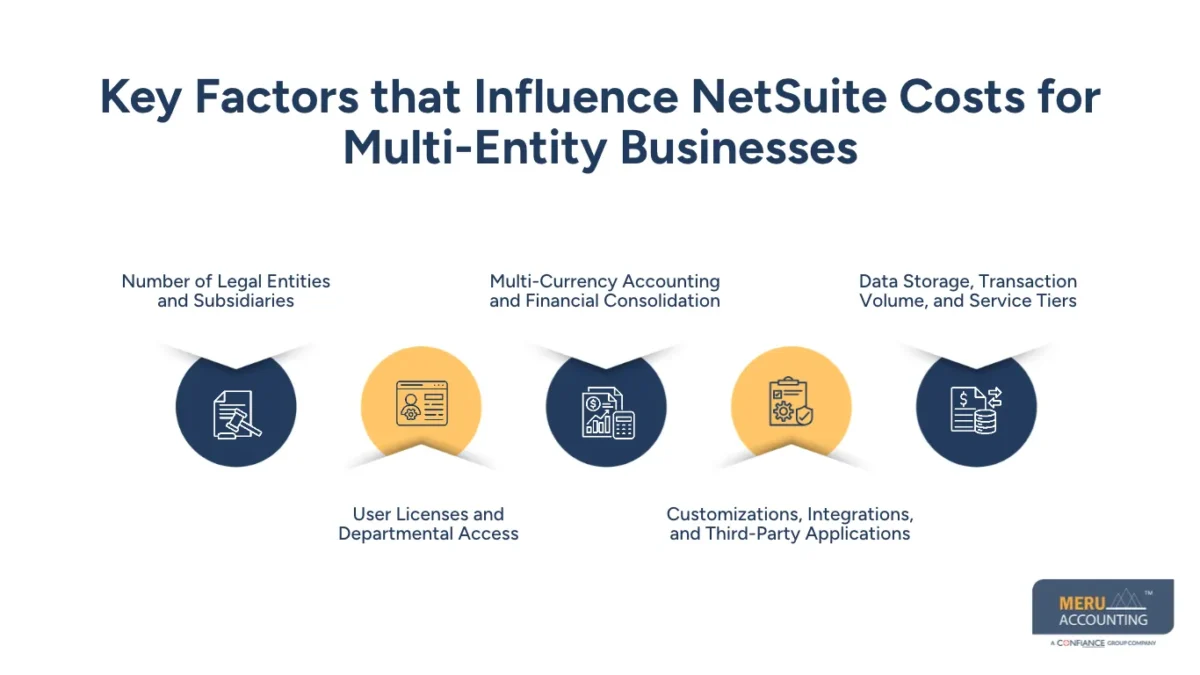
Key Factors that Influence NetSuite Costs for Multi-Entity Businesses
The NetSuite cost for mid-sized businesses depends on the company’s structure and daily financial needs. Five factors deserve attention before selecting a package.
Number of Legal Entities and Subsidiaries
A group with six subsidiaries may need more entity-level setup than a company with two. Each business may require separate accounting records, tax rules, and financial reporting. These requirements can affect how much does NetSuite cost per month.
User Licenses and Departmental Access
Finance, sales, HR, and operations teams may all use the ERP system. However, their access needs differ. Reviewing employee roles before purchasing licenses can prevent the company from paying for unnecessary access.
Multi-Currency Accounting and Financial Consolidation
A company operating in the US, Canada, and the UK may record transactions in USD, CAD, and GBP. Its parent company may also need consolidated reports in one currency. These requirements should be included in the pricing discussion.
Customizations, Integrations, and Third-Party Applications
Some companies connect NetSuite with payroll, CRM, tax, or e-commerce software. Custom approval rules may also be needed. Each integration or custom feature can add development and maintenance expenses.
Data Storage, Transaction Volume, and Service Tiers
A company processing thousands of invoices has different system needs from a smaller business. Storage, transaction volume, and processing requirements should match current activity and expected growth.
NetSuite Implementation Costs Beyond the Monthly Subscription
The subscription does not cover every expense. Businesses must also plan for setup, data migration, employee training, and technical work.
One-Time Implementation and Configuration Fees
Implementation includes chart of accounts design, subsidiary settings, tax rules, user roles, and approval flows. The NetSuite cost for mid-sized businesses may increase when different entities require separate accounting processes and configurations.
Data Migration and System Integration Expenses
Old records may be spread across spreadsheets and different accounting systems. Before migration, teams may need to remove duplicate entries, check balances, and prepare historical data. Integration work can add further costs.
Employee Training and Change Management
Employees need to learn how to perform their daily tasks in the new system. Finance teams may need training on transactions and reports, while managers may need guidance on approvals. Training should be part of the initial budget.
Ongoing Maintenance and Technical Support
After launch, businesses may need help with errors, reports, and workflow changes. Support may come from Oracle, an implementation firm, or internal technical staff. The required service level affects the ongoing expense.
optional anymore
on running the business
Hidden NetSuite Costs Multi-Entity Businesses Should Consider
The first quote may not show every future expense. When calculating how much does NetSuite cost per month, companies should also consider the following charges.
Additional Module and User License Charges
New employees, departments, or subsidiaries may require extra licenses and modules. Review these charges before expanding the system to avoid unexpected subscription increases.
Contract Renewal and Subscription Price Increases
The first-year price may change at renewal. Ask about future rate changes, notice periods, and renewal dates before signing the agreement.
Custom Reporting and Workflow Development
Management may need reports showing profit by subsidiary, department, or location. Standard reports may not cover every requirement. Custom development can increase project and maintenance costs.
Post-Implementation Optimization Expenses
After a few months, employees may identify workflows that need changes. New reports, access updates, and approval steps can require extra technical work. Keep a separate budget for these changes.
How to Reduce NetSuite Costs Without Compromising Financial Management
Controlling ERP expenses does not mean removing useful features. It means choosing the right tools and avoiding charges that do not match business needs.
Select the Right NetSuite Edition and Modules
Start with the company’s current accounting and reporting needs. Purchase additional modules only when a clear requirement exists. A phased rollout can also make the NetSuite cost for mid-sized businesses easier to manage.
Optimize User Licenses Across Subsidiaries
Review who needs full access and who can use limited access. Check inactive accounts and changing job roles regularly. This can prevent unnecessary license expenses.
Avoid Unnecessary Customizations
Use standard NetSuite features whenever they meet the business requirement. Custom scripts and workflows should be reserved for tasks that cannot be handled through standard tools.
Negotiate Subscription Terms and Renewal Conditions
Compare the full contract value instead of focusing only on the first-year offer. Ask about added users, new subsidiaries, renewal rates, and price changes before signing.
Is NetSuite Worth the Monthly Cost for Multi-Entity Businesses?
NetSuite may be worth the expense when a group needs consolidated financial reports and consistent records across subsidiaries. For example, a parent company with four businesses may spend several days collecting figures from separate accounting systems. A shared ERP platform can bring these records into one process.
However, how much does NetSuite cost per month should be compared with the total value the system provides. Subscription fees, implementation, training, and maintenance all belong in the calculation.
The NetSuite cost for mid-sized businesses may be justified when the company needs multi-entity reporting and stronger financial control. A smaller group with basic accounting needs may find a simpler system more affordable.
How Meru Accounting Manages Multi-Entity Accounting and Financial Reporting
Software can organize financial data, but accurate records still depend on regular bookkeeping and account checks. Meru Accounting provides accounting and bookkeeping services for businesses with ongoing financial reporting needs.
Multi-Entity Bookkeeping
Meru Accounting provides bookkeeping services that keep income, expenses, and account entries organized. Regular account checks make it easier to review records for each entity.
Financial Reporting
Meru Accounting provides financial reporting services covering revenue, costs, and account balances. Regular reports give business owners a clearer view of financial performance.
Accounts Payable and Receivable
Managing vendor bills and customer payments across subsidiaries can create extra work. Meru Accounting provides AP and AR services to maintain payment records and outstanding balances.
Month-End Close Assistance
Month-end close for mid-sized businesses involves checking account balances, reviewing transactions, and preparing reports to assess NetSuite costs. Meru Accounting provides accounting services based on the company’s close schedule and reporting needs.
Accounting Process Review
A review can identify duplicate entries, manual tasks, and gaps in account checks. Meru Accounting provides accounting services based on existing processes and financial requirements.
Our Expert Perspective
Before asking vendors for a quote, finance teams should list their reporting needs, user roles, and subsidiary requirements to evaluate NetSuite cost for mid-sized businesses. This makes it easier to compare prices and avoid paying for unused features. The real value of an ERP system should be measured through accurate records, fewer manual checks, and a more consistent month-end close.
Key Takeaways
- NetSuite has no single monthly price for all multi-entity businesses.
- The subscription depends on users, subsidiaries, modules, and service tiers.
- OneWorld provides features for subsidiary management and financial consolidation.
- Implementation, migration, training, and support add to the total cost.
- License reviews and limited customization can control spending.
- Businesses should compare the full contract value before purchasing.
FAQs
NetSuite monthly pricing depends on the OneWorld subscription, number of subsidiaries, user licenses, selected modules, and contract terms.
The main factors include the number of legal entities, user access, multi-currency requirements, optional modules, data storage, and service tier.
The total subscription depends on the OneWorld package and included subsidiary scope, so businesses should confirm additional entity charges in their pricing quote.
NetSuite implementation costs depend on system configuration, data migration, integrations, employee training, and the complexity of the company’s financial structure.
Businesses can control subscription costs by selecting essential modules, assigning suitable user licenses, avoiding unnecessary customizations, and negotiating renewal terms.
optional anymore
on running the business