For pastors, tax season can bring a few surprises. A church may pay a minister a salary, provide a parsonage, or approve a housing allowance. Add income from weddings, funerals, or guest sermons, and the tax picture gets even more complicated. The IRS clergy tax guide helps make sense of these special tax rules, many of which don’t apply to regular W-2 employees.
One detail worth knowing: a pastor’s church salary may count as employee income for federal income tax, while still being subject to self-employment tax. That’s just one of several rules that can affect how ministers report income, claim eligible tax benefits, and plan their payments. Let’s look at the 10 Clergy tax rules that matter most.
What You Will Learn From This Blog
- Who the IRS treats as a minister for tax purposes.
- Ten key tax rules that affect pastors and ministers.
- How church pay, gifts, and fees are taxed.
- How housing allowances and self-employment taxes work.
- Which tax forms and deductions may apply to clergy.
- When to seek help from a tax expert.
Who Qualifies as a Minister Under IRS Tax Rules?
The IRS does not treat every church worker as a minister for tax purposes. A person’s title alone does not decide their tax status. The IRS looks at their role, duties, and the rules of their church or faith group.
In general, a person may qualify as a minister if they are ordained, licensed, or commissioned by a church and have duties such as leading worship, giving sermons, or carrying out key rites of the faith. Their work must meet the IRS tests for ministerial status.
Some common roles that may qualify include:
- Pastors who lead a church or local group.
- Ministers who preach and lead worship.
- Priests and other ordained clergy.
- Ministers who perform weddings, funerals, and baptisms.
- Religious leaders who serve in roles that meet IRS tests.
A church title or job label does not prove that a person qualifies. The duties they perform and their standing in the faith group also matter. This is why the IRS clergy tax guide should be read with care before a church sets pay or a minister files a return.
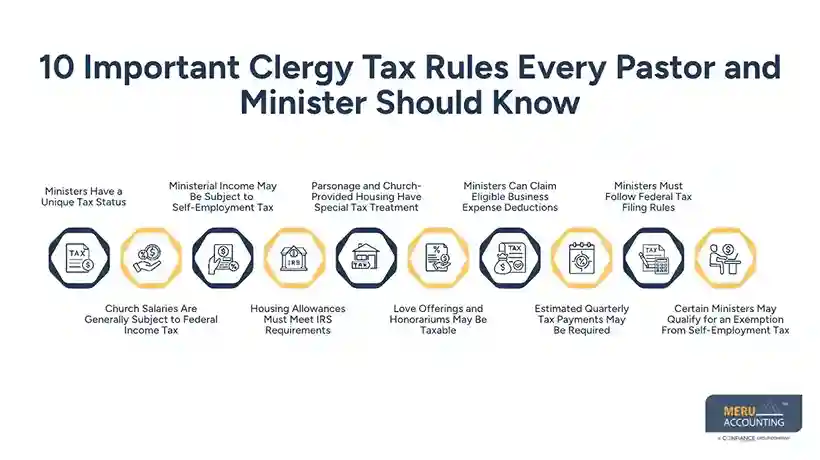
10 Important Clergy Tax Rules Every Pastor and Minister Should Know
The following Clergy tax rules cover the main areas that can affect a minister’s tax return.
Rule 1: Ministers Have a Unique Tax Status
Ministers can have a dual tax status. For federal income tax, a minister who works for a church is often treated as an employee. For Social Security and Medicare tax on ministerial pay, they are usually treated as self-employed.
This means a church may issue a Form W-2, but it will not usually withhold Social Security or Medicare tax from a minister’s pay. The minister may need to report this income and pay self-employment tax on Schedule SE.
Rule 2: Church Salaries Are Generally Subject to Federal Income Tax
A salary paid by a church is usually taxable income. This includes base pay, bonuses, and other forms of pay for work. A church may report this pay on Form W-2.
Ministers should check their W-2 each year and make sure it shows the right pay. They should also check if a housing allowance was listed in the right way. An approved housing allowance may be left out of federal income tax, but it is often still subject to self-employment tax.
Rule 3: Ministerial Income May Be Subject to Self-Employment Tax
Most ministers pay self-employment tax on income from their work. This tax helps fund Social Security and Medicare. It applies even when the minister is treated as an employee for federal income tax.
The tax may apply to church pay, fees for weddings, and other income from ministry work. Ministers often report this income on Schedule SE. They should keep a clear record of all pay and costs linked to their work.
Rule 4: Housing Allowances Must Meet IRS Requirements
A church may set aside part of a minister’s pay as a housing allowance. The church must name this amount in advance, before it pays the minister. The minister may leave out the lower of:
- The amount set by the church.
- The actual cost of a home.
- The fair rental value of the home, plus costs for basic needs.
The allowance must be used to pay for a home. Costs may include rent, mortgage payments, repairs, power, water, and home insurance. Any amount above the allowed limit must be reported as taxable income.
Rule 5: Parsonage and Church-Provided Housing Have Special Tax Treatment
Some churches give a minister a home to live in as part of their pay. This is often called a parsonage. The fair rental value of a church-provided home may be left out of federal income tax if the home is given as pay for ministry work.
However, the value of the home is usually still part of the income used to work out self-employment tax. Ministers who also get a cash housing allowance must check the rules that apply to both benefits.
Rule 6: Love Offerings and Honorariums May Be Taxable
Pastors may receive gifts or fees for weddings, funerals, talks, and other services. These payments are not always tax-free just because they are called gifts or love offerings.
If a payment is linked to a service or the minister’s work, it may count as taxable income. Ministers should keep a record of who paid them, why they got the money, and how much they received. The IRS clergy tax guide helps show why the name of a payment does not decide how it is taxed.
Rule 7: Ministers Can Claim Eligible Business Expense Deductions
Ministers may be able to claim costs linked to self-employed work. These can include travel, supplies, and other costs that meet IRS rules. The costs must be ordinary, needed for the work, and backed by good records.
But a church employee cannot claim most unreimbursed job costs as a federal itemized deduction under current law. A minister should not assume that all costs linked to church work can be claimed. A church plan that pays back valid work costs may be a better way to handle them.
Rule 8: Estimated Quarterly Tax Payments May Be Required
Churches may not withhold enough tax from a minister’s pay to cover the full tax bill. Since many ministers pay self-employment tax, they may need to send tax payments to the IRS during the year.
These are called estimated tax payments. They are often due in April, June, September, and January of the next year. A minister may also ask the church to withhold extra federal income tax from their pay. This can help cover both income tax and self-employment tax.
Rule 9: Ministers Must Follow Federal Tax Filing Rules
Ministers must report their taxable income and pay any tax due. They may need Form 1040, Schedule SE, and other forms based on their income and work.
A minister who earns fees from services outside their church may need to report that pay as business income. The right form will depend on how the work was done and the facts of the case. Good records can make tax filing much easier.
Rule 10: Certain Ministers May Qualify for an Exemption From Self-Employment Tax
Some ministers may seek an exemption from self-employment tax by filing Form 4361. But this is not a simple choice to lower a tax bill. The minister must meet strict IRS rules and have a valid reason based on faith and conscience.
The form must be filed on time and approved by the IRS. An exemption also means the minister gives up Social Security and Medicare benefits based on the income covered by it. Ministers should get expert tax advice before they apply.
How Does the IRS Tax Clergy Income?
The IRS looks at the type of income a minister receives and the work linked to it. A pastor may have more than one source of income in a tax year. Each source must be reported in the right way.
Here is how some common types of clergy income are treated:
Type of income | General tax treatment |
Church salary | Taxable for federal income tax and usually subject to SE tax |
Housing allowance | May be excluded from income tax, but is subject to SE tax |
Parsonage | Fair rental value may be excluded from income tax but is subject to SE tax |
Wedding and funeral fees | Generally taxable income and subject to SE tax |
Love offerings | Taxable when linked to services or ministerial work |
Speaking fees | Taxable income; treatment depends on the nature of the work |
A minister who receives a church salary and fees from members may need to report both. The church salary is often reported on Form W-2, while fees from personal services may count as self-employment income.
The key is to keep each source of income separate in the records. This makes it easier to report pay, claim valid costs, and work out the right tax. For more details, see IRS Tax Topic 417: Earnings for Clergy.
Clergy Housing Allowance: IRS Requirements and Tax Treatment
A housing allowance is one of the main tax benefits that may apply to pastors and ministers. It lets a church set aside part of a minister’s pay for home costs. If the rules are met, the minister may leave some or all of this amount out of federal taxable income.
But not every amount called a housing allowance is tax-free. The church must set the amount in an official record before it pays the money. The minister must also use the funds to provide a home during the year.
The amount that can be left out of federal income tax is the lowest of:
- The amount the church set aside in advance.
- The amount the minister spent on home costs.
- The fair rental value of the home, with basic items such as furniture and utilities.
For example, say a church sets aside $24,000 for a pastor’s housing allowance. The pastor spends $20,000 on home costs, and the fair rental value is $22,000. The pastor may exclude $20,000 from federal income tax. The extra $4,000 is taxable income.
Keep records of rent, mortgage costs, repairs, utilities, and other valid home costs. These records help show that the allowance meets IRS rules.
Also, remember that a housing allowance is not free from all taxes. It is usually included when working out self-employment tax. The IRS explains these limits in its guidance on ministers’ pay and housing allowances.
optional anymore
on running the business
Self-Employment Tax for Pastors and Ministers: What to Know
Self-employment tax pays for Social Security and Medicare. Most ministers must pay this tax on their net earnings from ministry work, even if they get a W-2 from their church.
Unlike many workers, ministers usually do not have Social Security and Medicare tax taken out of their church pay. They must work out the tax on their own and report it on Schedule SE.
The tax may apply to:
- Salary from the church.
- Housing allowance or the rental value of a parsonage.
- Fees for weddings, funerals, and other ministry work.
- Other pay linked to ministerial services.
Ministers may need to make estimated tax payments during the year to avoid a large bill when they file. They can also ask the church to withhold extra federal income tax from their pay to help cover the tax due.
Some ministers may qualify for an exemption by filing Form 4361. The IRS must approve the request, and the rules are strict. The exemption is not meant for those who want to avoid tax due to cost. It is for those who meet the faith-based tests set by law. Once approved, it cannot be undone.
Before filing, ministers should review IRS Publication 517 or speak with a tax expert who knows clergy tax rules.
What Tax Deductions Can Pastors and Ministers Claim?
Pastors may have costs linked to their work, but not all costs are tax-deductible. The right tax treatment depends on whether the minister is an employee or has self-employed income.
For example, a minister who gets fees for weddings or talks as an independent worker may be able to claim valid costs linked to that work. These may include:
- Travel costs for work trips.
- Books and supplies used for paid services.
- Fees paid to run a ministry-related business.
- Other costs that are both ordinary and necessary for the work.
A minister who is a church employee should ask whether the church has an accountable reimbursement plan. Under a valid plan, the minister must show the work purpose and amount of each cost and return any extra funds. Proper payments under such a plan are not treated as taxable wages.
Also, a housing allowance does not make every home cost deductible. Costs tied
IRS Tax Forms Every Pastor and Minister Should Know
The right forms depend on how a minister earns income and what tax rules apply. These are some common forms to review:
IRS form | Purpose |
Form 1040 | Reports annual federal income and tax |
Form W-2 | Reports wages paid by a church |
Schedule SE | Works out self-employment tax |
Schedule C | Reports income and costs from self-employed work |
Form 4361 | Requests an exemption from self-employment tax |
Form 1040-ES | Helps work out and pay estimated tax |
Not every minister needs every form. For example, a pastor who only gets church wages may not need Schedule C. A minister who earns fees from outside work may need it, based on the facts.
Before filing, match each form to the income it reports. Check that the W-2, church pay records, and housing allowance records agree. This simple review can help prevent errors and missed income.
Clergy Tax Services by Meru Accounting
A minister’s tax return needs more than a review of annual wages. Housing allowances, parsonage value, wedding fees, honorariums, and self-employment income must each be handled under the right tax rules. Meru Accounting helps pastors and churches manage these details with accurate tax preparation and accounting support.
Our clergy-focused services include:
- Minister Tax Return Preparation: Prepare clergy tax returns with the right treatment of church wages, ministry income, and other earnings.
- Housing Allowance Accounting: Review housing allowance records, eligible expenses, and applicable IRS limits.
- Self-Employment Tax Preparation: Calculate and report self-employment tax on eligible ministerial earnings.
- Clergy Income Classification: Review salaries, honorariums, wedding fees, funeral payments, and other ministry income.
- Church Payroll Services: Help churches manage minister compensation, payroll records, and tax reporting.
- Tax Planning and Compliance: Help ministers plan estimated tax payments and stay on top of filing duties.
Our team understands the accounting details that make clergy tax work different from standard individual tax preparation. We also provide ongoing bookkeeping, payroll, and financial reporting support to help churches maintain reliable records throughout the year.
Our Expert Insight
Clergy tax returns need a closer look at how a minister’s role and compensation are structured. One detail that can easily be overlooked is serving more than one church. A minister may receive pay from two congregations, with each church handling payroll and compensation on its own. This can affect total income, estimated tax payments, and the way the minister’s annual return is prepared.
We recommend reviewing the full compensation arrangement rather than looking at each payment in isolation. Changes in church duties, outside ministry work, retirement benefits, or compensation agreements can all affect tax treatment. An experienced tax professional can help identify these details early and reduce the risk of filing errors.
Key Takeaways
- Ministers can be church employees for income tax but self-employed for Social Security and Medicare tax.
- Church salaries, service fees, and offerings may be taxable.
- A housing allowance must be set in advance and meet IRS limits.
- A housing allowance may be free from federal income tax but still subject to self-employment tax.
- Most ministers must pay self-employment tax unless they qualify for an approved exemption.
- Form 4361 is only for ministers who meet strict IRS rules.
- Good records and a valid expense plan can help prevent tax errors.
- Ministers should review their tax position during the year, not just at filing time.
FAQs
Yes. Most pastors pay self-employment tax on their ministerial income, even if they receive a W-2 from their church.
A qualified housing allowance is generally exempt from federal income tax but remains subject to self-employment tax.
Self-employed ministers can deduct eligible business expenses. Church employees may use an accountable reimbursement plan for qualifying work expenses.
Common forms include Form 1040 and Schedule SE. Ministers with separate business income may also need Schedule C, while those seeking a tax exemption may file Form 4361.
Yes, some ministers may qualify by filing Form 4361. The IRS must approve the exemption, and financial reasons alone do not qualify.
optional anymore
on running the business