




Managerial accounting plays a vital role in helping businesses make informed decisions and manage resources efficiently. Unlike financial accounting, which focuses on reporting to external stakeholders, management-level accounting provides insights that guide internal operations, strategy, and planning.
In this blog, we will explore the practical applications of managerial accounting and how it contributes to smoother everyday business operations.
By analyzing costs, revenues, and operational data, management-level accounting allows managers to identify areas for improvement, optimize processes, and allocate resources effectively. It also helps businesses anticipate challenges, plan for growth, and maintain financial stability, making it an essential tool for both small and large organizations.
What You Will Learn From This Blog
- You will gain a clear understanding of what managerial accounting is and how it differs from other types of accounting.
- Learn how managerial bookkeeping and accounting can be applied in budgeting, cash flow management, inventory control, and pricing strategies.
- Discover how managerial accounting supports strategic business decisions and risk management.
- Understand how companies use managerial bookkeeping and accounting to improve performance, track KPIs, and streamline operations.
- Explore real-life examples of managerial accounting in action across different business sectors.
Introduction to Managerial Accounting
Managerial accounting is the process of collecting, analyzing, and presenting financial information to help business managers make informed decisions. Unlike financial accounting, it focuses on internal operations rather than external reporting, providing insights that guide day-to-day management and strategic planning. Its main purpose is to enhance decision-making by offering clarity on costs, efficiency, and profitability.
The primary users of management accounting are managers, department heads, and business owners who rely on this information to plan, control, and optimize operations.
To support these objectives, management accounting uses tools such as budgets, forecasts, variance analysis, and cost accounting and management accounting methods.
The scope of management accounting is broad, covering areas like budgeting, performance evaluation, cash flow analysis, inventory management, and risk assessment. By providing accurate and timely information, it enables businesses to make practical decisions, improve operational efficiency, and maintain financial stability.
Understanding the Difference Between Managerial Accounting and Financial Accounting
Aspect | Managerial Accounting | Financial Accounting |
Focus | Focuses on internal decision-making | Focuses on reporting to investors and regulators |
Reporting Frequency | Reports are prepared as needed | Reports follow fixed periods like quarterly or annually |
Level of Detail | Provides detailed, department-level information | Summarizes the company’s overall performance |
Flexibility in Standards | Does not strictly follow GAAP or IFRS, flexible for management insights | Must comply with GAAP or IFRS standards |
Decision Support | Helps managers make operational and strategic decisions | Focuses on compliance and external reporting |
Key Principles of Cost Accounting and Management Accounting
Cost Identification
Understanding and categorizing costs is a core principle to help managers control expenses effectively.
Cost Allocation
Assigning costs to specific products or departments allows businesses to understand profitability and resource usage.
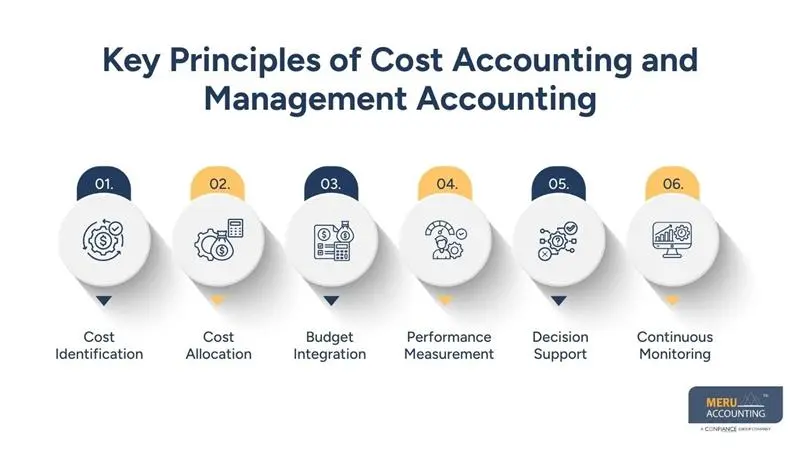
Budget Integration
Cost accounting and management accounting are integrated into budgeting processes to plan future expenses and revenues.
Performance Measurement
Using cost accounting techniques, businesses evaluate efficiency and identify areas for improvement.
Decision Support
Accurate cost information aids in pricing, production decisions, and investment planning.
Continuous Monitoring
Management accounting requires ongoing tracking to adapt to changes in market conditions and operational needs.
How Managerial Accounting Supports Everyday Business Decisions
Daily Operations Guidance
Managerial accounting provides real-time insights that guide day-to-day operational decisions, from procurement to production.
Strategic Planning Assistance
Helps managers plan for future growth, investments, and expansion using detailed financial data.
Cost Management
Supports identifying unnecessary expenses and optimizing resource allocation.
Pricing Decisions
Informs pricing strategies by analyzing production costs and market conditions.
Performance Tracking
Helps in monitoring departmental performance to ensure objectives are being met.
Inventory Control Support
Provides data on stock levels, helping managers avoid overstocking or shortages.
Risk Assessment Support
Helps managers identify potential financial or operational risks before they escalate.
Resource Allocation Optimization
Assists in assigning resources efficiently to projects and departments that need them most.
Operational Decision Insights
Provides actionable insights that help managers adjust processes for improved productivity.
Budgeting and Forecasting With Managerial Accounting
Budget Creation
Business accounting helps create detailed budgets for departments and overall operations.
Revenue Forecasting
Forecasting expected revenue ensures that companies plan for cash inflows effectively.
Expense Planning
Managers can plan for fixed and variable costs, preventing overspending.
Variance Analysis
Comparing actual performance with budgets highlights areas needing corrective actions.
Resource Allocation
Ensures resources are distributed efficiently to departments that drive business growth.
Scenario Planning
Enables managers to prepare for different business conditions and uncertainties.
Monitoring Cash Flow and Financial Health Through Management-Level Accounting
Cash Flow Tracking
Management-level accounting tracks incoming and outgoing cash to ensure liquidity.
Short-Term Planning
Helps businesses manage day-to-day expenses and operational needs.
Debt Management
Supports decisions on borrowing and repayment schedules.
Profitability Analysis
Helps managers see which products or services contribute most to profit.
Expense Control
Allows identification of high-cost areas to reduce unnecessary spending.
Financial Reporting
Provides reports that help managers understand the company’s financial health.
Using Cost Accounting and Management Accounting for Pricing Strategies
Product Costing
Calculates the exact cost of production to inform appropriate pricing strategies. This ensures that every product is priced to cover costs and generate profit.
Profit Margin Analysis
Managerial accounting ensures products are priced to meet profit objectives. It also helps identify products with higher profitability potential for strategic focus.
Competitor Comparison
Supports pricing decisions by analyzing competitor products and market rates. This helps businesses remain competitive while maintaining healthy margins.
Cost-Volume-Profit Analysis
Helps understand how changes in cost and volume affect overall profits. Managers can forecast profit outcomes under different production and sales scenarios.
Pricing Flexibility
Allows managers to adjust prices based on cost data and market demand. This ensures that pricing remains responsive to market changes without sacrificing profitability.
Decision Support
Provides actionable insights to set competitive and sustainable pricing. It also guides strategic decisions regarding discounts, promotions, and product bundling.
Inventory Management and Cost Control Using Managerial Accounting
Stock Level Monitoring
Helps managers maintain optimal inventory levels to prevent shortages or excesses.
Cost of Goods Sold Calculation
Tracks production costs to determine profitability and manage cash flow.
Waste Reduction
Identifies areas where resources are being wasted, saving money.
Supplier Management
Helps in evaluating supplier costs and negotiating better terms.
Just-In-Time Planning
Supports implementing JIT inventory methods to reduce holding costs.
Inventory Valuation
Provides accurate inventory valuation for financial reporting and decision-making.
Performance Evaluation and KPI Tracking With Managerial Accounting
Key Performance Indicators (KPIs) identify metrics to measure efficiency, productivity, and profitability.
Departmental Reports
Generates reports for each department to assess performance accurately.
Variance Tracking
Highlights differences between planned and actual performance.
Employee Performance Analysis
Helps evaluate team performance in cost management and operational efficiency.
Informed Decision-Making
Supports management decisions with clear, data-driven insights.
Continuous Improvement
Encourages ongoing assessment to enhance processes and outcomes.
Risk Management and Decision Making Through Managerial Accounting
Identifying Financial Risks
Managerial accounting helps detect risks like cost overruns and cash shortages.
Scenario Planning
Enables preparation for different market conditions and business challenges.
Budgetary Controls
Establishes controls to prevent overspending and manage operational risk.
Investment Decisions
Supports decisions on capital expenditure and resource allocation.
Operational Risk Assessment
Analyzes process inefficiencies to reduce the chance of losses.
Strategic Risk Management
Provides data to support long-term planning and risk mitigation strategies.
How Managerial Accounting Improves Operational Efficiency
Process Analysis
Evaluates operational processes to reduce inefficiencies and costs.
Resource Optimization
Helps allocate resources where they generate the most value.
Cost Reduction Strategies
Identifies cost-saving opportunities without affecting quality.
Time Management
Tracks labor and operational hours to improve productivity.
Technology Integration
Supports the use of tools like accounting software for faster, accurate reporting.
Operational Decision Support
Provides actionable data to make informed daily and strategic decisions.
Real-Life Example
In the retail business, managerial accounting helps store managers track inventory levels, monitor sales trends, and optimize pricing strategies. By analyzing cost and revenue data, retailers can make informed decisions on stock replenishment, promotional offers, and product placement. This ensures better profitability and efficient daily operations.
How Meru Accounting Supports Businesses With Managerial Accounting
Meru Accounting offers expert support to businesses looking to implement managerial accounting effectively. Our services help companies make informed decisions, control costs, and improve overall operational performance.
Tailored Financial Insights
Meru Accounting helps businesses implement managerial bookkeeping and accounting practices specific to their operations. This ensures that financial insights are relevant, actionable, and aligned with business goals.
Cost Analysis and Management
We assist in applying cost accounting and management accounting techniques to reduce expenses and optimize operations. By identifying high-cost areas, we help businesses make smarter spending decisions.
Budgeting and Forecasting
Our team helps create accurate budgets and forecasts to guide business planning. This allows companies to anticipate challenges and plan for growth with confidence.
Performance Monitoring
We track KPIs and departmental performance to improve operational efficiency. Regular monitoring helps identify bottlenecks and supports continuous improvement across the business.
Decision Support
Meru Accounting provides actionable insights for strategic and operational decisions. These insights help managers respond quickly to market changes and business needs.
Risk Management Assistance
We help identify financial risks and develop solutions to mitigate them. This proactive approach protects businesses from potential losses and ensures long-term stability.
Key Takeaways
- Managerial accounting is essential for internal decision-making.
- Cost accounting and management accounting support budgeting, pricing, and performance evaluation.
- Businesses can improve efficiency, reduce costs, and enhance profitability using managerial accounting.
- Meru Accounting offers expertise in implementing management-level accounting to suit specific business needs.
- Regular monitoring and analysis of financial data ensure better planning and informed decisions.
FAQs
Managerial bookkeeping and accounting help businesses plan budgets, control costs, manage inventory, and track performance for daily operations.
Managerial bookkeeping and accounting provide cost data, performance reports, and forecasts that help managers choose the best actions for the business.
Cost accounting and management accounting help small businesses understand expenses, set correct prices, and avoid unnecessary costs.
Managerial accounting helps create budgets, compare planned and actual results, and adjust future plans based on real data.
Yes, management-level accounting identifies cost issues, process gaps, and performance areas that need improvement, helping businesses work more efficiently.


