


A manufacturing accountant helps businesses manage rising costs while protecting profits during challenging production conditions. Increased expenses for materials, labor, and utilities make financial control essential for survival.
A skilled manufacturing accountant tracks costs accurately and supports informed decisions across production stages. Following cost accounting standards also ensures product costs remain reliable and consistent.
High production costs can quickly reduce profits if expenses are not tracked properly. A manufacturing accountant helps businesses understand where money is spent and where savings are possible. By reviewing cost data regularly and applying cost accounting standards, manufacturers gain better control over pricing, budgeting, and overall financial health.
What You Will Learn From This Blog
- Learn why manufacturing costs increase and how they directly affect business profitability.
Understand how clear cost awareness helps businesses respond faster to production cost pressure. - See how a manufacturing accountant supports cost control beyond basic bookkeeping tasks.
- Learn how planning and analysis improve financial decision making in manufacturing operations.
- Understand why knowing exact costs improves pricing accuracy and profit protection.
- Learn how better cost visibility prevents losses caused by hidden production expenses.
- Explore how cost accounting standards support accurate and consistent product costing.
- See how standardized costs help businesses compare expenses across different periods.
Introduction To The Role Of A Manufacturing Accountant In the Modern High-Cost Production Environment
A manufacturing accountant plays an important role in modern high cost production environments by closely monitoring material, labor, and overhead expenses. Continuous cost tracking helps identify issues early, before they begin to affect profit margins. Accurate cost data also supports better production planning and pricing decisions, allowing management to respond quickly to changing cost conditions.
Ensuring cost accuracy is another key responsibility. Correct costing prevents underpricing and unexpected losses while improving reliability through the use of standard costing methods. Regular cost reviews promote spending control and create accountability across production teams, reducing unnecessary expenses and improving overall efficiency.
Manufacturing accounting also involves meeting compliance requirements by following accepted cost rules, which lowers audit risks and reporting errors. Strong accounting systems support stable cash flow management, helping manufacturers handle cost fluctuations with greater confidence and maintain financial stability over time.
What Does A Manufacturing Accountant Do For Modern Manufacturing Businesses
Product Cost Calculation
A manufacturing accountant calculates the true cost of each product precisely and accurately. This includes material, labor, and allocated overhead expenses for correct product costing.
Cost Tracking Systems
They create reliable systems to track production costs at every stage efficiently. Accurate tracking ensures management can make better cost comparisons over time.
Budget Preparation
Budgets are prepared using historical cost data and projected production expenses effectively. This approach helps support realistic financial planning and spending control decisions.
Applying Cost Accounting Standards
Cost accounting standards provide clear guidance for consistent and accurate costing practices. They ensure costs are comparable across different reporting periods and production cycles.
Variance Analysis
Cost differences between planned and actual expenses are carefully analyzed for inefficiencies. This analysis helps management identify problems and take corrective action promptly.
Management Reporting
Reports summarize cost behavior, production efficiency, and overall product profitability clearly. Management uses these reports to make informed decisions about production strategy.
Why High-Cost Production Environments Demand Specialized Manufacturing Accounting Expertise
Rising Input Costs
Material and labor costs often change rapidly every production cycle. Specialized accounting tracks these cost changes accurately for informed decisions.
Thin Profit Margins
Small increases in cost can reduce profits very quickly. Precise cost control is essential to maintain business profitability.
Complex Overhead Structures
Factories share overhead costs across multiple products and production lines. Proper allocation prevents errors and ensures correct product costing.
Compliance With Cost Accounting Standards
Manufacturers must follow defined rules for cost accounting accuracy. This compliance avoids financial inconsistencies and reporting mistakes effectively.
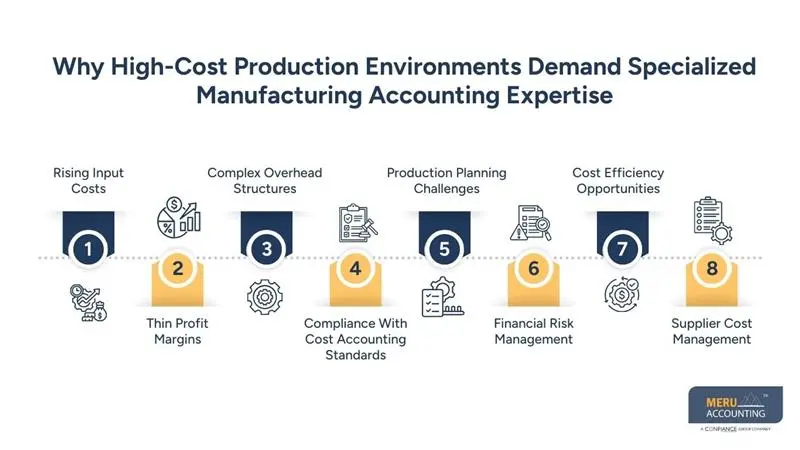
Production Planning Challenges
Unclear production costs often disrupt effective manufacturing planning processes. Accurate accounting improves forecasting and cost prediction for management.
Financial Risk Management
Specialized accounting reduces unexpected financial surprises during production operations. This supports better planning and long-term financial stability.
Cost Efficiency Opportunities
Identifying waste and inefficiencies improves overall cost efficiency significantly. Proper analysis helps optimize resources and reduce unnecessary expenses.
Supplier Cost Management
Regular review of supplier pricing ensures significant cost savings. Better negotiations with suppliers reduce overall production costs effectively.
How A Manufacturing Accountant Controls Rising Raw Material And Labor Costs
Raw Material Cost Monitoring
A manufacturing accountant regularly tracks all material purchase prices carefully. This monitoring helps identify opportunities to save production expenses efficiently.
Labor Cost Tracking
Labor hours are analyzed carefully against actual output levels produced. This analysis highlights productivity gaps and potential efficiency improvements.
Waste Reduction Analysis
Cost data reveals waste in both materials and labor usage. Reducing waste directly lowers total production costs significantly.
Supplier Cost Reviews
Supplier pricing is reviewed periodically for cost reduction opportunities. This evaluation supports stronger negotiations with vendors and suppliers.
Cost Control Reporting
Regular reports highlight any cost overruns in production activities. Timely actions prevent erosion of profits and financial stability.
Budget Versus Actual Comparison
Actual production costs are compared carefully against planned budget amounts. Differences guide management to take corrective actions promptly.
Importance Of Cost Accounting Standards For Accurate Product Costing
Standardized Cost Methods
Standard costing methods clearly define accepted approaches for accurate costing. This practice significantly improves consistency in all cost calculations.
Accurate Product Pricing
Standard costs help maintain fair and reliable product pricing. This approach protects profit margins against unexpected production cost changes.
Cost Comparability
Costs can now be compared accurately across multiple reporting periods. This comparison supports performance evaluation and financial decision making.
Inventory Valuation Accuracy
Standard costing improves the accuracy of inventory valuation processes. This approach strengthens reliability in all financial reporting activities.
Audit Readiness
Following standard costing methods simplifies internal and external audits. Clear records reduce risks of errors and compliance issues.
Financial Transparency
Standardized costs improve clarity in all financial statements and reports. Management gains better understanding of true production costs consistently.
How Cost Accounting Standards Improve Cost Consistency And Financial Transparency
Uniform Cost Practices
Cost accounting standards promote consistent and uniform costing practices effectively. This approach reduces errors and internal inconsistencies in cost records.
Clear Cost Documentation
Documented standards improve traceability of all production cost details. This process supports accurate reviews and proper cost verification.
Improved Decision Support
Consistent costs improve the accuracy of management decision making. Management relies on dependable cost data for operational planning.
Reduced Cost Disputes
Clear standards reduce disagreements over internal production cost calculations. Teams align and follow consistent methods for cost determination.
Better Regulatory Compliance
Standard costing ensures compliance with regulatory and reporting expectations. Following these standards reduces risks of financial reporting issues.
Enhanced Financial Confidence
Reliable cost data builds confidence in management and stakeholder reports. Stakeholders gain better understanding of the company’s financial performance.
The Role Of A Manufacturing Accountant In Overhead Allocation And Cost Absorption
Identifying Overhead Costs
A manufacturing accountant identifies all indirect production costs accurately. This includes utilities, factory overhead, and shared production expenses.
Selecting Allocation Bases
Appropriate allocation bases ensure fair and accurate cost distribution. This prevents distorted product costs from incorrect overhead assignment.
Absorbing Fixed Costs
Fixed costs are properly absorbed into each product unit. This method improves pricing accuracy and financial reporting.
Reviewing Overhead Rates
Overhead rates are reviewed and updated on a regular basis. This ensures they reflect current production and cost conditions.
Supporting Cost Accounting Standards
Overhead allocation methods follow recognized standard costing methods closely.
This alignment guarantees compliance with accepted accounting practices.
Improving Profit Measurement
Accurate overhead allocation allows better evaluation of product profitability. Management can see the true performance of each product clearly.
How Manufacturing Accountants Help Businesses Adapt To Inflation And Supply Chain Volatility
Monitoring Cost Trends
Manufacturing accountants track changes in material and labor costs. This tracking supports timely adjustments to pricing and budgets.
Scenario Cost Planning
Different production cost scenarios are carefully evaluated by accountants. This planning improves preparedness for financial uncertainty or cost increases.
Supplier Cost Impact Analysis
Supply chain disruptions can affect material and production costs. Accountants analyze financial impact to minimize unexpected losses.
Cash Flow Planning
Rising costs affect cash requirements for production and operations. Proper planning ensures adequate cash is available when needed.
Updating Cost Structures
Cost models are updated regularly to reflect actual production expenses. This keeps costing relevant and supports accurate financial reporting.
Supporting Stable Operations
Financial insights help maintain stable production and operational planning. Businesses respond more effectively to inflation and cost volatility.
Why Choose Meru Accounting For Manufacturing Accounting Support
Industry Focused Expertise
Meru Accounting has a deep understanding of manufacturing cost challenges. Our expertise ensures accurate financial control across production operations.
Skilled Manufacturing Accountants
The accounting team manages complex cost structures efficiently and accurately. They provide reliable insights to support management decisions consistently.
Strong Cost Compliance
All processes follow recognized cost accounting standards carefully and accurately. This approach ensures consistent and correct costing practices are maintained.
Clear Financial Reporting
Reports are prepared clearly and easy to understand for management. They provide actionable insights to support better production decisions.
Scalable Support
Services can scale easily according to the company’s business needs. We provide support for both small and large manufacturing businesses.
Trusted Advisory Partner
Meru Accounting helps companies achieve long-term profitability goals successfully. Our advice focuses on practical solutions for daily financial challenges.
Key Takeaways
- Rising production costs require strong financial oversight. Accurate accounting protects margins.
- A manufacturing accountant supports cost planning and control. Their role impacts profitability.
- Cost accounting standards improve costing consistency and reduce errors effectively.
- Reliable cost data improves management decisions and supports business growth.
- Consistent cost reviews prevent losses and maintain financial discipline.
- Professional support strengthens cost management and gives manufacturers greater confidence.
FAQs
A manufacturing accountant tracks all production costs accurately. They help businesses plan budgets and maintain profitability.
They monitor material, labor, and overhead costs regularly. This helps identify waste and reduce unnecessary expenses.
Standard costing methods ensure consistent and accurate costing. They help in pricing products fairly and avoiding errors.
Yes, they analyze cost changes and plan accordingly. This supports steady profits even during high-cost periods.
They track actual costs versus budgets and identify inefficiencies. Timely adjustments help businesses protect profit margins.


