




Setting the right product prices can determine the success of a manufacturing business. Prices that are too low reduce margins, while prices that are too high may drive customers away. A manufacturing accountant helps businesses understand the true cost of production and guides pricing decisions based on accurate financial data.
By tracking raw materials, labor, and overhead costs, a manufacturing accountant ensures that pricing reflects actual expenses and allows for healthy profit margins.
This blog also explains how following a structured manufacturing accounting guide can help avoid pricing errors, maintain consistency, and keep your business competitive over time.
What You Will Learn From This Blog
- How a manufacturing accountant supports accurate product pricing
- Why pricing is complex for manufacturing businesses
- How to calculate true production costs correctly
- The role of direct and indirect costs in profit planning
- How a manufacturing accounting guide helps reduce pricing errors and uncertainty
Why Product Pricing Is a Challenge for Manufacturing Businesses
Multiple Cost Components
Manufacturing includes materials, labor, overhead, and logistics costs. Missing even one cost can lead to incorrect pricing.
This complexity makes manual pricing unreliable without proper accounting support.
Fluctuating Material Prices
Raw material prices change frequently due to market conditions. Without tracking updates, product prices quickly become outdated.
Complex Production Processes
Different products use different machines and labor hours. This makes cost comparison difficult without structured cost tracking.
Overhead Allocation Issues
Expenses like rent and utilities apply across multiple products. Incorrect allocation can hide the true cost of individual items.
Market Pressure
Manufacturers must balance internal costs with customer expectations. Pricing must stay competitive while still covering rising expenses.
The Role of a Manufacturing Accountant in Building Accurate Product Prices
Cost Identification
A manufacturing accountant ensures all production-related costs are recorded. This prevents hidden expenses from affecting profitability later.
Cost Classification
Costs are grouped as direct or indirect for better clarity. This classification improves pricing accuracy across product lines.
Margin Planning
Profit margins are calculated using real cost data. This avoids guesswork when setting selling prices.
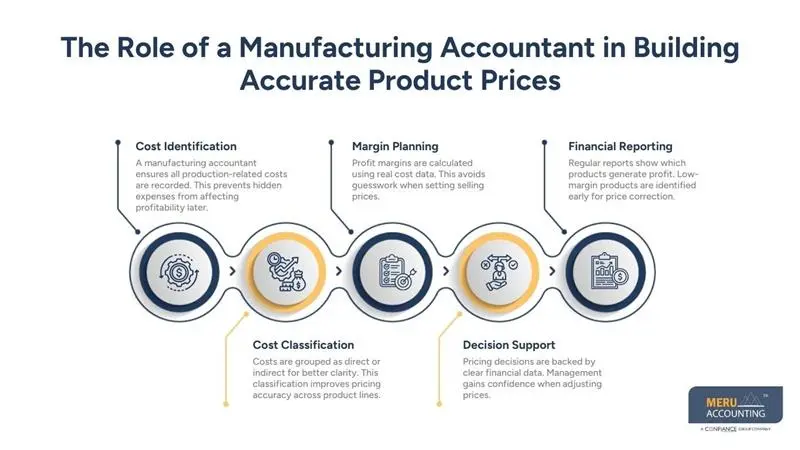
Financial Reporting
Regular reports show which products generate profit. Low-margin products are identified early for price correction.
Decision Support
Pricing decisions are backed by clear financial data. Management gains confidence when adjusting prices.
Understanding Your True Production Costs Before Setting Prices
Raw Material Costs
Material usage per unit is tracked for accuracy consistently. This prevents underestimating the actual cost per product unit.
Labor Costs
Labor hours are assigned based on actual production time. This ensures cost calculations remain precise across all departments.
Machine Usage Costs
Machine depreciation and repair costs must always be included. Ignoring these expenses reduces long-term profitability for the business.
Utility Consumption
Energy and water usage are linked directly to production. These costs significantly impact per-unit product pricing calculations.
Waste and Scrap
Scrap and rejected units are counted as production losses. Ignoring them can create distorted profit calculations for products.
How Direct and Indirect Costs Impact Product Profitability
Direct Costs
Direct costs, such as materials and labor, affect product cost. These costs are easily traced to each unit produced accurately. A manufacturing accountant tracks these expenses for proper pricing decisions.
Accurate calculation ensures products are sold at profitable margins consistently. Ignoring direct costs can cause serious underpricing and lost revenue.
Indirect Costs
Indirect costs, like rent, utilities, and supervision, are shared. They support production but are not linked to one product directly.
A manufacturing accountant allocates these costs fairly across products. Without proper allocation, pricing may seem profitable but fail eventually. Using a manufacturing accounting guide ensures indirect costs are managed correctly.
Cost Allocation Methods Used by a Manufacturing Accountant
Job Costing
Costs are tracked for each individual job or order. This method suits custom or project-based manufacturing.
Process Costing
Used when products are produced in continuous batches. Costs are averaged across similar units.
Activity-Based Costing
Costs are assigned based on activities that create expenses. This method improves accuracy for complex operations.
Standard Costing
Pre-set cost standards help compare planned and actual costs. Variances highlight areas needing attention.
Hybrid Methods
Some businesses use multiple methods together. A manufacturing accountant selects the best fit.
Managing Raw Material, Labor, and Overhead Costs Effectively
Material Tracking Systems
Inventory systems track material usage accurately in real time daily. This reduces waste significantly and prevents errors in product pricing.
Labor Efficiency Monitoring
Labor productivity is reviewed consistently across all departments regularly. This monitoring helps control rising labor costs efficiently over time.
Overhead Budgeting
Overhead expenses are carefully planned and reviewed periodically, monthly. This process prevents unexpected cost increases from affecting product pricing.
Supplier Cost Reviews
Supplier pricing agreements are reviewed thoroughly for better cost control. Better negotiated terms help maintain stable and competitive product pricing.
Cost Control Reports
Reports highlight rising costs early for management decision-making. Management can respond quickly before profit margins start dropping significantly.
How a Manufacturing Accounting Guide Helps Avoid Underpricing and Overpricing
Clear Cost Visibility
A manufacturing accounting guide displays all production costs clearly and accurately. This visibility prevents any important expenses from being missed during pricing.
Consistent Pricing Logic
The same pricing method is applied across all products consistently. This approach ensures fairness and consistency in product pricing decisions.
Profit Margin Protection
Profit margins are calculated using actual, precise production cost data. This process avoids selling products below their true production cost.
Risk Reduction
Pricing decisions are based on verified facts, not guesses. This practice lowers financial risk and protects overall business profitability.
Long-Term Stability
Structured accounting processes support stable and reliable pricing over time. This ensures businesses avoid frequent, disruptive, or sudden price corrections.
Pricing Decisions Based on Volume, Capacity, and Demand
Volume Discounts
Higher production volumes reduce the cost per unit significantly. Pricing is adjusted to reflect these savings accurately and fairly.
Capacity Utilization
Unused production capacity increases the cost of each unit. Proper pricing accounts for this inefficiency to protect profit margins.
Demand Forecasting
Sales forecasts guide pricing decisions for all manufactured products. Prices are set to align with expected customer demand accurately.
Seasonal Demand
Seasonal changes directly affect production planning and resource allocation. Pricing adjusts based on cost variations caused by seasonal production.
Break-Even Analysis
A manufacturing accountant calculates accurate break-even points for products. This shows the minimum sales required to prevent any financial losses.
Common Pricing Mistakes Manufacturers Make Without Proper Accounting
Ignoring Indirect Costs
Only direct costs are considered when setting product prices. This common mistake frequently results in underpriced and unprofitable products.
Guess-Based Pricing
Prices are set based entirely on intuition, not actual costs. This approach significantly increases financial risk for the manufacturing business.
Outdated Cost Data
Old cost figures are used to calculate product pricing. Actual expenses may be much higher than the outdated figures.
One-Price-Fits-All Approach
All products are priced the same, ignoring cost differences. This method prevents an accurate reflection of production cost variations.
No Regular Review
Product prices are not reviewed or updated consistently over time. Profit margins slowly decline if pricing is left unchecked.
How Ongoing Support from a Manufacturing Accountant Improves Pricing Accuracy
Regular Cost Reviews
Costs are reviewed monthly or quarterly for accurate tracking. Pricing stays aligned with real expenses and current production realities.
Updated Financial Reports
Reports clearly highlight changes in production costs across products. Management can quickly adjust pricing based on accurate financial data.
Margin Tracking
Profit margins are monitored continuously for all manufactured products. Low-margin products are identified and corrected promptly by accountants.
Process Improvements
Accounting insights highlight inefficiencies in production and cost allocation. These improvements save costs and strengthen accurate product pricing.
Business Growth Support
As operations expand, pricing must adjust smoothly over time. A manufacturing accountant ensures accurate pricing during business scaling.
Choosing the Right Manufacturing Accounting Guide for Your Business
Industry Focus
Choose a guide specifically designed for manufacturing businesses. Generic accounting methods often fail to capture important cost details.
Simple Cost Structure
The guide should be simple and easy to understand fully. Complex systems often reduce adoption and proper cost tracking.
Scalable Approach
The guide must scale as your business and products grow. New products should integrate easily into the cost structure system.
Compliance Support
Accounting must follow all relevant reporting standards consistently. This ensures legal and tax requirements are fully satisfied.
Expert Backing
Professional guidance strengthens the implementation of the accounting guide. A manufacturing accounting guide works best with experienced experts.
How Meru Accounting Supports Manufacturing Pricing Decisions
Pricing products accurately is one of the biggest challenges for manufacturers. At Meru Accounting, our manufacturing accountants help track costs, analyze expenses, and set profitable prices.
Using our structured manufacturing accounting guide, businesses can make informed and reliable pricing decisions.
Dedicated Manufacturing Expertise
Meru Accounting works closely with manufacturing clients for accuracy. Our team understands production costs and pricing challenges deeply.
Accurate Cost Tracking
We ensure every cost is recorded accurately for each product. No expense is ever overlooked during pricing or reporting processes.
Pricing Support
We help set prices based on real production cost data. This ensures margins remain protected and competitive in the market.
Clear Reporting
Our reports are simple, clear, and easy for management. Business owners quickly understand costs, profits, and pricing decisions.
Ongoing Advisory
Continuous support from a manufacturing accountant keeps pricing accurate. We adapt pricing strategies as your business changes or grows.
Key Takeaways
- A manufacturing accountant improves pricing accuracy
- True production costs must be identified before pricing
- Direct and indirect costs both affect profit
- A structured manufacturing accounting guide reduces pricing errors
- Ongoing accounting support leads to stable pricing
FAQs
Because many different costs affect each product, and some are easy to miss.
A manufacturing accountant tracks costs and helps set prices that cover expenses.
It explains how to record costs and use them for pricing decisions.
Yes. Selling more does not help if prices do not cover costs.
Prices should be reviewed whenever costs or production levels change.


