



Manufacturing businesses always deal with many complex operations almost every day. It includes tracking raw materials, labor, machinery, overhead, and inventory. Even small accounting mistakes can lead to major losses. This is why strong accounting systems for manufacturers are essential for every production company. These operations involve multiple cost layers that are easy to overlook. Without proper systems, small gaps can quickly become serious financial issues. Manufacturing accounting pays attention to recording, analyzing, and controlling production costs. It helps every type of manufacturer understand where their money is spent. They can also get an idea about how efficiently their resources are used, and where profits are generated.
With proper production cost management practices, companies gain financial clarity and operational control. This clarity supports smarter operational decisions. It also improves coordination between finance and production teams. This blog explains the most important accounting practices for manufacturers every company should implement. It also highlights the benefits of outsourcing manufacturing accounting and explains how expert support can simplify financial management. Each section is designed to be practical and easy to follow. The goal is to help manufacturers strengthen financial control step by step.
What You Will Learn From This Blog
By reading this blog, you will gain practical insights into production focused accounting systems and how they support business growth. The information is useful for manufacturers at different stages of development. It applies to both small production units and growing operations.
In this blog, you will learn:
- What manufacturing accounting is and how it works
- Why production focused accounting is critical for financial accuracy
- Key cost control practices used by successful manufacturers
- How outsourcing improves efficiency and accuracy
- The benefits of outsourcing manufacturing accounting to professionals
What Is Manufacturing Accounting?
Manufacturing accounting is a specialized branch of accounting designed for production based businesses. It focuses on tracking all costs involved in manufacturing goods, from raw materials to finished products. These costs are monitored throughout the production cycle. This approach provides better visibility into operational expenses.
Manufacturing accounting includes:
- Direct material costs
- Direct labor expenses
- Manufacturing overhead
- Work in progress valuation
- Finished goods inventory
Unlike general accounting, production cost accounting provides detailed cost breakdowns. It helps manufacturers calculate true product costs and avoid hidden losses. Accurate manufacturing finance systems support pricing, budgeting, and long term planning. It also improves forecasting accuracy. This helps businesses prepare for future growth.
Why Manufacturing Accounting Is Crucial for Every Business
Manufacturing accounting is crucial because production costs are constantly changing. Material prices fluctuate. Labor rates increase. Equipment maintenance adds unexpected expenses. A structured production accounting framework captures these changes accurately. Without this visibility, costs can spiral out of control.
- Importance of effective manufacturing cost control:
- Improves cost control and profitability
- Prevents underpricing and overproduction
- Ensures accurate inventory valuation
- Supports compliance and audits
- Improves cash flow management
Without strong financial controls for manufacturing operations, businesses often rely on estimates. This leads to financial uncertainty and poor decision making. Inaccurate estimates weaken pricing strategies. Over time, this can affect competitiveness.
Key Manufacturing Accounting Practices Every Company Should Implement
Implementing structured financial practices for manufacturers improves accuracy and operational efficiency. Below are the most important practices manufacturers should follow. Each practice supports better financial control. Together, they create a reliable accounting framework.
Cost Accounting: Tracking Production Costs Accurately
Cost accounting is the foundation of manufacturing cost management. It records all costs associated with producing goods. These costs must be tracked consistently. Clear tracking prevents misallocation.
Key elements of cost accounting:
- Raw material tracking
- Labor cost allocation
- Manufacturing overhead tracking
Accurate cost accounting helps manufacturers understand cost per unit. Production accounting tools highlight inefficiencies and cost overruns. This supports better pricing and profit planning. It also improves internal cost reviews. Management can act faster on cost issues.
Inventory Management and Valuation Techniques
Inventory is a major asset in manufacturing finance operations. Poor inventory management leads to cash flow problems and inaccurate financial reports. Excess stock ties up capital. Shortages disrupt production schedules.
Production accounting tracks:
- Raw materials inventory
- Work in progress inventory
- Finished goods inventory
Inventory valuation methods such as FIFO or weighted average must be applied consistently. Accounting systems for manufacturers ensure inventory values reflect reality and support compliance. Proper valuation improves reporting accuracy. It also strengthens audit readiness.
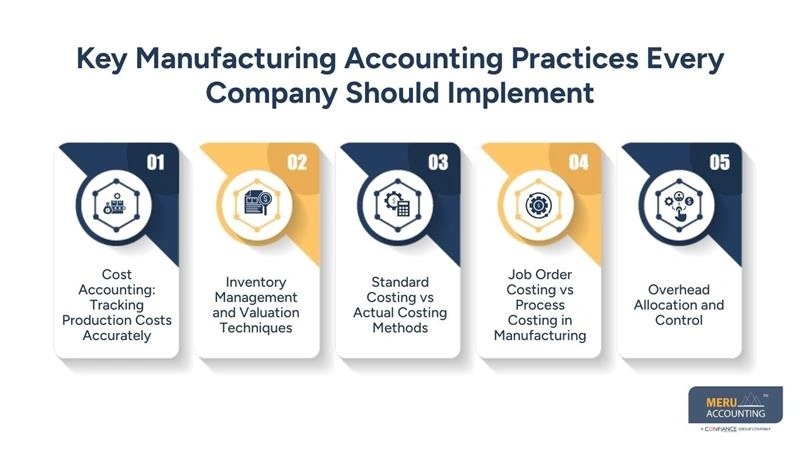
Standard Costing vs Actual Costing Methods
Both standard costing and actual costing play important roles in production cost analysis. Each method serves a different purpose. Using both provides better insight.
Standard costing:
- Uses estimated costs
- Helps with budgeting and planning
- Identifies performance variances
Actual costing:
- Records real production expenses
- Ensures accurate financial reporting
- Reflects true profitability
A balanced manufacturing cost accounting approach combines both methods to improve control and decision making. Variance analysis highlights inefficiencies. This supports continuous improvement.
Job Order Costing vs Process Costing in Manufacturing
Manufacturing finance systems use different costing methods based on production type. Selecting the right method is critical. It directly affects cost accuracy.
Job order costing:
- Suitable for customized production
- Tracks costs per job or batch
- Supports accurate pricing
Process costing:
- Used for mass production
- Averages costs across units
- Tracks costs by department
Choosing the correct method improves cost accuracy for manufacturers. It also ensures clearer reporting. Cost comparisons become more reliable.
Overhead Allocation and Control
Manufacturing overhead includes indirect costs such as utilities, rent, and depreciation. Production accounting systems must allocate these costs correctly. Improper allocation distorts product costs. This affects pricing decisions.
Overhead allocation methods include:
- Machine hours
- Labor hours
- Production volume
Accurate overhead allocation prevents distorted product costs. Manufacturing finance management also helps monitor and control overhead expenses to protect margins. Regular monitoring highlights rising costs early. This supports better budget control.
Benefits of Outsourcing Manufacturing Accounting
Many manufacturers struggle to manage complex accounting tasks internally. This is why the benefits of outsourcing manufacturing accounting are increasingly recognized. Internal teams often face workload pressure. Outsourcing reduces this burden. It also minimizes errors caused by limited internal expertise. Over time, outsourcing creates more stable and reliable financial
processes.
Key benefits of outsourcing manufacturing accounting include:
Access To Manufacturing Accounting Experts
Outsourcing provides access to professionals who specialize in production based accounting. These experts understand industry specific challenges and compliance requirements. Their experience improves accuracy and decision making.
Reduced Staffing And Training Costs
Hiring and training in house accounting staff can be expensive. Outsourcing eliminates recruitment, onboarding, and ongoing training costs. Businesses can control expenses more effectively.
Improved Accuracy And Compliance
Professional service providers follow structured processes and standards. This reduces errors and ensures compliance with accounting and tax regulations. Accurate records lower audit risks.
Faster Financial Reporting
Outsourced teams use established systems and workflows. Reports are prepared on time without delays. Faster reporting supports timely business decisions.
Scalable Support As Production Grows
Outsourcing services can easily scale with business expansion. Additional support is available without hiring new staff. This flexibility supports long term growth.
The benefits of outsourcing manufacturing accounting also include reduced workload for management. Outsourcing allows internal teams to focus on production and operations. This improves productivity across departments. Decision making becomes faster. Managers spend less time reviewing errors. Strategic planning receives more attention.
By outsourcing, manufacturers gain reliable data and professional support without expanding internal resources. Costs remain predictable. Financial processes become more efficient. Businesses also benefit from consistent reporting. This builds confidence in financial performance.
Meru Accounting’s Manufacturing Accounting Services
Meru Accounting provides specialized financial services for manufacturers designed for production based businesses. We understand industry specific challenges and deliver practical solutions. Our approach focuses on accuracy and consistency. Every service is aligned with business goals.
Our services include:
- Cost accounting and analysis
- Inventory management and valuation
- Overhead allocation and monitoring
- Financial reporting and compliance
Clients experience the benefits of outsourcing manufacturing accounting through better accuracy and reduced stress. Our team works closely with manufacturers to support long term success. Communication remains clear and regular. We act as a trusted partner.
With Meru Accounting, production cost management becomes simple, reliable, and growth focused. Systems are designed for scalability. Businesses gain confidence in their financial data.
Key Takeaways
- Manufacturing accounting is essential for financial clarity and control
- Accurate cost accounting improves pricing and profitability
- Inventory management is a critical part of production accounting
- Choosing the right costing methods ensures accuracy
- The benefits of outsourcing manufacturing accounting include expertise, savings, and scalability
- Strong financial practices help manufacturers grow with confidence
FAQs
Manufacturing accounting tracks production costs, inventory, and overhead. It helps manufacturers calculate true product costs and profits. This improves financial accuracy.
Manufacturing accounting improves cost control, cash flow, and financial accuracy. It supports better decision making and compliance. Businesses gain stability.
Inventory affects cash flow and profit reporting. Production accounting ensures inventory is tracked and valued correctly. This prevents reporting errors.
The benefits of outsourcing manufacturing accounting include expert support, lower costs, improved accuracy, and scalability. It also reduces internal workload.
Meru Accounting offers industry focused financial services for manufacturers. We help businesses stay compliant, organized, and profitable. Our support is consistent and reliable.


