



Manufacturing outsourced accounting is becoming the preferred choice for manufacturers who want stronger cost control and clear financial reporting. Rising labor costs, strict compliance rules, and complex production expenses have made it harder for internal teams to keep up.
Many companies now find that depending on a single manufacturing accountant creates delays, errors, and higher costs as operations grow.
Instead of expanding internal finance departments, manufacturers are choosing manufacturing outsourced accounting to gain access to skilled professionals, accurate data, and steady support. This shift helps businesses focus on production while ensuring their financial records remain reliable and up to date.
What You Will Learn From This Blog
- Understand what manufacturing outsourced accounting covers and how it works for manufacturers. It includes common tasks handled by external teams and why they matter.
- Learn how a manufacturing accountant traditionally supports factory operations and the daily responsibilities involved in managing production finances.
- Identify common issues faced by internal finance departments, such as challenges that affect accuracy, reporting speed, and cost control.
- Explore why manufacturers are moving toward manufacturing outsourced accounting and how outsourcing helps solve long-standing financial management challenges.
- Recognize when outsourcing accounting becomes the better option and the signs that indicate an in-house setup may no longer be sufficient.
What Is Manufacturing Outsourced Accounting?
Manufacturing outsourced accounting involves assigning a company’s accounting tasks to an external firm. These services take over critical financial functions, ensuring accuracy and timely management of records without the need for a full in-house team.
The services are tailored specifically for manufacturing businesses, focusing on production processes, inventory management, and product costing. This ensures that the unique financial needs of manufacturers are fully addressed.
Daily accounting tasks, such as bookkeeping, payroll processing, and expense tracking, are handled by the outsourced team. They maintain detailed records and provide reports that help management make informed decisions.
Additionally, manufacturing outsourced accounting offers cost and inventory tracking, helping businesses monitor raw materials, labor, and overhead expenses effectively. With a team of professionals rather than a single manufacturing accountant, companies gain reliable support and expertise for smoother financial operations.
The Traditional Role Of The In-House Manufacturing Accountant
Transaction Recording
Maintains daily entries for purchases, sales, and all expenses. Accurate recording ensures correct financial statements for management review.
Payroll Handling
Processes wages, overtime, and payments for factory staff regularly. Timely payroll keeps employees satisfied and avoids compliance penalties.
Product Costing
Allocates labor, materials, and overhead to finished goods accurately. Manufacturing outsourced accounting provides precise product costing, helping businesses determine pricing and profitability more effectively.
Financial Statements
Prepares monthly and annual reports for internal management purposes. These statements provide insight into company’s financial performance effectively.
Tax And Compliance Tasks
Handles tax filings and supports audits when required properly. Ensures all legal and regulatory obligations are always met.
Budgeting And Forecasting
Assists in preparing budgets and financial forecasts accurately. Helps management plan resources and predict future financial needs.
Internal Controls
Implements checks to prevent errors and fraudulent activities efficiently. Maintains processes that safeguard company assets and financial data.
Key Challenges Faced By In-House Finance Teams In Manufacturing
High Salary Costs
Employing a skilled manufacturing accountant increases fixed expenses. Additional benefits and training further raise overall employment costs.
Limited Skill Coverage
One person cannot manage all areas of manufacturing finance. Manufacturing outsourced accounting brings a team of experts, covering all specialized tasks efficiently.
Heavy Workload
Peak production periods strain internal accounting resources significantly. Overworked staff may delay reports and make costly mistakes.
Risk Of Errors
Manual processes increase mistakes in costing and reporting regularly. Even small errors can affect pricing, profit, and decision-making.
Staff Dependency
Losing a manufacturing accountant disrupts financial operations immediately. Replacement delays can create reporting gaps and compliance risks.
Can You Integrate Commercial Real Estate CRM with Accounting Software?
Yes, you can integrate commercial real estate crm with accounting software. Modern platforms support secure system connectivity.
How Integration Works
Integration enables automatic data exchange between systems. Lease events trigger accounting transactions instantly.
Automated Invoicing Processes
Rent invoices are generated directly from CRM lease data. This ensures billing accuracy and consistency.
Payment Synchronization
Tenant payments update both CRM and accounting records. This maintains aligned operational and financial data.
Technology Used for Integration
APIs and connectors enable real-time system communication. Custom workflows handle complex leasing scenarios.
Business Adoption Trends
Most commercial real estate firms now adopt integrated systems. Integration supports scalable real estate accounting operations.
Why Manufacturing Outsourced Accounting Is Replacing The In-House Model
Access To Skilled Professionals
Manufacturing outsourced accounting provides experienced specialists for complex tasks. Expert teams handle costing, inventory, and reporting efficiently and accurately.
Lower Fixed Costs
You avoid long-term salary and benefit commitments entirely. Outsourcing reduces overhead while still maintaining professional accounting support.
Flexible Service Levels
Support scales with production volume and changing business needs. Services can expand or shrink depending on company requirements easily.
Better Accuracy
Multiple reviews reduce accounting errors and prevent financial mistakes. Teams ensure that reports are reliable and error-free consistently.
Operational Focus
Management spends less time solving daily finance issues internally. More time can be devoted to production, strategy, and growth.
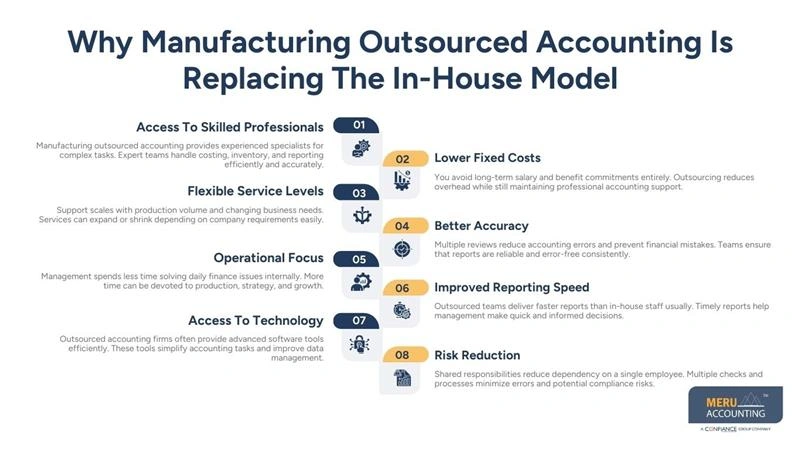
Improved Reporting Speed
Outsourced teams deliver faster reports than in-house staff usually. Timely reports help management make quick and informed decisions.
Access To Technology
Outsourced accounting firms often provide advanced software tools efficiently. These tools simplify accounting tasks and improve data management.
Risk Reduction
Shared responsibilities reduce dependency on a single employee. Multiple checks and processes minimize errors and potential compliance risks.
Cost Benefits Of Manufacturing Outsourced Accounting
Reduced Hiring Expenses
No need to recruit or train a manufacturing accountant. Eliminates salary, benefits, and recruitment costs for internal staff. Resources can be redirected toward core business operations efficiently.
Controlled Monthly Fees
Costs remain predictable and easier to budget effectively. Helps management plan cash flow and avoid unexpected expenses. Provides financial stability and simplifies long-term business planning.
Lower Technology Spend
Accounting tools are often included as part of services. No extra software purchases or maintenance costs are required. Teams use advanced systems without burdening company IT resources.
Fewer Error Losses
Accurate records reduce costly financial mistakes consistently. Prevents wrong decisions caused by incomplete or incorrect data. Minimizes risk of penalties or financial discrepancies in reporting.
Improved Cost Tracking
Manufacturing outsourced accounting highlights waste and inefficiencies clearly. Supports better allocation of resources and lowers unnecessary spending. Provides insight for management to optimize production and operations.
How Outsourced Accounting Supports Better Decision-Making
Regular Financial Updates
Timely reports help management respond faster to financial issues. Provides accurate insights for informed decisions and operational planning.
Clear Cost Visibility
Accurate data supports fair product pricing and profitability analysis. Helps identify areas where expenses can be reduced effectively.
Cash Flow Awareness
Shows real-time inflows and outflows for better financial control. Enables management to plan payments, investments, and expenses wisely.
Inventory Control
Better tracking prevents overstocking and production shortages efficiently. Helps reduce waste and ensures raw materials are used properly.
Expert Guidance
Insights go beyond what a single manufacturing accountant can offer. Supports strategic decisions with experience from multiple accounting professionals.
Outsourced Vs. In-House: Manufacturing Accounting Comparison
Aspect | Outsourced Accounting | In-House Accounting |
Cost Difference | Often more affordable than maintaining full-time staff. Reduces salary, benefits, and recruitment expenses. | Higher fixed costs due to salaries, training, and benefits. |
Skill Availability | Provides access to a wider skill set and multiple experts. Specialists handle complex manufacturing finance tasks efficiently. | Limited to the skills of one or few accountants, may lack specialization. |
Business Continuity | Services continue even during staff changes or absences. Ensures consistent financial operations without interruptions. | Disruption occurs when staff leave or are unavailable. |
Reporting Accuracy | External reviews improve reliability and reduce errors consistently. Multiple professionals verify all reports before delivery. | Dependent on one person; higher risk of mistakes in data. |
Scalability | Easier to adjust services as business grows or shrinks. Can scale resources quickly to match production demands. | Scaling requires hiring or training additional staff, which is slower. |
When Should A Manufacturer Transition To Outsourced Accounting?
Growing Production Levels
Higher output increases accounting complexity and daily transaction volume. In-house teams may struggle to maintain accurate records consistently.
Delayed Financial Reports
Late data signals capacity issues within the internal accounting team. Delays can affect decision-making and overall business planning negatively.
Rising Compliance Pressure
Tax and reporting needs become harder to manage internally. Mistakes may result in penalties or other regulatory complications.
Frequent Staff Changes
Replacing a manufacturing accountant becomes costly and time-consuming. Transitions can create reporting gaps and disrupt regular financial operations.
Need For Better Insights
Manufacturing outsourced accounting provides clearer and more detailed financial views. Expert teams help management plan resources, pricing, and growth strategies.
Why Choose Meru Accounting For Manufacturing Outsourced Accounting
Manufacturing Experience
We understand factory costing and inventory challenges effectively. Expert knowledge ensures accurate handling of complex manufacturing finances.
Dedicated Support Team
You get more than one manufacturing accountant for assistance. A team approach guarantees faster work and fewer errors consistently.
Accurate Reporting
At Meru Accounting, financial data is prepared and reviewed carefully every month. Reports provide management with clear insight for strategic decisions.
Affordable Services
Our plans reduce internal accounting costs without compromising quality. Helps businesses save money while maintaining professional financial support.
Reliable Partnership
We support your business at every growth stage efficiently. Consistent service ensures long-term stability and trustworthy accounting guidance.
Key Takeaways
- Manufacturing outsourced accounting is becoming more common and replacing internal teams.
- External services help reduce salary, training, and overall operational costs.
- Team-based reviews improve accuracy and significantly reduce accounting errors.
- Dependency on a single manufacturing accountant is minimized with outsourced support.
- Clear and accurate financial data enables better management and decision-making.
FAQs
Manufacturing outsourced accounting is when an external team handles all finance tasks for a manufacturing company, including bookkeeping, costing, payroll, and reporting.
Outsourced accounting provides a team of experts, reducing errors, cutting costs, and offering better financial insights than relying on one internal manufacturing accountant.
Costs are usually lower because you avoid full-time salaries, benefits, and training while getting access to skilled professionals and software.
Yes, outsourced teams specialize in tracking raw materials, labor, and overhead, ensuring accurate product costing for better decisions.
Switch when accounting errors increase, reports are delayed, internal staff are overworked, or you need clearer financial data to make informed production decisions.


