A nonprofit’s financial health isn’t measured by its bank balance alone. A large donation may come with spending limits, a grant may cover only certain project costs, and everyday expenses still need to be paid. Keeping all these moving parts in check takes more than basic bookkeeping. That’s where outsourced accounting for nonprofits can make a real difference.
Instead of stretching a small team across bookkeeping, payroll, grant records, and financial reports, nonprofits can bring in outside accounting support to handle the numbers. This gives leadership a clearer view of available funds, program costs, and upcoming financial needs while keeping accounting work on track.
But is outsourcing worth the cost, and how can it help with grant compliance? Let’s look at what nonprofit leaders should consider before making that decision.
What You Will Learn From This Blog
- What outsourced accounting for nonprofits means and how it works.
- Why nonprofit organizations need accounting support that fits their funding model.
- The key benefits of outsourcing bookkeeping and accounting work.
- Which accounting tasks nonprofits can hand over to an external team.
- How nonprofit fund accounting services help track grants, donations, and restricted funds.
- What to know about grant accounting and financial compliance.
What Is Outsourced Accounting for Nonprofits?
Outsourced accounting for nonprofits means hiring an external accounting team to manage some or all of an organization’s financial work. Rather than hiring staff for every accounting task, a nonprofit can use outside experts for bookkeeping, payroll, bank reconciliations, grant tracking, and financial reports.
These services can support small charities, foundations, community groups, and larger nonprofit organizations. The scope can vary based on the size of the organization, the number of funding sources, and the level of reporting it needs.
For example, a small nonprofit may only need help with monthly bookkeeping, bank records, and expense reports. A larger organization may need full accounting support, including grant tracking, budget reports, payroll, and year-end audit prep.
With outsourced accounting for nonprofits, leaders can get regular financial support without taking on the full cost of an in-house accounting department. They can also scale the level of service as their programs, staff, and funding grow.
Why Do Nonprofit Organizations Need Specialized Accounting Services?
Nonprofit accounting is not the same as standard business accounting. A company may focus on sales, profit, and operating costs, while a nonprofit must also track where its money comes from and how it can be spent.
Here are some key reasons nonprofits need accounting support that fits their needs:
- Tracking restricted and unrestricted funds: Donors and grant makers may set rules for how their funds can be used. Nonprofits need clear records to keep these funds separate and avoid spending them on costs that do not meet the set terms.
- Meeting grant terms: Each grant may have its own budget, cost rules, proof needs, and report dates. Good records help the nonprofit show that grant funds were used as agreed.
- Keeping donors informed: Clear reports help show how funds support programs and daily work. This can build trust and help the board make sound choices.
- Managing program costs: Nonprofits often run more than one program. They need to track costs by program, project, or funding source to see how funds are used.
- Preparing for audits: Well-kept books, bank records, grant files, and expense proof make it easier to answer audit questions and support financial reports.
Key Benefits of Outsourced Accounting for Nonprofits
Working with an external accounting team can offer more than help with daily books. It can also improve cost control, reporting, and fund tracking.
1. Lower Accounting and Staffing Costs
Hiring a full-time accountant comes with costs such as salary, benefits, training, and software. For a small or mid-sized nonprofit, this may not be the best use of its funds.
Outsourcing lets the organization pay for the level of support it needs. It can get help with key accounting tasks without adding the cost of a full in-house team.
2. Access to Trained Accounting Staff
Nonprofits need people who can work with donations, grants, fund records, and program costs. An outsourced team can bring trained staff to support these tasks and help keep the books up to date.
This can be useful when an organization does not have the budget to hire staff for each accounting role.
3. More Accurate Financial Records
Late entries, missed bills, and poor bank checks can lead to wrong reports. Regular bookkeeping and account reviews help catch errors before they affect the books.
A sound review process can also help spot unusual costs, missing records, and entries that need more proof.
4. Better Budget and Cash Flow Control
Nonprofits may receive grants and donations at set times, while program costs, payroll, and bills are due each month. This can make cash flow hard to manage.
Regular reports help leaders see cash on hand, unpaid bills, expected income, and program costs. They can then plan spending based on the funds they can use.
5. Stronger Grant Tracking and Compliance
Each grant may have its own rules for spending, records, and reports. Outsourced accounting for nonprofits can help track grant income and costs, keep proof in order, and flag expenses that need review.
This helps the nonprofit stay on top of grant terms and prepare reports on time.
6. More Time for Mission-Driven Work
Nonprofit leaders and staff need to focus on programs, donors, and the people they serve. Spending too much time on books and reports can take them away from this work.
With accounting tasks handled by an outside team, staff can give more time to program goals and daily operations.
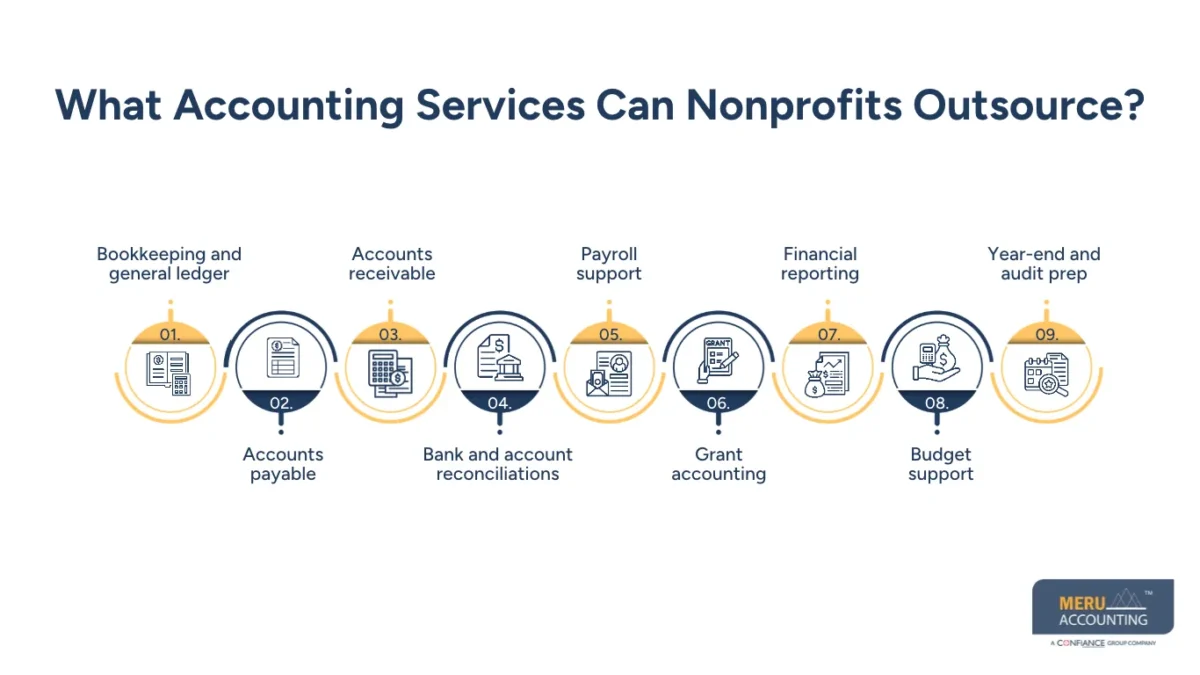
What Accounting Services Can Nonprofits Outsource?
The services a nonprofit outsources depend on its size, budget, and funding needs. Some may need help with only a few tasks, while others may want full accounting support.
Common services include:
- Bookkeeping and general ledger: Record donations, bills, payroll costs, and other daily entries. Keep accounts up to date and well organized.
- Accounts payable: Review bills, track due dates, record costs, and support timely vendor payments.
- Accounts receivable: Track pledges, grants due, program fees, and other amounts owed to the organization.
- Bank and account reconciliations: Match bank and credit card records with the books to find missing or wrong entries.
- Payroll support: Track wages, payroll costs, and related entries while helping keep payroll records in order.
- Grant accounting: Track grant income, eligible costs, budget use, and the records needed for grant reports.
- Financial reporting: Prepare monthly statements, budget reports, and program-wise cost reports for leaders and board members.
- Budget support: Help build budgets, track actual costs against plans, and report on budget gaps.
- Year-end and audit prep: Organize account records, schedules, and supporting files for year-end reviews and audits.
A nonprofit should keep control over key decisions, such as approving budgets, authorizing payments, and setting program goals. Outsourcing accounting work does not remove the board’s or management’s duty to oversee the organization’s finances.
optional anymore
on running the business
How Nonprofit Fund Accounting Services Support Financial Accountability
Fund accounting is a way to track money based on the purpose or rules tied to it. It helps nonprofits show which funds are available for general use and which must be spent on a set program or purpose.
Nonprofit fund accounting services help keep these records clear by tracking income, costs, and balances by fund, grant, or program.
1. Tracking Restricted and Unrestricted Funds
Restricted funds must be used for the purpose set by the donor or grant maker. Unrestricted funds can be used for general needs, based on the nonprofit’s goals and policies.
For example, a donor may give $10,000 to support a youth program. The nonprofit should track that gift and use it only for costs allowed under the donor’s terms.
2. Monitoring Grant and Program Costs
A nonprofit may run several programs with funds from different sources. Fund-based records help show how much each program has received and spent.
This makes it easier to compare actual costs with the approved budget and spot overspending or unused funds.
3. Keeping Clear Donation Records
Each donation should be recorded with the right details, such as the date, amount, donor, and any use limits. This helps the nonprofit track gifts and answer donor questions.
4. Preparing Clear Financial Reports
Nonprofits need reports that show their financial position and how funds were used. Fund-based records help prepare reports for managers, board members, donors, and grant makers.
For US nonprofits, key financial statements often include the statement of financial position, statement of activities, and statement of cash flows.
5. Supporting Audit Readiness
Good fund records make it easier to trace income and costs back to source documents. They also help auditors review grant spending, donor limits, and program costs.
Meru Accounting’s Nonprofit Fund Accounting Services
A grant received, a donor contribution recorded, or a program expense paid each transaction needs to be assigned to the right fund and backed by proper records. Meru Accounting helps nonprofit organizations manage these financial details through dedicated bookkeeping and accounting support. We understand the importance of accurate fund records, clear expense tracking, and timely reports when multiple grants, donors, and programs are involved.
Our nonprofit accounting services cover the day-to-day work as well as the reporting needs behind sound financial management:
- Fund Accounting & Reconciliation: Track restricted and unrestricted funds, maintain fund-wise records, and reconcile balances to keep financial data accurate.
- Grant Accounting & Expense Tracking: Record grant income, monitor spending against approved budgets, classify eligible costs, and organize supporting documents for reporting.
- Donation & Contribution Recording: Maintain records of donor contributions, pledges, designated gifts, and other incoming funds.
- Accounts Payable & Receivable: Manage vendor bills, payment records, outstanding pledges, and grant receivables to keep cash flow visible.
- Payroll & Expense Allocation: Maintain payroll entries and allocate shared staff costs across the right programs, grants, or departments.
- Financial Statements & Budget Reports: Prepare statements of activities, financial position reports, cash flow reports, and budget-to-actual comparisons.
- Bookkeeping Cleanup & Catch-Up: Review past entries, correct account discrepancies, reconcile outstanding balances, and bring incomplete books up to date.
Our team also follows a review-led accounting process to help identify misclassified expenses, missing documentation, and fund balance discrepancies before they affect financial reports. Whether your organization needs ongoing bookkeeping or more focused support with grant accounting and fund reporting, Meru Accounting can help build a more reliable financial record-keeping process giving your leadership team better information to plan programs, manage funds, and meet reporting obligations.
Our Expert Insight
A mistake we often see in nonprofit financial planning is relying too heavily on the annual budget. A budget may look balanced at the start of the year, but delayed grant payments, seasonal donations, or unexpected program costs can quickly change the picture.
We recommend reviewing budget-to-actual results each month and updating cash flow forecasts based on expected funding dates and upcoming commitments. This helps nonprofit leaders spot a funding gap early rather than waiting until payroll, vendor bills, or program costs are due. A budget is useful, but timely financial data is what makes it useful for decision-making.
Key Takeaways
- Outsourced accounting for nonprofits helps manage books, payroll, grants, and reports without the cost of a full in-house team.
- Nonprofits need clear records to track restricted funds, donor gifts, and program costs.
- Nonprofit fund accounting services help show where money comes from and how it is used.
- Grant records should match the grant terms, approved budget, and report needs.
- Regular account checks and clear financial reports help improve trust and audit readiness.
- Nonprofit leaders and boards must still oversee spending and key financial decisions.
FAQs
A nonprofit should consider outsourcing when financial reports fall behind, grant records become hard to manage, or internal staff lacks the time or expertise to handle accounting work. It can also be a practical choice when hiring a full-time accountant is not financially viable.
The cost depends on transaction volume, number of funding sources, payroll needs, reporting requirements, and the level of accounting support. Basic bookkeeping generally costs less than full-service accounting with grant reporting and financial oversight. Most firms offer custom pricing based on these needs.
Nonprofits generally follow FASB accounting standards in the United States. These include rules for reporting contributions, donor restrictions, net assets, and financial statements. Organizations that receive federal awards must also follow applicable requirements under 2 CFR Part 200.
Nonprofit fund accounting separates financial activity based on donor restrictions, grant terms, and organizational purposes. It helps show whether funds are available for general use or reserved for specific activities. Regular business accounting does not typically require this same level of fund-based reporting.
Yes. A nonprofit can outsource routine accounting work while keeping control of budgets, payment approvals, spending decisions, and financial oversight. Clear approval rules, access controls, regular reports, and independent reviews help maintain accountability.
optional anymore
on running the business