
Tax season creates significant operational pressure for CPA firms. Managing multiple tax filings, reconciliations, compliance reviews, and client communication within strict deadlines often stretches internal teams beyond capacity. Offshore accounting helps firms manage this workload by providing access to trained remote professionals who support bookkeeping, payroll, tax preparation, and financial reporting without the expense of local hiring.
Complementing this, virtual assistant for CPAs services manage administrative tasks like scheduling, client communication, and document collection, freeing accountants to focus on compliance and advisory work.
What You Will Learn From This Blog
- Why CPA firms face heavy workload pressure during tax season
- Common operational issues experienced by accounting firms
- How remote accounting reduces staffing stress
- The role of virtual assistants in tax operations
- Ways CPA firms manage multi-client workloads through remote teams
- Important factors for selecting an offshore accounting partner
- Why hybrid accounting models are becoming more common
- How a trusted accounting partner assists CPA firms with remote support
Why Offshore Accounting is Becoming Essential for CPA Firms During Tax Season
Rising Client Demands
Clients expect faster turnaround times during tax season. Businesses and individuals want accurate tax filings within strict deadlines.
Offshore accounting allows firms to increase processing capacity without expanding local teams.
Shortage Of Skilled Local Staff
Many CPA firms struggle to recruit experienced accounting professionals during peak seasons. Hiring locally also requires additional salary costs, benefits, workspace, and training.
External accounting professionals provide firms with experienced support without long recruitment cycles.
Increasing Compliance Work
Tax laws, filing rules, and reporting standards continue to change. CPA firms spend more time reviewing compliance requirements for different clients.
Additional accounting support assists with document preparation and reconciliation work so senior accountants can focus on reviews and advisory tasks.
Cost Management Pressure
Local hiring during tax season may increase operational expenses significantly. Temporary hiring also carries onboarding and training costs.
Flexible staffing arrangements offer a more controlled structure for seasonal workload management.
Need For Extended Working Hours
Time zone differences create operational advantages for CPA firms. Accounting professionals working from different locations can continue tasks after local office hours, which speeds up tax return preparation and financial reporting processes.
Better Workload Distribution
Many firms experience burnout during tax season. Staff members often work long hours for several weeks.
Outsourced accounting support helps reduce repetitive accounting work. A virtual assistant for CPAs can manage administrative coordination, client scheduling, and document follow-ups, creating a more balanced workflow during tax season.
Major Tax Season Bottlenecks Faced By CPA Firms
Delayed Client Documents
Clients often submit incomplete records or delay financial documents. This creates pressure near filing deadlines and increases review work for accounting teams.
High Volume Of Tax Returns
CPA firms handle hundreds or thousands of tax returns within limited timeframes. Managing multiple clients manually increases the risk of missed deadlines and review errors.
Staff Burnout During Peak Periods
Long working hours during tax season reduce productivity and employee satisfaction. Fatigue may affect the accuracy of financial reporting and tax calculations.
Limited Time For Advisory Services
CPA firms often spend most of their time on data entry and compliance tasks during tax season. Using a virtual assistant for CPAs to handle routine communications and follow-ups can free senior staff to focus on financial planning and client advisory work.
Training Temporary Employees
Seasonal hiring requires additional training and supervision. Temporary employees may also lack familiarity with firm procedures and tax software systems.
Managing Multi-State Or International Clients
Firms handling clients across different states or countries must manage varying tax regulations. Offshore accounting teams with specialized experience can assist in organizing and preparing required financial records.
How Offshore Accounting Reduces Tax Season Workload For CPA Firms Without Local Hiring
Remote Accounting Teams Handle Routine Tasks
Bookkeeping, reconciliations, accounts payable, payroll processing, and tax preparation tasks can be handled by external accounting professionals. This reduces the pressure on in-house accountants and allows firms to manage tax season workloads more effectively.
Faster Tax Return Preparation
Remote accounting teams work on document organization and data processing before final CPA review. This shortens turnaround times during busy filing periods.
Flexible Staffing Structure
CPA firms can increase or reduce offshore accounting resources depending on seasonal demand. Firms avoid long-term payroll obligations associated with permanent local hiring.
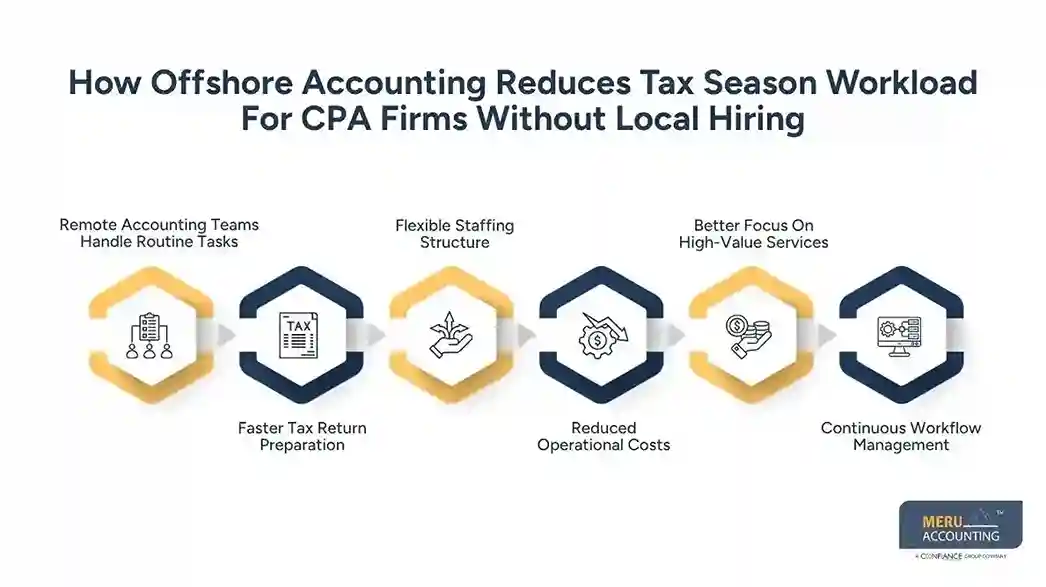
Reduced Operational Costs
Office space, hardware, employee benefits, and local recruitment expenses increase overhead costs. Utilizing external accounting support helps minimize many of these operational expenses, allowing firms to allocate resources more efficiently and invest in client services.
Better Focus On High-Value Services
When repetitive accounting work is handled externally, senior accountants gain more time for financial analysis, tax strategy discussions, and client meetings. This also allows firms to strengthen client relationships by dedicating attention to advisory and planning services.
Continuous Workflow Management
Accounting professionals working across different time zones can continue tasks beyond local office hours. Faster completion cycles during peak periods allow firms to address urgent deadlines more efficiently and maintain steady operational flow.
How Virtual Assistant For CPAs Services Support Remote Tax Operations
Appointment Scheduling
A virtual assistant for CPAs can manage client appointments, meeting reminders, and follow-up communication during busy tax periods. Organized scheduling reduces missed meetings and helps accounting teams manage daily workloads more efficiently.
Document Collection Coordination
Many tax delays occur because clients fail to upload required documents. Administrative support teams coordinate document requests and maintain organized financial records.
Email And Client Communication
Administrative communication consumes a large portion of daily working hours. Remote support teams manage basic client responses, appointment coordination, and follow-up communication.
Tax Workflow Monitoring
Remote administrative support tracks pending tasks, filing deadlines, and approval stages to maintain workflow organization. Better tracking helps accounting firms monitor deadlines carefully and complete tasks on time.
CRM And Data Updates
Client databases require regular updates during tax season. Administrative professionals maintain records and update client information accurately.
Administrative Task Management
Invoice generation, payment reminders, and onboarding paperwork often consume valuable time. Remote support solutions reduce administrative pressure on accounting teams.
How CPA Firms Can Choose the Right Offshore Accounting Partner
Industry Experience
CPA firms should work with providers that understand tax preparation, bookkeeping standards, payroll processing, and compliance procedures. Experienced partners can adapt quickly to firm-specific workflows and client requirements.
Data Security Standards
Financial data protection is critical in accounting operations. Firms should review security measures, confidentiality policies, and secure access systems before outsourcing work to ensure sensitive information is protected.
Skilled Accounting Professionals
Partners should employ trained accountants familiar with relevant accounting software, reporting standards, and client record management. Qualified professionals reduce errors and maintain high-quality outputs.
Communication Structure
Clear communication processes are necessary for workload management. Firms should confirm reporting timelines, escalation procedures, and review structures to ensure smooth collaboration.
Scalability During Tax Season
The provider should be able to increase staffing during peak filing periods without affecting service quality. Flexible scalability allows firms to handle larger client volumes efficiently.
Technology Compatibility
CPA firms should verify whether the offshore accounting provider works with systems like QuickBooks, Xero, Drake, ProSeries, or Lacerte to ensure smooth integration and workflow coordination.
Why CPA Firms are Moving Toward Hybrid Accounting Support Models
Combination Of Local And External Teams
Hybrid models combine local CPA leadership with external accounting support for execution tasks. This structure balances client interaction with operational efficiency while maintaining quality during peak periods.
Better Resource Allocation
Local teams focus on client advisory and tax review work, while offshore accounting professionals and a virtual assistant for CPAs handle routine processing and document coordination. This allows firms to manage workloads effectively and maintain timely service delivery.
Improved Turnaround Time
Hybrid support structures allow multiple teams to work on the same client files simultaneously, reducing delays during tax season. Coordinated workflows also ensure faster completion of urgent tasks.
Lower Recruitment Pressure
Firms avoid emergency hiring cycles by using hybrid staffing models supported through external accounting resources. This reduces recruitment stress and provides flexibility during high-demand periods.
Stronger Operational Stability
Hybrid accounting models create backup support systems during staff absences or sudden workload increases. Additional support ensures continuity and reliability in client service.
Long-Term Growth Planning
Many CPA firms use hybrid support systems not only for tax season but also for year-round accounting operations and bookkeeping management. This approach supports sustainable business growth and improved client relationships.
How Offshore Accounting Helps CPA Firms Manage Multi-Client Portfolios
Organized Financial Data Processing
Structured records for multiple clients make tax preparation and bookkeeping more manageable during peak periods. Organized data also simplifies reconciliation and reduces the risk of errors.
Standardized Reporting Procedures
Consistent reporting methods reduce confusion across client accounts and streamline review processes. Standardization allows accountants to quickly identify discrepancies and maintain accuracy.
Dedicated Teams For Different Clients
Some offshore accounting providers assign separate teams for bookkeeping, payroll, and tax support based on client requirements. Focused teams improve turnaround time and maintain high-quality output for different client portfolios.
Reduced Deadline Pressure
Additional accounting support, complemented by a virtual assistant for CPAs who tracks deadlines and document submissions, enables firms to complete filings earlier and avoid last-minute stress.
Better Client Response Time
Routine processing work handled externally allows firms to respond to client questions more quickly. Faster responses improve client satisfaction and confidence in services.
Improved Accuracy Through Layered Reviews
Structured review processes before final approval reduce the chance of errors. Layered checks ensure that financial statements and tax filings are accurate and reliable.
Why Meru Accounting is a Trusted Offshore Accounting Partner For CPA Firms
Meru Accounting provides reliable offshore accounting services to CPA firms, covering tax preparation, bookkeeping, payroll processing, reconciliations, and financial reporting.
We work with multiple accounting platforms such as QuickBooks, Xero, NetSuite, Odoo, Drake, Lacerte, and ProSeries, allowing smooth collaboration with CPA firms and their existing workflows.
Our flexible staffing solutions allow firms to manage peak tax season workloads efficiently without increasing local hiring costs.
At Meru Accounting, we follow structured data management and confidentiality practices to protect sensitive financial information.
We also provide industry-focused accounting support for businesses in real estate, healthcare, construction, retail, hospitality, and professional services. Through regular communication, workflow tracking, and timely reporting coordination, we ensure CPA firms receive dependable accounting support throughout the engagement period.
Our Expert Perspective
Based on our experience working with CPA firms across different industries, offshore accounting has evolved from a cost-saving option into a long-term operational strategy.
Firms increasingly use offshore support not only during tax season but throughout the year to manage bookkeeping, payroll, reconciliations, and reporting tasks more efficiently.
Our experts have observed that firms using structured remote accounting support often improve turnaround times, reduce employee burnout, and create greater capacity for advisory-focused services.
Key Takeaways
- Offshore accounting allows CPA firms to manage tax season workloads without large local hiring expenses.
- Remote accounting teams handle bookkeeping, reconciliations, payroll, and tax preparation tasks.
- Offshore services improve efficiency, accuracy, and turnaround times for routine accounting work.
- Hybrid accounting support models, including virtual assistant for CPAs, are becoming more common among growing CPA firms.
- Better workload distribution and reduced staff burnout help CPA firms maintain productivity and service quality during peak tax seasons.
- CPA firms should evaluate data security, experience, communication, and scalability before selecting a partner.
FAQs
Offshore accounting means working with accounting professionals located in another country to manage bookkeeping, payroll, tax preparation, and financial reporting tasks remotely.
CPA firms use remote accounting support to manage high workloads, reduce overtime pressure, and avoid the cost of hiring temporary local staff.
Secure systems, confidentiality agreements, encrypted communication, and controlled access methods help protect financial information.
A virtual assistant for CPAs manages scheduling, document follow-ups, email coordination, client communication, and administrative tasks during tax season.
Yes, small CPA firms can use offshore accounting services to manage seasonal workloads, improve turnaround time, and reduce staffing pressure without expanding office operations.