
Finance-heavy businesses process large volumes of invoices, payroll files, tax records, bank statements, and vendor reports daily. Delays or errors in updating these records can disrupt budgeting, cash flow tracking, and financial decisions. Offshore data entry services provide trained external teams to handle high-volume financial data accurately and efficiently, reducing manual workload and keeping reporting processes well-organized.
Many companies also work with a reliable data entry service provider to reduce spreadsheet errors, invoice mismatches, duplicate entries, and reporting gaps. By assigning repetitive financial data tasks to offshore professionals, internal finance teams can focus more on planning, compliance, and financial analysis.
Industries such as healthcare, construction, logistics, insurance, retail, and real estate often use offshore data entry services to maintain reporting accuracy and reduce operational pressure during monthly and yearly reporting cycles.
What You Will Learn From This Blog
- The meaning and working process of offshore data entry services
- Common reporting problems faced by finance-heavy businesses
- Ways offshore support reduces financial reporting delays
- The role of a professional data entry service provider
- Benefits of outsourcing financial data management work
- Best methods for integrating offshore teams into reporting systems
- Why finance businesses choose external data support services
- How Meru Accounting manages offshore data entry operations
- Key practices that improve reporting accuracy and turnaround time
- Common questions businesses ask before outsourcing data entry work
What Are Offshore Data Entry Services And How Do They Work
Financial Data Collection
Offshore data entry services begin with collecting invoices, receipts, vendor bills, payroll records, bank files, and transaction reports from the client. These records are gathered through secure channels for processing and organization.
Data Processing and Entry
Trained offshore teams enter financial data into accounting software, ERP systems, spreadsheets, or cloud-based platforms. The process follows structured formats to maintain consistency in records.
Verification and Quality Checks
Most offshore data entry services include review stages where entered records are checked for duplicate entries, missing values, tax mismatches, and incorrect classifications before final submission.
Report Preparation Support
A professional data entry service provider may also assist in preparing basic financial summaries, reconciliations, expense sheets, and reporting documents required by internal finance teams.
Secure Data Management
Security procedures such as restricted access, encrypted file sharing, and controlled workflows are commonly used to protect financial records during offshore processing activities.
Regular Workflow Updates
Businesses receive periodic updates regarding completed entries, pending tasks, corrections, and reporting schedules. This creates better visibility for finance departments managing high-volume records.
Common Reporting Bottlenecks Faced By Finance-Driven Companies
Delayed Invoice Entry
Late invoice recording often causes reporting gaps during month-end closing activities. Finance teams may struggle to finalize reports when invoices remain unprocessed.
Duplicate Financial Records
Manual data handling increases the risk of duplicate entries across accounting systems. Duplicate transactions create reporting confusion and affect account balances.
Incomplete Expense Tracking
Expense records from multiple departments may not reach finance teams on time. Missing records reduce reporting accuracy and affect budget monitoring.
High Volume Of Transactions
Finance-heavy businesses process large transaction volumes every day. Internal teams may not always have enough staff to manage increasing workloads efficiently.
Manual Spreadsheet Dependency
Many companies still rely heavily on spreadsheets for financial tracking. Manual spreadsheet management increases the chances of formula errors and reporting inconsistencies.
Reporting Deadline Pressure
Finance teams often face pressure during audits, tax filing periods, payroll cycles, and financial reviews. Delays in data processing can affect compliance timelines and management reporting.
How Offshore Data Entry Services Help Eliminate Financial Reporting Bottlenecks
Faster Financial Record Processing
Offshore data entry services allow businesses to process large amounts of financial records daily without increasing internal staffing costs. Faster entry cycles reduce reporting delays significantly.
Better Transaction Organization
Structured workflows keep invoices, bills, receipts, and vendor records properly categorized. Organized financial data makes reporting more accurate and easier to review.
Reduced Manual Errors
Experienced offshore teams follow standard operating procedures while processing data. This reduces typing mistakes, incorrect classifications, and duplicate transactions.
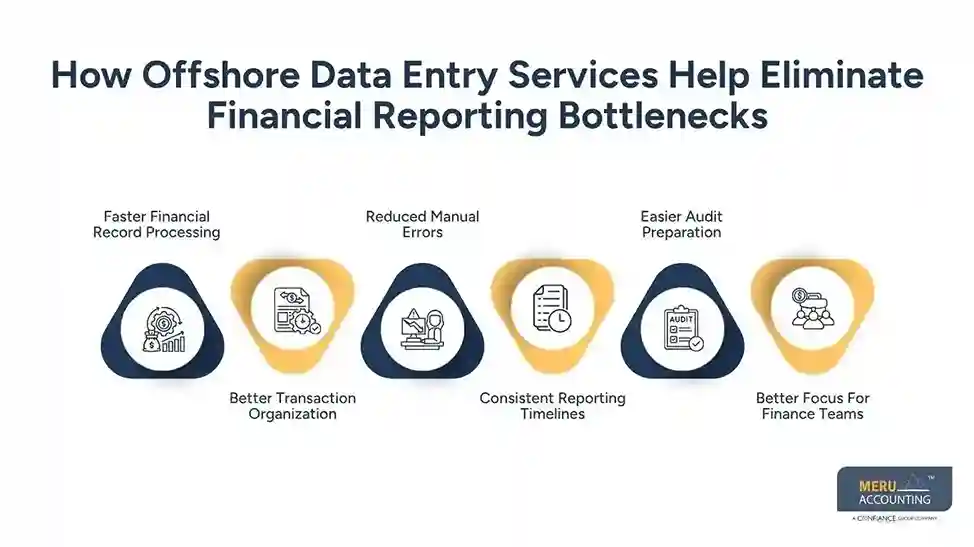
Consistent Reporting Timelines
A dependable data entry service provider works according to fixed schedules. Daily or weekly processing keeps reporting tasks current throughout the financial cycle.
Easier Audit Preparation
Well-maintained financial records simplify internal and external audit preparation. Organized transaction history also reduces document retrieval time during compliance reviews.
Better Focus For Finance Teams
When offshore teams handle repetitive data entry tasks, internal finance staff get more time for important work. They can focus on forecasting, budgeting, financial analysis, and management reporting activities.
Role of a Reliable Data Entry Service Provider in Accuracy And Speed
Standardized Data Procedures
A trusted data entry service provider follows defined processes for document handling, entry formatting, verification, and reporting updates. Standardization creates more reliable records.
Trained Financial Data Staff
Offshore teams are familiar with invoice formats, accounting terms, transaction categories, and reporting structures used in finance operations.
Experience in financial data management supports accurate and organized recordkeeping. Knowledge of industry-specific reporting practices improves processing efficiency.
Multi-Level Review Systems
Quality control systems reduce the chances of incorrect entries. Supervisors review completed work before reports are shared with clients.
Software Compatibility Support
Many offshore data entry services work with accounting software such as QuickBooks, Xero, Zoho Books, Sage, NetSuite, and ERP platforms. Compatibility with multiple systems allows smooth data transfer and uninterrupted workflows.
Turnaround Time Management
Timely processing is important for finance operations. A professional data entry service provider maintains clear turnaround schedules for daily and monthly reporting activities.
Data Security Monitoring
Reliable offshore firms use secure access systems, confidentiality agreements, and controlled file-sharing methods to protect financial information from unauthorized access. Regular audits strengthen compliance and safeguard sensitive data.
Best Practices For Integrating Offshore Support Into Financial Workflows
Define Clear Data Entry Processes
Businesses should establish clear instructions for invoice handling and transaction coding. Reporting timelines and expense classifications should be defined before offshore operations.
Use Shared Workflow Systems
Cloud-based accounting platforms improve coordination between internal and offshore finance teams. Shared task systems allow better tracking of workflow progress and updates.
Maintain Regular Communication
Weekly meetings help identify reporting issues before they affect financial operations. Regular reporting reviews maintain alignment between internal and offshore finance teams.
Create Data Validation Rules
Validation procedures reduce reporting inconsistencies across financial records and transaction entries. Defined rules ensure all entries follow required financial reporting structures.
Monitor Performance Metrics
Tracking turnaround time and correction rates helps evaluate processing performance accurately. Processing volume reports also supports workflow monitoring and operational improvements.
Review Security Standards
Finance-heavy companies should review confidentiality agreements before selecting offshore support providers. Access controls and data protection procedures strengthen financial information security.
Why Businesses Choose Meru Accounting For Offshore Data Entry Services
- Meru Accounting provides offshore data entry services for businesses handling large financial transaction volumes across different industries.
- We follow organized procedures for invoice entry, expense recording, payroll support, reconciliation assistance, and financial data processing.
- Meru Accounting works with multiple accounting platforms and cloud-based systems, making integration easier for businesses with existing financial software.
- Each financial record passes through verification stages to reduce data inconsistencies and maintain reporting accuracy.
- Businesses can scale offshore support based on reporting cycles, project needs, or transaction volume changes during peak periods.
- Meru Accounting emphasizes proper record handling, timely updates, and organized reporting support for finance-driven businesses.
Our Expert Perspective
Based on our experience in finance operations, reporting problems often begin with small data gaps instead of major accounting failures. Delayed invoices, missing receipts, and incorrect vendor codes may appear minor at first, but such issues gradually create reporting confusion and slow financial reviews. Consistent financial record management keeps reporting activities more organized and reduces reconciliation difficulties.
Our experience with finance-heavy businesses shows that overloaded internal teams often struggle with repetitive transaction processing work. Offshore data entry services help maintain updated financial records and reduce reporting backlogs. Properly managed workflows also give finance teams more time for analysis, planning, budgeting, and financial decision-making.
Key Takeaways
- Offshore data entry services reduce reporting delays for finance-heavy businesses
- Organized transaction management creates cleaner financial reports
- A reliable data entry service provider improves accuracy and workflow consistency
- Offshore teams reduce administrative pressure on internal finance staff
- Structured data handling lowers the risk of duplicate and incorrect records
- Better financial record organization simplifies audits and reconciliations
- Scalable offshore support manages growing transaction volumes effectively
- Secure workflows protect financial data during processing activities
- Consistent reporting schedules support stronger financial planning
- Finance teams gain more time for analysis and strategic work
FAQs
Offshore data entry services involve assigning financial data processing work to trained teams located in another country. These teams manage invoices, receipts, payroll records, and transaction entries for businesses.
Finance-heavy businesses outsource data entry work to reduce manual workload, maintain organized records, and complete reporting tasks faster with fewer errors.
A professional data entry service provider uses review systems, trained staff, standard procedures, and verification checks to maintain accurate financial records.
Yes, many offshore firms use secure file-sharing systems, restricted access controls, and confidentiality agreements to protect financial data during processing.
Yes, offshore teams commonly work with accounting software such as QuickBooks, Xero, Zoho Books, Sage, and ERP systems used by finance departments.