A nonprofit can bring in more donations, win new grants, and expand its programs, yet still struggle to keep its finances in order. More funding often means more rules to follow, more expenses to track, and more reports to prepare. Outsourced accounting for nonprofits gives organizations a way to handle this added workload without having to build a large in-house finance team.
But good nonprofit accounting is about more than keeping the books up to date. A missed grant expense, an incorrect fund balance, or a poorly planned budget can affect future funding and board decisions. In this blog, we look at the financial problems nonprofits often face and how experienced accounting professionals help solve them.
What You Will Learn From This Blog
- Why nonprofit accounting needs a clear and well-planned process.
- Common money and reporting issues that can affect nonprofit work.
- How outsourced accounting for nonprofits helps solve these issues.
- How nonprofit accounting consultants support fund tracking and financial control.
- What to look for when hiring an outside accounting team.
Why Nonprofit Organizations Face Unique Accounting Challenges
Nonprofit accounting is not the same as standard business accounting. A business may focus on sales, costs, and profit. A nonprofit must also show how its funds are used and whether they meet donor rules and grant terms.
Several factors make this work more complex.
1. Different sources of funds
Nonprofits may get money from grants, gifts, member fees, events, and other sources. Each source may have its own terms, use limits, and reporting needs. The finance team must track each one with care.
2. Restricted and unrestricted funds
Some donors give money for a set goal, such as a food drive or a school program. Other funds can be used for daily costs. These funds must be kept apart in the books to avoid the wrong use of money.
3. Donor and grant reporting
Donors and grant makers may ask for reports that show how funds were used. These reports must match the books and include the right costs. Late or wrong reports can harm trust and future funding.
4. Small finance teams
Many nonprofits have small teams and tight budgets. One person may handle bills, payroll, bank records, and reports. This can lead to delays, errors, and weak checks.
5. Audit and tax needs
Nonprofits must keep clear records and follow rules that apply to their legal status and funding. In the US, this may include IRS filing needs, state rules, and grant terms. Some groups may also need an audit based on law or funding terms.
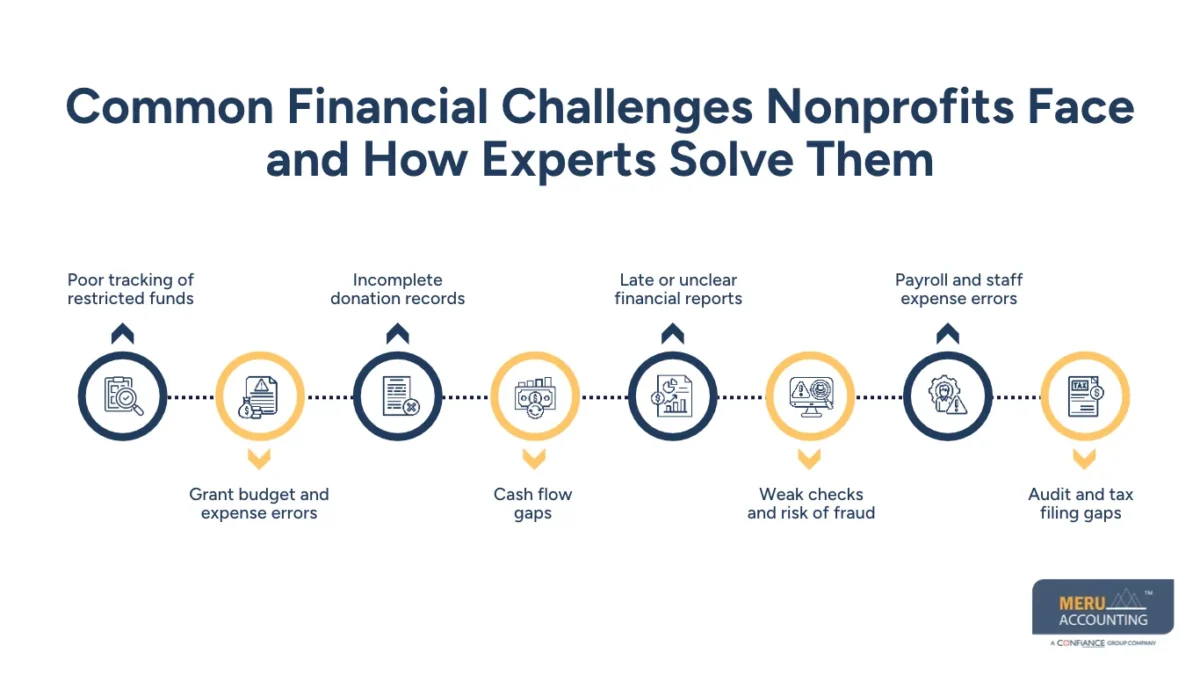
Common Financial Challenges Nonprofits Face and How Experts Solve Them
Financial issues can affect daily work, donor trust, and the long-term health of a nonprofit. Here are some common issues and ways an expert team can help.
1. Poor tracking of restricted funds
When a nonprofit gets funds for a set goal, it must track how much came in, how much was spent, and how much is left. If all funds are mixed in one broad account, it can be hard to tell which costs fit each grant or donor rule.
How experts solve it: They set up clear fund codes, track costs by program, and review each fund on a set basis. This helps staff see how much money is free to use and how much must stay set aside.
2. Grant budget and expense errors
Grant funds often come with a set budget and clear rules on what can be paid from them. A cost may look valid but still fall outside the grant terms. Poor tracking can lead to overspending or a need to repay funds.
How experts solve it: An accounting team maps grant costs to the right budget lines, checks spend against the grant terms, and flags costs that may not qualify. They can also help set up grant reports with clear support for each cost.
3. Incomplete donation records
A nonprofit may get gifts through its site, bank, checks, events, and online giving tools. If these records do not match, the books may show the wrong gift total. Donor records may also lack key details.
How experts solve it: They match gift records to bank deposits, review payment fees, and check totals from each giving tool. They also help keep records of donor gifts and any limits placed on their use.
4. Cash flow gaps
A nonprofit may have enough funds on paper but still lack cash to pay bills on time. This can happen when a grant payment is late, a pledge has not yet been paid, or funds are set aside for a set use.
How experts solve it: They track cash due in and bills due out, build cash flow plans, and help leaders spot gaps early. This gives the board time to plan for costs and avoid last-minute funding stress.
5. Late or unclear financial reports
Board members and donors need reports that show how the nonprofit is doing. If reports are late or hard to read, leaders may not see budget gaps or rising costs in time.
How experts solve it: They prepare clear monthly reports, compare actual costs with the budget, and flag key changes. This helps leaders act on facts rather than wait until year-end.
6. Weak checks and risk of fraud
When one staff member can set up a vendor, approve a bill, and make a payment, there is a higher risk of error or fraud. Small nonprofits may lack the staff to split these tasks.
How experts solve it: They help set clear approval steps, review bank activity, and match bills to payments. Even when a small team cannot split every task, a board member or leader can review key records and approve payments.
7. Payroll and staff expense errors
Nonprofits may have full-time staff, part-time staff, and paid workers on grant-funded programs. Payroll costs must be coded to the right program, and staff expenses need proper proof and approval.
How experts solve it: They review payroll records, track labor costs by program, and match staff expenses to receipts and policy rules. This helps keep payroll reports in line with grant budgets and the books.
8. Audit and tax filing gaps
Poor records can make an audit slow and hard. Missing bills, unclear grant costs, or bank records that do not match the books can lead to more review work.
How experts solve it: They keep key records in order, match accounts on time, and prepare schedules that support reported balances. They can also work with the nonprofit’s CPA or auditor during the review.
What Is Outsourced Accounting for Nonprofits?
Outsourced accounting for nonprofits means hiring an outside accounting team to handle some or all of an organization’s financial tasks. Instead of hiring a full in-house team, a nonprofit can work with trained staff who manage its books, reports, payroll, and other accounting needs.
The level of support depends on the size of the organization, its funding sources, and the work it needs done.
Common services include:
- Bookkeeping: Recording gifts, grants, bills, and daily costs.
- Fund accounting: Tracking restricted and unrestricted funds.
- Grant accounting: Recording grant income and costs by project.
- Accounts payable and receivable: Managing bills, payments, and money due.
- Payroll: Processing pay and tracking labor costs.
- Financial reporting: Preparing monthly reports for leaders and board members.
- Audit support: Keeping records and schedules ready for audit review.
A nonprofit can outsource only the tasks it needs or hire a team to manage its full accounting process. This makes it easier to get expert help without the cost of hiring several full-time staff members.
How Outsourced Accounting for Nonprofits Solves These Financial Challenges
The main value of outsourcing is not just getting daily tasks done. It is having a set process for each task, with clear checks and timely reports.
For example, when a grant payment comes in, the accounting team can record it under the right fund, track costs against the grant budget, and report the balance. When a bill is paid, the team can check that it has the right approval and is charged to the right program.
A good outsourced accounting process should include:
- Set monthly close steps: Bank, card, and account records are checked each month.
- Clear fund records: Gifts and grants are tracked based on their use terms.
- Regular budget reviews: Actual costs are checked against approved budgets.
- Timely reports: Leaders get clear reports to review income, costs, and cash.
- Record checks: Bills, receipts, payroll, and grant costs have proof to back them up.
These steps help reduce errors and give nonprofit leaders a better view of their funds. However, outsourcing does not shift legal or board duties to the service firm. The nonprofit remains in charge of its funds, approvals, and reporting duties.
optional anymore
on running the business
How Nonprofit Accounting Consultants Improve Financial Management
Beyond daily bookkeeping, nonprofit accounting consultants can help an organization review how its finance work is set up and find areas that need change.
Their role may include:
- Reviewing fund accounting methods: They can check whether funds are tracked in line with donor terms and grant rules.
- Improving financial controls: They can review who records, checks, and approves payments to reduce the risk of errors and fraud.
- Making reports more useful: They can help build reports that show program costs, grant balances, cash flow, and budget gaps.
- Supporting grant oversight: They can review how grant costs are coded and whether reports match the books and grant terms.
- Helping with budgets: They can use past costs and known funding plans to help leaders build sound budgets.
For example, a nonprofit may find that its food program is over budget while its other programs have funds left. A clear report can help leaders see the gap, review the cause, and plan their next steps. This is more useful than seeing only the total amount spent by the organization.
Outsourced Accounting for Nonprofits by Meru Accounting
A grant may have its own budget, a donor may set limits on how a gift can be used, and each program may need a separate expense report. Keeping all these records accurate takes time and a sound accounting process.
Our outsourced accounting services for nonprofits cover the key areas that need regular attention:
- Nonprofit bookkeeping and bank reconciliation: We record donations, grant income, bills, and other transactions, then match bank and card records with the books.
- Fund and grant accounting: We track income and expenses by fund, program, and grant to help maintain clear records of restricted and unrestricted funds.
- Grant expense tracking: We help record costs against grant budgets and prepare expense details for review and reporting.
- Accounts payable and receivable: We manage vendor bills, payment records, incoming funds, and outstanding balances.
- Nonprofit payroll accounting: We process payroll records and help track staff costs across programs and funding sources.
- Financial statements and reporting: We prepare regular reports that help nonprofit leaders review income, expenses, fund balances, and budget performance.
- Accounting cleanup and catch-up: We review past entries, address unreconciled accounts, and bring incomplete books up to date.
- Audit preparation support: We organize financial records, reconcile accounts, and prepare supporting schedules for the nonprofit’s CPA or audit team.
Our work is supported by trained accounting professionals and quality checks that help keep records consistent and reports reliable. We can also work with your existing accounting setup rather than push a fixed software choice or change your current process without a clear need.
Whether you need help with grant expense records, monthly financial reports, payroll, or a complete outsourced accounting team, Meru Accounting can provide support based on your organization’s needs. This gives your nonprofit access to experienced accounting professionals at a fraction of the cost of building a comparable in-house team in the US.
Our Expert Insight
One area nonprofits should watch closely is how they split shared costs across grants and programs. Expenses such as rent, utilities, and admin salaries often support more than one program. If these costs are not allocated fairly and consistently, grant reports may show the wrong expenses or include costs that a funder will not cover.
For example, a nonprofit that runs three programs from one office should have a clear basis for splitting rent and utility costs. This could be based on the space each program uses or another fair method. The same method should be used each month and backed by proper records.
We recommend reviewing these cost splits before submitting grant reports. This helps catch errors early, avoid duplicate charges across grants, and give funders a more accurate picture of how their money was spent.
Key Takeaways
- Nonprofits face unique accounting needs due to grants, donor limits, and fund tracking.
- Poor records can lead to errors in grant reports, cash flow plans, and financial statements.
- Outsourced accounting for nonprofits gives organizations access to trained accounting staff without the cost of building a large in-house team.
- Nonprofit accounting consultants can help improve fund tracking, financial controls, and reports.
- Regular account reviews and clear approval steps help reduce errors and support donor trust.
- The right accounting partner should have nonprofit experience, clear work processes, and strong data security practices.
FAQs
Costs depend on the number of transactions, grant activity, payroll needs, and level of support required. Basic bookkeeping costs less than full-service accounting with grant tracking and financial reporting.
Yes. Nonprofits can outsource grant expense tracking, budget reviews, account reconciliation, and financial reports. The organization remains responsible for meeting grant terms and approving expenses.
Look for experience in nonprofit accounting, fund accounting, and grant reporting. Also check the firm’s review process, data security, reporting schedule, and experience with your accounting system.
Yes. They can maintain financial records and prepare accounting data needed for Form 990 and other tax filings. A qualified tax professional should review the return before filing.
Yes. An outside team can handle tasks such as bookkeeping, payroll, account reconciliation, and grant tracking while the finance manager oversees budgets, reviews reports, and manages financial decisions.
optional anymore
on running the business