
In recent years, outsourced accounting for SaaS companies has become a practical choice for founders who want better financial control without building large in-house teams.
As subscription-based products grow more complex, founders are now focusing on improving financial accuracy, compliance, and cash flow visibility instead of building large in-house teams.
Many early-stage and scaling SaaS businesses are also adopting saas outsourced accounting to manage reporting, revenue tracking, and investor expectations in a more structured way. This shift is helping founders reduce financial stress and improve decision-making with clearer data.
What You Will Learn From This Blog
- Why SaaS founders are moving away from in-house accounting setups
- Common financial challenges in subscription-based businesses
- How revenue tracking becomes easier with structured systems
- Benefits of better investor reporting and compliance
- When SaaS companies should consider switching to external support
- How firms like Meru Accounting support SaaS growth
Introduction To The Outsourced Accounting For SaaS Companies
SaaS businesses operate on subscription-based models where revenue comes from recurring billing, upgrades, downgrades, and cancellations. This structure makes financial tracking more complex compared to traditional businesses, where income is usually recorded at the point of sale. Because of this ongoing and changing revenue flow, accurate accounting becomes critical for long-term stability.
To handle these challenges, outsourced accounting for SaaS companies provides structured financial systems that track revenue across different billing periods with accuracy.
These systems help ensure that income is recorded correctly over time, supporting compliance and reducing financial errors that often occur in manual processes.
External accounting teams play an important role in managing bookkeeping, reporting, and reconciliation activities for SaaS firms. This allows founders to shift their focus from routine financial operations to product development and business growth.
As startups scale quickly, many also prefer saas outsourced accounting because it reduces the need for hiring full-time finance staff while improving financial clarity and control.
With better tools, expert support, and structured processes, SaaS companies gain improved visibility into their financial performance. This helps them make more informed decisions based on accurate and timely financial data.
The Rise Of The Outsourced Accounting For SaaS Companies
Growth of the Subscription Economy
The global shift toward subscription services has increased accounting complexity, making outsourced accounting for SaaS companies more relevant than ever. This model demands continuous tracking of recurring revenue and deferred income.
Investor Pressure For Clean Data
Investors expect accurate and timely financial reports before funding decisions, pushing startups toward structured accounting support. Clean and audit-ready data has become a key factor in securing funding.
Remote Work Adoption
Remote teams have made it easier to collaborate with external finance professionals without location limits. This has expanded access to skilled accounting talent across regions.
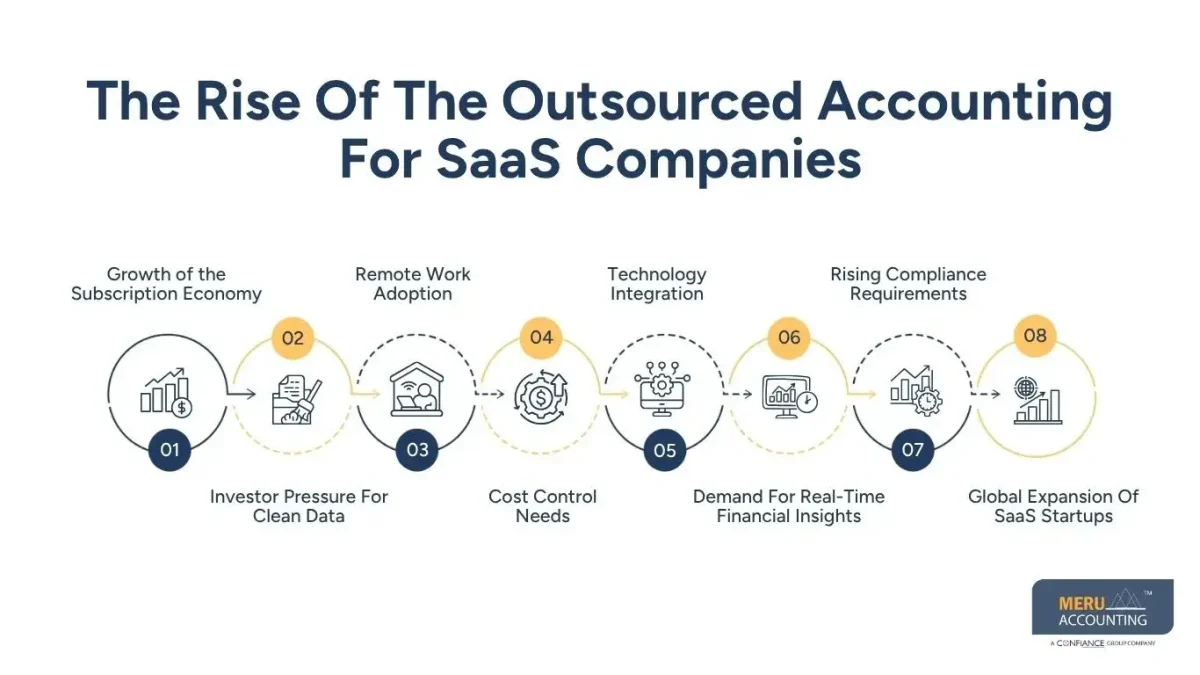
Cost Control Needs
Hiring full-time accounting staff is expensive for startups. Many rely on saas outsourced accounting to manage costs efficiently. It helps convert fixed payroll costs into flexible service expenses.
Technology Integration
Cloud tools and automation now support real-time financial reporting, making outsourcing more effective. This improves accuracy and speeds up decision-making for founders.
Demand For Real-Time Financial Insights
SaaS founders now expect instant visibility into revenue, churn, and cash flow. Outsourced teams help deliver updated financial dashboards regularly.
Rising Compliance Requirements
Accounting standards like ASC 606 require strict revenue recognition rules. External accounting support helps SaaS firms stay compliant without added internal burden.
Global Expansion Of SaaS Startups
As SaaS companies expand globally, managing multi-currency and cross-border transactions becomes complex. Outsourced accounting teams help simplify global financial operations and reporting.
Why SaaS Founders Prefer Outsourced Accounting For SaaS Companies
Focus On Core Product Development
Founders prefer spending time improving product features rather than handling financial records and reconciliations. This helps them focus on building better customer value and improving user experience.
Access To Skilled Experts
With outsourced accounting for SaaS companies, startups gain access to professionals experienced in SaaS financial models. These experts understand subscription billing, revenue recognition, and SaaS-specific reporting needs.
Faster Monthly Reporting
External teams deliver financial reports on time, helping founders make quicker decisions. Timely reporting also improves planning for marketing, hiring, and product investments.
Reduced Hiring Burden
Recruiting, training, and managing finance teams becomes unnecessary with saas outsourced accounting solutions. This reduces both operational effort and long-term payroll commitments.
Scalable Support System
As revenue grows, accounting needs expand. Outsourcing provides flexibility to scale without restructuring teams. This allows SaaS companies to adjust support based on business growth stages.
Key Financial Challenges Faced By SaaS Businesses
Complex Revenue Recognition
SaaS companies must recognize revenue over subscription periods, not at the time of payment. This requires careful allocation across contract durations to ensure accuracy.
Subscription Billing Variations
Different billing cycles, upgrades, and downgrades create confusion in financial tracking. These variations often lead to mismatches in revenue records if not managed properly.
Churn Impact On Revenue
Customer cancellations directly affect forecasts and require accurate monitoring systems. Even small churn changes can significantly impact long-term revenue projections.
Deferred Revenue Tracking
Unearned revenue must be recorded properly to comply with accounting standards, a process efficiently handled by outsourced accounting for saas companies. This ensures that financial statements reflect only earned income for a given period.
Global Transactions
Multi-currency operations increase complexity in reporting and reconciliation. Exchange rate fluctuations also add an extra layer of financial adjustment requirements.
How SaaS Outsourced Accounting Solves Revenue Recognition Issues
Compliance With Accounting Standards
Standards like ASC 606 require precise revenue allocation. Outsourced accounting for saas companies ensures compliance with ASC 606 and other revenue recognition standards.. This helps SaaS firms avoid reporting errors during audits and funding reviews.
Automated Revenue Scheduling
Revenue is distributed across contract periods using structured systems. This ensures that income is recognized in the correct accounting periods without manual intervention.
Reduced Manual Errors
Automation and expert review reduce mistakes in financial entries. This improves accuracy in subscription tracking and reduces reconciliation issues in outsourced accounting for saas companies.
Accurate Monthly Close Process
Financial closing becomes faster and more reliable with expert handling. It also ensures that reports are ready on time for management and investors.
Better Audit Preparation
Well-maintained records simplify audit processes and reduce risks. This allows auditors to review financial data quickly without missing documentation.
Benefits Of SaaS Outsourced Accounting For Fast-Growing Startups
Lower Operational Costs
Startups save significantly by avoiding full-time accounting teams. This helps them allocate more funds toward product development and customer acquisition.
Real-Time Financial Insights
Cloud-based reporting in outsourced accounting for saas companies improves access to updated financial data in real time. This allows founders to monitor performance and make quicker financial decisions.
Improved Cash Flow Management
Better tracking in outsourced accounting for saas companies helps startups manage expenses and plan growth more effectively. It also reduces the risk of cash shortages during expansion phases.
Strong Financial Control Systems
External experts help maintain accuracy and reduce fraud risks. This strengthens internal checks and improves financial reliability.
Flexible Scaling Options
Accounting support grows with business expansion without disruption. This ensures financial operations remain stable even during rapid scaling.
How SaaS Outsourced Accounting Improves Investor Reporting
Clean Financial Statements
Investors require structured and transparent financial data for decision-making. Clean statements also reduce confusion during due diligence and funding discussions.
Better KPI Tracking
Metrics like MRR, ARR, and churn are tracked more accurately. This gives investors a clear view of business performance and growth trends.
Faster Fundraising Process
Well-prepared reports from outsourced accounting for saas companies speed up investor discussions and funding rounds. This helps founders respond quickly to investor queries and data requests.
Clear Expense Classification
Expenses are categorized properly for better financial understanding. This improves visibility into spending patterns and operational efficiency.
Increased Investor Confidence
Reliable data builds trust and improves funding opportunities. It also strengthens long-term relationships with investors and stakeholders.
When Should SaaS Companies Switch To Outsourced Accounting For SaaS Companies
Early Growth Stage
Startups benefit from outsourcing early to avoid financial confusion. This helps them build a strong accounting foundation from the beginning.
Rapid Revenue Expansion
As transactions increase, internal systems may struggle to keep up. Outsourcing ensures financial records remain accurate during high-growth phases.
Before Fundraising Rounds
Clean and accurate reports are essential for investor presentations. This improves credibility and reduces delays during due diligence.
Lack Of Internal Expertise
Many SaaS teams do not have specialized accounting knowledge. External support fills this gap with trained SaaS finance professionals.
International Expansion
Global operations require structured financial systems and compliance. Outsourcing helps manage multi-country reporting and currency challenges.
High Volume Of Subscription Transactions
When monthly subscriptions grow rapidly, tracking becomes difficult for small internal teams. Outsourced support helps manage large invoice volumes without delays or errors.
Need For Faster Financial Close
If monthly or quarterly closing takes too long, decision-making gets delayed. Outsourced accounting for saas companies helps speed up the closing process with better systems and workflows.
How Meru Accounting Supports SaaS Businesses
SaaS-Focused Financial Teams
Meru Accounting provides outsourced accounting for saas companies with experts trained in subscription-based business models and reporting. These specialists understand SaaS-specific challenges like deferred revenue and churn tracking.
Revenue Recognition Expertise
We ensure compliance with accounting standards for SaaS firms. This helps companies follow proper rules like ASC 606 without errors in reporting.
Investor-Ready Reporting Support
At Meru Accounting, our reporting systems help startups prepare for funding discussions. This makes it easier for founders to present clear financial data to investors.
Cloud-Based Accounting Tools
Modern tools allow real-time tracking and financial transparency. This improves visibility into daily financial performance and cash flow.
Global SaaS Experience
With experience across markets, they support startups in different growth stages. This helps SaaS companies manage both local and international financial requirements effectively.
Key Takeaways
- SaaS financial systems are more complex than traditional business models
- External support improves accuracy and reduces workload for founders
- Investor reporting becomes easier with structured financial data
- Cost efficiency is a major reason for outsourcing adoption
- Scalable systems support long-term SaaS growth
- outsourced accounting for SaaS companies and saas outsourced accounting help improve financial control and decision-making
FAQs
Many founders prefer outsourced accounting for SaaS companies because it reduces cost and improves financial accuracy.
Yes, early-stage companies benefit from saas outsourced accounting as it avoids hiring full finance teams.
It ensures revenue is recorded correctly over subscription periods using structured methods.
Yes, they prepare key reports like ARR, MRR, and cash flow statements for investors.
Yes, saas outsourced accounting improves accuracy, control, and reporting consistency across all financial processes.