



Construction contractors often operate on tight margins. Material prices change, labor costs rise, and payment delays are common. Even a small mistake in cost tracking or billing can turn a profitable job into a loss. This is why many contractors depend on an outsourced construction accounting business to keep their finances accurate, controlled, and predictable.
For contractors working with narrow profit margins, strong accounting support is not optional. It plays a direct role in protecting cash flow, controlling job costs, and supporting better project decisions.
This blog explains how an outsourced construction accounting business helps contractors stay financially stable when margins are thin.
What You Will Learn From This Blog
In this blog, you will learn:
- What an outsourced construction accounting business actually does
- How outsourced accounting supports contractors with tight margins
- The role of a construction accountant in cost control and profit tracking
- Why accurate job costing is critical for margin protection
- When contractors should consider outsourcing accounting
- How Meru Accounting supports contractors with practical financial solutions
This blog is written in simple language so contractors can clearly understand how accounting directly affects profitability.
Understanding Outsourced Construction Accounting Business
An outsourced construction accounting business provides accounting services specifically designed for contractors. Instead of hiring an in-house team, contractors partner with specialists who understand construction costs, project billing, and compliance needs.
These services typically include job costing, billing management, payroll processing, financial reporting, and tax support. A dedicated construction accountant works closely with project data to ensure costs are tracked correctly and profits are visible.
Unlike general accounting services, an outsourced construction accounting business focuses on project-based accounting. Every job is treated as a separate financial unit, making it easier to measure success and identify problems early.
How an Outsourced Construction Accounting Business Supports Contractors
An outsourced construction accounting business supports contractors by creating clear systems for tracking money at every stage of a project. This includes:
- Recording costs by job and cost code
- Monitoring invoices and customer payments
- Managing vendor bills and subcontractor payments
- Preparing accurate monthly financial reports
With this support, contractors gain better visibility into where money is spent and when cash will be received. A professional accountant reviews this data regularly to ensure numbers reflect real project performance.
For contractors with thin margins, this level of control helps prevent budget overruns and payment delays from damaging cash flow.
The Role of a Construction Accountant in Managing Costs and Profits
A construction accountant plays a key role in helping contractors manage costs and profits. Their responsibility goes beyond data entry. They actively review job costs, compare budgets to actual spending, and flag issues early.
Reviewing Job Cost Reports
A construction accountant regularly reviews job cost reports to compare estimated costs with actual spending. This helps identify where budgets are being exceeded and which cost areas need attention.
Monitoring Labor and Material Expenses
Labor and materials are the highest costs in most construction projects. A monitor these expenses closely to ensure hours, rates, and material costs are recorded correctly and assigned to the right jobs.
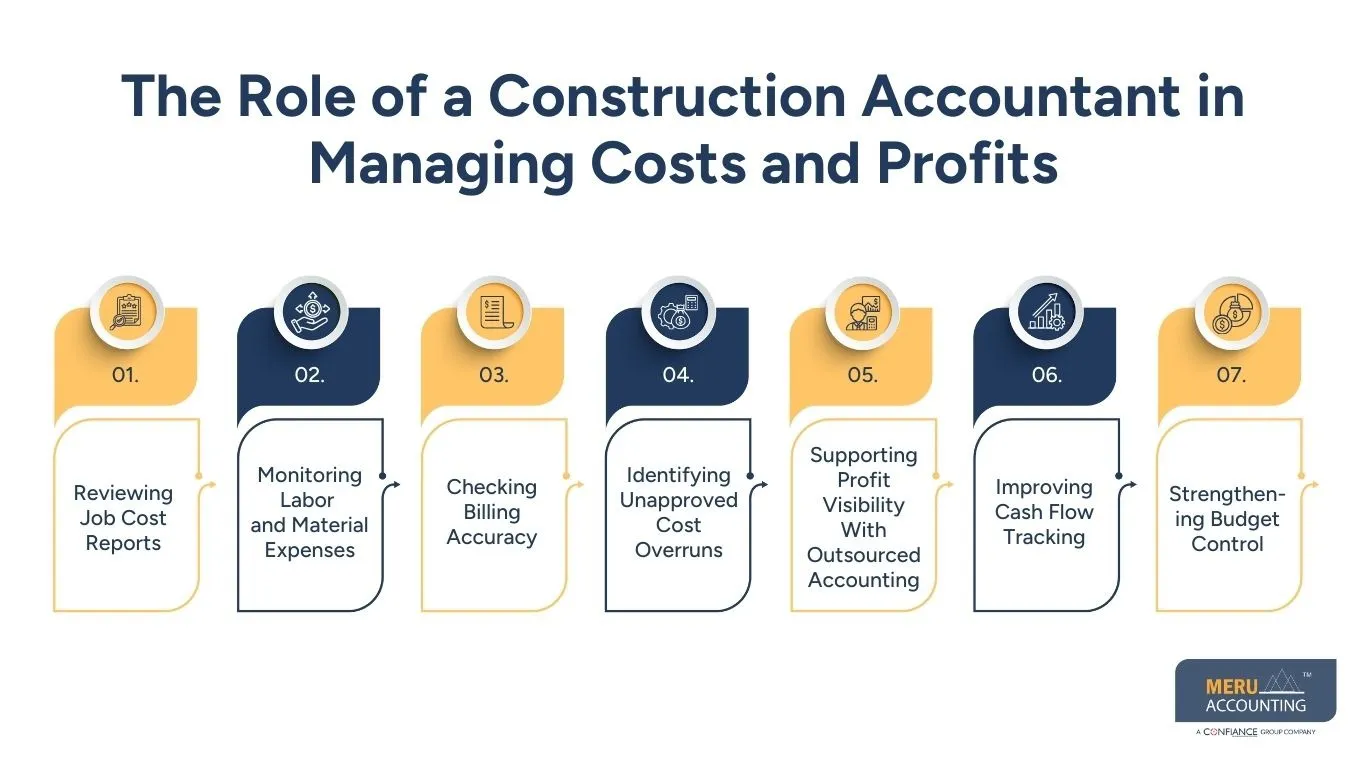
Checking Billing Accuracy
Accurate billing is critical for steady cash flow. An expert checks invoices to confirm that billed amounts match completed work and approved costs, reducing the risk of disputes or delayed payments.
Identifying Unapproved Cost Overruns
Cost overruns can reduce profits quickly if they are not approved or communicated. An accountant flags unapproved expenses early so contractors can address issues with project managers or clients.
Supporting Profit Visibility With Outsourced Accounting
By working with an outsourced construction accounting business, a construction professional helps contractors clearly see which projects are profitable and which are not. This insight is essential for better decision-making, especially when operating with thin margins.
Improving Cash Flow Tracking
A construction professional tracks payments, retainage, and outstanding invoices across projects. This helps contractors plan expenses and avoid cash shortages.
Strengthening Budget Control
By comparing budgets with actual results, a professional accountant helps contractors stay aligned with planned costs. This control supports more predictable project outcomes and protects margins.
Why Financial Control Matters More When Margins Are Tight
Limited Margin for Errors
Thin margins leave no space for mistakes in cost tracking or billing. Even small errors can quickly reduce profits without early visibility.
Role of Outsourced Accounting in Financial Control
An outsourced construction accounting business provides regular reports and consistent cost tracking. This helps contractors always know their true financial position.
Review and Oversight by a Construction Accountant
An accountant reviews financial data to ensure costs and revenue are recorded correctly. This review helps identify issues before they become serious problems.
Faster Response to Financial Issues
Clear financial control allows contractors to react quickly to rising costs or delayed payments. Early action helps prevent losses from growing further.
Improving Job Costing Accuracy to Protect Margins
Job costing is the foundation of construction profitability. Inaccurate job costing leads to underpricing, budget overruns, and reduced profits. This is especially risky for contractors with thin margins.
An outsourced construction accounting business improves job costing accuracy by:
- Assigning expenses to the correct job and phase
- Tracking labor hours accurately
- Matching vendor bills to specific projects
- Monitoring subcontractor costs and change orders
- Updating budgets when project scopes change
- Reviewing cost variances regularly to spot issues early
A construction accountant reviews job cost data to ensure errors are corrected quickly. Accurate job costing allows contractors to see real profit margins while work is still in progress.
How Outsourced Accounting Improves Project-Level Profitability
Project-level profitability depends on knowing exactly how much each job costs and how much revenue it generates. An outsourced construction accounting business provides detailed project reports that show this clearly.
These reports help contractors:
- Compare estimated costs to actual costs
- Identify jobs with shrinking margins
- Adjust billing or spending decisions
- Track project cash flow and payment timing
- Monitor change orders and their impact on profits
- Measure project performance by phase or task
A professional accountant reviews project reports and helps contractors understand where profits are being lost. This level of insight supports better decision-making throughout the project lifecycle.
When Contractors Should Consider Hiring a Construction Accountant
Contractors should consider working with a construction accountant when:
Job Costs Are Hard to Track
If you cannot clearly see job-wise costs, it becomes difficult to know which projects are profitable. A professional accountant helps set up accurate job costing and cost tracking systems.
Cash Flow Is Unpredictable
When payments are delayed or expenses spike unexpectedly, cash flow becomes unstable. A construction accountant monitors cash flow and helps contractors plan for upcoming expenses.
Profit Margins Vary Widely
If some projects make money and others don’t, it may be hard to identify why. An accountant analyzes each job to identify where margins are shrinking.
Financial Reports Arrive Late or Lack Detail
Late or incomplete financial reports make decision-making difficult. A professional accountant ensures reports are accurate, timely, and easy to understand.
Partnering with an outsourced construction accounting business makes it easier to access experienced construction professionals without the cost of hiring full-time staff. This is especially useful for growing contractors or those managing multiple projects.
Key Benefits of Partnering With an Outsourced Construction Accounting Business
Working with an outsourced construction accounting business offers several practical benefits:
- Better job cost visibility
- Improved cash flow planning
- Accurate and timely financial reports
- Reduced accounting errors
- Lower overhead costs
- Faster invoice and payment tracking
- Better compliance with tax and labor rules
- More time for contractors to focus on projects
A professional accountant ensures these benefits translate into real financial improvements. For contractors with thin margins, these advantages help protect profits and support steady growth.
How Better Financial Reporting Leads to Smarter Bidding Decisions
Bidding accurately is one of the biggest challenges contractors face. Poor financial data leads to underpriced bids and shrinking margins. An outsourced construction accounting business provides clean historical data that supports smarter bidding.
With accurate job cost history, contractors can:
- Price bids more accurately
- Include realistic labor and material costs
- Protect profit margins
A construction accountant helps review past project data and identify cost patterns. This information helps contractors submit bids that are competitive without risking losses.
How Meru Accounting Supports Contractors With Thin Margins
Meru Accounting specializes in construction-focused accounting services. As an experienced outsourced construction accounting business, we help contractors manage job costs, cash flow, and financial reporting with accuracy and consistency.
Job Costing System Setup
At Meru Accounting, we set up job costing systems that track expenses by project and phase. This helps contractors understand true job costs and avoid hidden losses.
Monitoring Project-Level Profitability
We monitor project profitability to identify which jobs are making money and which are not. This helps contractors make quick decisions before losses increase.
Clear Monthly Financial Reports
At Meru Accounting, we prepare clear monthly financial reports so contractors always know their financial position. These reports help contractors plan better and avoid surprises.
Billing and Payment Tracking Support
We support billing and payment tracking to ensure invoices are accurate and payments are received on time. This improves cash flow and reduces delays.
Each client is supported by a dedicated construction accountant who understands construction workflows and cost structures. Meru Accounting helps contractors stay financially organized, even when margins are tight.
Contact Meru Accounting’s construction accounting experts today. Talk to our construction professionals team to improve job costing, cash flow, and project profitability.
Key Takeaways
- Managerial accounting is essential for internal decision-making.
- Cost accounting and management accounting support budgeting, pricing, and performance evaluation.
- Businesses can improve efficiency, reduce costs, and enhance profitability using managerial accounting.
- Meru Accounting offers expertise in implementing management-level accounting to suit specific business needs.
- Regular monitoring and analysis of financial data ensure better planning and informed decisions.
FAQs
Construction projects have many moving costs. Specialized accounting helps track these costs accurately and avoids hidden losses.
It manages job costing, billing, reporting, payroll, and financial tracking for construction companies.
A construction accountant reviews costs, monitors profits, and helps identify financial issues early.
For many contractors, outsourced accounting provides expert support at a lower cost than hiring full-time staff.
When job costs, cash flow, or reporting become difficult to manage internally.


